Power

Single Crystal Lithium-Ion Batteries Last 8x Longer, Researchers Show (techxplore.com) 99

Researchers used Canada's national synchrotron light source facility "to analyze a new type of lithium-ion battery material — called a single-crystal electrode — that's been charging and discharging non-stop in a Halifax lab for more than six years," reports Tech Xplore.

The results? The battery material "lasted more than 20,000 cycles before it hit the 80% capacity cutoff," which they say is equivalent to driving 8 million kms (nearly 5 million miles). That's more than eight times the life of a regular lithium-ion battery that lasted 2,400 cycles before reaching the 80% cutoff — and "When the researchers looked at the single crystal electrode battery, they saw next to no evidence of this mechanical stress." (One says the material "looked very much like a brand-new cell." Toby Bond [a senior scientist at the CLS, who conducted the research for his Ph.D.] attributes the near absence of degradation in the new style battery to the difference in the shape and behavior of the particles that make up the battery electrodes... The single crystal is, as its name implies, one big crystal: it's more like an ice cube. "If you have a snowball in one hand, and an ice cube in the other, it's a lot easier to crush the snowball," says Bond. "The ice cube is much more resistant to mechanical stress and strain." While researchers have for some time known that this new battery type resists the micro cracking that lithium-ion batteries are so susceptible to, this is the first time anyone has studied a cell that's been cycled for so long...

Bond says what's most exciting about the research is that it suggests we may be near the point where the battery is no longer the limiting component in an EV — as it may outlast the other parts of the car. The new batteries are already being produced commercially, says Bond, and their use should ramp up significantly within the next couple of years. "I think work like this just helps underscore how reliable they are, and it should help companies that are manufacturing and using these batteries to plan for the long term."

Thanks to long-time Slashdot reader schwit1 for sharing the news.
Displays

Donald Bitzer, a Pioneer of Cyberspace and Plasma Screens, Dies At 90 (msn.com) 18

The Washington Post reports: Years before the internet was created and the first smartphones buzzed to life, an educational platform called PLATO offered a glimpse of the digital world to come. Launched in 1960 at the University of Illinois at Urbana-Champaign [UIUC], it was the first generalized, computer-based instructional system, and grew into a home for early message boards, emails, chatrooms, instant messaging and multiplayer video games.

The platform's developer, Donald Bitzer, was a handball-playing, magic-loving electrical engineer who opened his computer lab to practically everyone, welcoming contributions from Illinois undergrads as well as teenagers who were still in high school. Dr. Bitzer, who died Dec. 10 at age 90, spent more than two decades working on PLATO, managing its growth and development while also pioneering digital technologies that included the plasma display panel, a forerunner of the ultrathin screens used on today's TVs and tablets. "All of the features you see kids using now, like discussion boards or forums and blogs, started with PLATO," he said during a 2014 return to Illinois, his alma mater. "All of the social networking we take for granted actually started as an educational tool."

Long-time Slashdot reader theodp found another remembrance online. "Ray Ozzie, whose LinkedIn profile dedicates more space to describing his work as a PLATO developer as a UIUC undergrad than it does to his later successes as a creator of Lotus Notes and as Microsoft's Chief Software Architect, offers his own heartfelt mini-obit." Ozzie writes: It's difficult to adequately convey how much impact he had on so many, and I implore you to take a few minutes to honor him by reading a bit about him and his contributions. Links below. As an insecure young CS student at UIUC in 1974, Paul Tenczar, working for/with Don, graciously gave me a chance as a jr. systems programmer on the mind-bogglingly forward thinking system known as PLATO. A global, interactive system for learning, collaboration, and community like no other at the time. We were young and in awe of how Don led, inspired, and managed to keep the project alive. I was introverted; shaking; stage fright. Yeah I could code. But how could such a deeply technical engineer assemble such a strong team to execute on such a totally novel and inspirational vision, secure government funding, and yet also demo the product on the Phil Donahue show?

"Here's to the crazy ones. The misfits. The rebels. The troublemakers. The ones who see things differently. They're not fond of rules." You touched so many of us and shaped who we became and the risks we would take, having an impact well beyond that which you created. You made us think and you made us laugh. I hope we made you proud."

China

America Prepares New AI Chip Restrictions to Close China's Backdoor Access (msn.com) 20

The U.S. wants to limit China's access to advanced AI chips, reports the Wall Street Journal, with new rules to restrict sales in parts of the world.

"The rules are aimed at China, but they threaten to create conflict between the U.S. and nations that may not want their purchases of chips micromanaged from Washington. The latest round of curbs could come this month... Among the restrictions, the administration aims to introduce caps on shipments of AI chips to certain countries for use in large computing facilities, people familiar with the plans said. One grouping of countries — close U.S. allies — would be unrestricted, the people said, while another tier of countries would face limits on the number of chips that can go into data centers used for AI... The purchasing caps primarily apply to regions such as Southeast Asia and the Middle East, the people said...

The administration recently sent letters to major chip-makers including Taiwan Semiconductor Manufacturing and Samsung Electronics informing them about some of the restrictions, these people said. The letters said the companies needed to apply for a license to transfer chips to China that are manufactured using advanced chip-making technology or meet other criteria. These criteria include a size and transistor-number limit as well as any indication that the chips are for use in training AI models, the people said. Previous regulations already limit the shipment of advanced GPUs and memory chips to China, but the new rules spell out more clearly to manufacturers what is banned.

U.S. officials "are also considering other options," the article points out. "The administration is considering placing controls on exports of the so-called weights that underlie advanced AI models, according to people familiar with the matter, and weighing further China-specific restrictions on chip manufacturing."
Power

Chinese Electric Cars are Already Surging in Popularity in Mexico, Europe, Asia, and Africa (msn.com) 223

"The Chinese government has long subsidized carmakers with the goal of becoming a major auto exporter," notes the New York Times. But this week they reported on dozens of dealerships around Mexico that are now selling China-made electric vehicles, saying it could be "a potentially grave threat to the North American auto industry."

One employee said their dealership "was selling cars as fast as they arrived from China," including "a small but capable four-door electric compact that costs about $18,000." Chinese carmakers are effectively barred from the United States by tariffs that double the sticker price of vehicles imported from China, and they are not yet manufacturing significant numbers of vehicles in Mexico that could be exported across the border. But their ambition to expand overseas is on vivid display in Mexico and across Latin America, Asia, Europe and Africa. Ads for Chinese brands are in airports and soccer stadiums and loom above Mexico City streets on large billboards. Chinese cars, both gasoline and electric models, are an increasingly common sight. BYD and others are also looking for places to build factories in Mexico, although none have announced firm plans. Initially, the plants would serve Latin America, part of a campaign by Chinese automakers to erode the dominance of Japanese, American and European carmakers in places like Brazil and Thailand.

But there is little doubt that, eventually, Chinese carmakers hope to use Mexico as an on-ramp to the United States.

One of Mexico's EV dealers suggested to the Times that "maybe next year BYD can enter the United States." And he added with a smile, "If not, I can deliver." It is very unlikely that the Dolphin or any other Chinese car brand will be available in the United States soon. Because of the high tariffs, Chinese carmakers have not tried to establish dealerships or get approval from federal regulators to sell in the United States. (BYD does make electric buses in California.) And someone buying a BYD from a Mexican dealer like Mr. Alegría would have a hard time registering and insuring it in the United States because the cars have not demonstrated that they meet safety standards... But in the years to come it may be difficult to explain to consumers in the United States why they're not allowed to buy inexpensive electric vehicles that are readily available across the border, especially if they're made in Mexico, which already manufactures millions of cars for the United States.

Less than 20 years ago, Chinese cars were widely seen as inferior, even by many Chinese drivers. But in recent years, the country's manufacturers have pulled even with foreign rivals in mechanical quality, analysts say, and often surpass U.S., Japanese and European carmakers in battery technology, autonomous driving and entertainment software. (Think in-car karaoke and rotating touch screens)... [T]he auto industry does not appear to have seen anything like the current wave of Chinese brands, which have quickly overtaken Japanese companies as the world's largest auto exporters. Chinese carmakers have made deep inroads in countries where they have local production or face few significant trade barriers. In Brazil, Chinese brands have a 9 percent share of car sales, up from 1 percent in 2019. In Thailand, they have 18 percent of the market, up from 5 percent in 2019, according to JATO.

The article notes that for the world's largest car market — China itself — General Motors just announced "a more than $5 billion hit to its profit" to restructure China operations that have been losing money in recent years. And the article includes this quote from Felipe Munoz, global analyst at the research firm JATO Dynamics.

"Before the pandemic, the rules were set down by the Western carmakers. Now it's the opposite."
Intel

Intel Executives Say a Manufacturing Spinoff Is Possible (yahoo.com) 30

Intel's interim co-CEOs acknowledged that the company may be forced to sell its manufacturing operations if a new chipmaking technology slated for next year does not succeed. Reuters reports: Speaking at a Barclays investment banking conference in San Francisco on Thursday, Michelle Johnston Holthaus and David Zinsner - who were tapped as co-CEOs after the ouster of former CEO Pat Gelsinger last week - were asked if the company's continued combination of manufacturing and design was tied to the success of a new chipmaking technology called 18A due next year. Intel plans to use that technology to bring manufacturing of a flagship PC chip back in-house after being forced to outsource its biggest product to rival Taiwan Semiconductor Manufacturing. "Pragmatically, do I think it makes sense that they're completely separated and there's no tie?" Holthaus said of the company's product and manufacturing divisions. "I don't think so. But someone will decide that."

Zinsner, also chief financial officer, outlined how Intel is already separating the finances and operations of this manufacturing division into a standalone subsidiary. Zinsner said Intel Foundry, as the division is known, is already run separately from Intel's other businesses and is setting up a separate operational board and business process software system. "That's going to happen," Zinsner said. "Does it ever fully separate? That's an open question for another day."

Data Storage

LG Discontinues Blu-ray Players (tomshardware.com) 109

FlatpanelsHD: LG has discontinued all Blu-ray players, including the UBK80 and UBK90 UHD Blu-ray players, with remaining units only available while stocks last.

The announcement echoes similar moves from Oppo in 2018 and Samsung in 2019, when both companies exited the optical disc player market. LG has now officially discontinued its Blu-ray and UHD Blu-ray players, as reflected on LG's online portals and confirmed by multiple sources to FlatpanelsHD.

United States

Bitcoin Miner Purchases 112-Megawatt Texas Wind Farm, Takes it Off the Grid (chron.com) 104

This week a Florida-based Bitcoin-tech company named MARA Holdings announced it had bought a 114-megawatt Texas wind farm, reports Chron.com, "and will subsequently take it off the power grid and use it to energize its mining operations."

MARA's CEO tells the site they're "leveraging renewable resources that would have otherwise been curtailed" while "reducing our bitcoin production costs through vertical integration, and demonstrating MARA's commitment to environmental stewardship." The wind farms were not a part of the Electric Reliability Council of Texas (ERCOT) grid, but instead they were located within the Southwest Power Pool, which manages the market for the central U.S., including but not limited to most or parts of Oklahoma, Kansas, Nebraska, South Dakota and North Dakota... A 114-MW facility could power somewhere between 20,000 and 100,000 homes, depending on who you ask...

Historically, the facilities use up a lot of power and have generated backlash from neighbors who have complained about the noise of the machines inside. Texas has been a haven for cryptocurrency tech companies, primarily because of the state's space, deregulated power market and friendly business climate. Two weeks ago, the Public Utilities Commission adopted a rule requiring crypto and other virtual currency miners within the ERCOT grid to register their locations, ownership information and electricity demands, to further ensure that they could be watchful of this emerging source of energy consumption.

"Crypto mining operations currently consume around 2.3 percent of US electricity, and it requires roughly 155,000kWh to mine one Bitcoin," notes the site Data Centre Dynamics. This is the second off-grid power deal MARA has signed over the last few months. In October, it launched a 25MW micro data center operation across oil wellheads in Texas and North Dakota. The data center will be powered exclusively by excess natural gas from oilfield production that would have otherwise been flared. The operation will be distributed across wellheads in Texas and North Dakota, with operational status expected by January 2025.
Some context from Bloomberg: A few years ago Bitcoin miners took part in a global scramble for electricity to power their specialized computers... But the rise of AI, with its insatiable demand for electricity, dwarfed the needs of crypto and upended energy markets worldwide. Miners must now compete with much-larger tech firms for connections to electrical grids and power contracts. "Bitcoin miners are being forced to go look at marginal generation," said [MARA CEO Fred] Thiel. "The AI guys can afford to pay a much higher amount for energy than a Bitcoin miner"... MARA's plan to mine only when the wind is blowing makes economic sense because its mine will house last-generation computers that would otherwise have been retired, Thiel said.
"Thiel said he'd be interested to potentially buy more wind farms over time."
AI

Small AI Chip Maker Marvell is Now More Valuable Than Intel (msn.com) 38

This year Marvell's stock rose 95%, giving it a $100 billion market capitalization, according to the Wall Street Journal.

"The latest gains have even put Marvell's market cap ahead of much-beleaguered Intel, which still generates 10 times as much annual revenue." Marvell's recent trajectory suggests that the revenue gap will continue to narrow. The explosive growth of its data center business has finally reached a point where it can more fully offset weakness in the company's more legacy segments, which sell chips used in goods such as telecommunications gear, cable TV boxes and autos. Data center sales nearly doubled year over year to $1.1 billion in the just-ended quarter, and Marvell's projection for the current period indicates the company will end its fiscal year in January with the data center unit encompassing about 72% of its total revenue, up from 40% in the previous year.

The next year is looking bright as well. Marvell's latest deal with Amazon is a five-year "multigenerational" agreement that has Marvell helping Amazon design its own artificial intelligence chips. Amazon, which runs the world's largest cloud computing service, has been expanding its internal chip efforts significantly, in part to reduce its reliance on Nvidia for crucial AI components. Amazon announced the next generation of its largest AI chip, called Trainium, at its annual developers conference this week. Analysts believe Trainium will play a role in Marvell's AI custom revenue more than doubling in the next fiscal year ending January of 2026.

That is expected to help propel Marvell's annual revenue to more than $8 billion in fiscal 2026, up 40% from what is expected for this year, according to consensus estimates from Visible Alpha. In addition, 20% growth is expected for the following year, when Marvell expects to be in production of custom AI chips for another unnamed big tech customer that analysts believe to be Microsoft. Analyst Mark Lipacis of Evercore ISI projects that the industry for custom AI chips will reach $30 billion to $50 billion in sales by 2030. In a note to clients last week, he said Marvell "has the potential to capture one-third of that market."

Marvell's CEO "has been among the few names floated as potential replacements for the recently ousted Pat Gelsinger at Intel's corner office," the article points out — which meant he had to reassure investors on an earnings call that he was staying at Marvell.

"The company is outstanding. The technology is best-in-class. I can't think of a better place to work than Marvell."
Intel

What Arm's CEO makes of the Intel debacle (theverge.com) 17

Arm " is worth almost $150 billion," writes the Verge, "which is now considerably more than Intel."

"With the news earlier this week that Intel CEO Pat Gelsinger 'retired' and Intel is evaluating its options for a possible spinoff or outright sale, I wanted to hear what [Arm CEO Rene] Haas thought should happen to his longtime frenemy. There were reports that [Haas] approached Intel about buying a big chunk of the company before Gelsinger was ousted...." Haas: As someone who has been in the industry my whole career, it is a little sad to see what's happening... Intel is an innovation powerhouse. At the same time, you have to innovate in our industry. There are lots of tombstones of great tech companies that don't reinvent themselves.

I think Intel's biggest dilemma is how to disassociate being either a vertical company [where a company owns its supply chain] or a fabless company, to oversimplify it. That is the fork in the road that they've faced for the last decade. Pat [Gelsinger] had a strategy that was very clear that vertical was the way to win. In my opinion, when he took that strategy on in 2021, that was not a three-year strategy. That was a five-to-10-year strategy. He's gone and there's a new CEO to be brought in and the decision has to be made.

My personal bias says that vertical integration is a pretty powerful thing. If they could get that right, I think they would be in an amazing position. But the cost associated with it is so high that it may be too big of a hill to climb. I'm not going to comment on the rumors that we wanted to buy them. But I think, again, if you're a vertically integrated company and the power of your strategy is in the fact that you have a product and you have fabs, inherently, you have a potential huge advantage in terms of cost versus the competition.

When Pat was the CEO, I did tell him more than once, "You ought to license Arm because if you've got your own fabs, fabs are all about volume and we can provide volume." I wasn't successful in convincing him to do that...

Haas also obliquely commented on rumors that Arm will build its own AI chips, saying that companies making hardware are closer to the "interlock" of between hardware and software and "have a much better perspective in terms of the design tradeoffs to make. So, if we were to do something, that would be one of the reasons."

The full interview will be coming to the Verge's Decoder podcast soon...
Microsoft

Microsoft Discontinues Its $4,500 All-in-One Desktop, 'Surface Studio' (arstechnica.com) 29

An anonymous reader shared this report from the blog Windows Central: Microsoft has ended production on the Surface Studio 2+, its ultra-premium all-in-one desktop PC designed for creatives and commercial customers. Starting at a whopping $4,500, the Studio 2+ was the ultimate Windows all-in-one with the best touchscreen display on a unique hinge that allowed the screen to lay down like a draft board... So, if you're interested in buying a Surface Studio 2+, you better hurry, as whatever stock is remaining is all that's left. Unfortunately, it's likely that the end of production on the Surface Studio 2+ also marks an end to the Surface Studio line as a whole. My own sources tell me there's no Studio 2+ successor lined up currently.
Ars Technica points out that over the eight-year run of the Surface Studio, Microsoft only updated it twice. Like the Surface Laptop Studio, the desktop's claim to fame was a unique hinge design for its screen, which could reposition it to make it easier to draw on with the Surface Pen. But the desktop's high cost and its perennially outdated internal components made it a less appealing machine than it could have been...

The longest-lived Studio desktop was the Surface Studio 2, which was released in 2018 and wasn't replaced until a revised Surface Studio 2+ was announced in late 2022. It used an even higher-quality display panel, but it still used previous-generation internal components. This might not have been so egregious if Microsoft had updated it more consistently, but this model went untouched for so long that Microsoft had to lower Windows 11's system requirements specifically to cover the Studio 2 so that the company wouldn't be ending support for a PC that it was still actively selling.

The Studio 2+ was the desktop's last hurrah, and despite jumping two GPU generations and four CPU generations, it still didn't use the latest components available at the time. Again, more consistent updates like the ones Microsoft provides for the Surface Pro and Surface Laptop could have made this less of a problem, but the Studio 2+ once again sat untouched for two years after being updated.

Power

New Nuclear Fuel Rods Endure 3,452F For 120-Day Test, Raising Hopes for Safer Reactors (interestingengineering.com) 80

Nuclear rods are traditionally clad in metal. But a U.S. energy company wants to develop a better, safer alternative that instead uses silicon carbide composites. Working with America's Energy Department, General Atomics Electromagnetic Systems just completed a 120-day irradiation testing period simulating the intense radiation and extreme temperatures (3,452F) of a pressurized water reactor in a real-world nuclear power plant.

And the tests "showed no significant mass change, indicating promising performance," the company said in a statement. "This indicates that the SiGA cladding is exceptionally resistant to the damaging effects of radiation." Long-time Slashdot reader fahrbot-bot shared this report from the Interesting Engineering blog: "This success is a key milestone on SiGA cladding's development path to enhance the safety of the existing U.S. fleet of light water reactors," added Scott Forney, president of GA-EMS. "It could also do the same for the future generation of advanced nuclear power systems." This advanced material offers significant advantages over traditional metal cladding. It can withstand temperatures up to 1900 degreesC (3452 degreesF), far exceeding the limits of current materials. This enhanced heat resistance is crucial for improving safety margins in nuclear reactors. Moreover, the company claims that in case of any accident, SiGA cladding is designed to maintain its integrity at temperatures where traditional cladding might fail. This could prevent the release of radioactive materials and significantly improve overall reactor safety.

Furthermore, SiGA cladding offers performance benefits. It enables higher power operation and longer fuel lifetimes. This translates to increased efficiency and reduced costs for nuclear power plants...

The design, safety, and installation of new nuclear reactors have been a prime subject for research. Recently, France-based Newcleo applied to the United Kingdom's Department of Energy Security and Net Zero (DESNZ) to enter its lead-cooled small modular reactor for generating fission energy in the generic design assessment phase. Newcleo's SMR can operate at atmospheric pressure, and the company also states that no significant energy release occurs in cases of vessel failure. This also eliminates the need for high-pressure-resistant containment.

The article notes that General Atomics's collaboration with the U.S. Energy Department is "part of the Accident Tolerant Fuel Program, a national effort to improve the safety and performance of nuclear reactors."
Linux

Linux Preps for Kunpeng ARM Server SoC With High Bandwidth Memory (phoronix.com) 25

An anonymous reader shared this report from Phoronix: New Linux patches from Huawei engineers are preparing new driver support for controlling High Bandwidth Memory (HBM) with the ARM-based Kunpeng high performance SoC...

[I]t would appear there is a new Kunpeng SoC coming that will feature integrated High Bandwidth Memory (HBM).Unless I missed something, this Kunpeng SoC with HBM memory hasn't been formally announced yet and I haven't been able to find any other references short of pointing to prior kernel patches working on this HBM integration... It will be interesting to see what comes of Huawei Kunpeng SoCs with HBM memory and ultimately how well they perform against other AArch64 server processors as well as the Intel Xeon and AMD EPYC competition.

Transportation

Do Electric Cars Offer 'Fake Shifting, Real Fun'? (theverge.com) 315

The Verge is applauding Hyundai's electric SUV, the IONIQ 5 for "Fake shifting, real fun." And others agree. "The Ioniq 5 N is also special for how it simulates the 'feel' of gear shifting," writes the blog Inside EVs, "including the jolt and brief interruption in power that happens and the mechanical resistance that's normal upon downshifting.

"The Ioniq 5 N also simulates engine sounds through the speakers, will let you rev the 'engine' while parked and has a 'redline' you'll hit before you need to shift again. It's all great fun." [E]very single person who drives the Hyundai Ioniq 5 N, whether they're a die-hard EV person or the most hardcore electro-skeptic, absolutely loves it. And they love the fake shifting most of all... Shut up and embrace the fake EV shifting, you nerds. Find some joy in your life for once.

And joy will definitely be on order with the new 2025 Kia EV6 GT. The U.S.-spec version of Kia's updated crossover made its debut [November 21] at the L.A. Auto Show. And while there's still a lot we don't know about it, we have power specs and one key detail: the EV6 GT now gets a simulated gear shift feature. "The GT's new Virtual Gear Shift feature enhances driving immersion by simulating gear shifts with visuals, engine sound effects, and a tactile sensation through motor torque adjustments," Kia officials said in a news release.

The Verge points out that Hyundai's Ioniq 5 N even uses speakers — both inside the car and outside — to broadcast the sounds of ignition, a boosted EV sound, and a third sound which "sounds like a robotic version of a fighter jet." Paired with the seemingly endless power and torque offered by the electric motors, I couldn't stop grinning. It's just like a little kid making car noises as they push a Hot Wheels car around a track, but combined with the driving experience in the Ioniq 5 N, it just taps into a pure enthusiast joy. Even kids around my neighborhood stopped and looked when I started the Ioniq 5 N up with the sound management turned on. They'd pull out their phones to take photos and videos as I drove off, happily faking the internal combustion engine experience and knowing I wasn't adding a drop of carbon to the atmosphere.

The Ioniq 5 N just might be the performance EV that will change self-described "auto enthusiast" minds about the electric transition. It's that good.

Power

Millions of Cubans Had Another Power Outage Wednesday (cnn.com) 104

Wednesday Cuba's energy grid collapsed, "leaving millions without power," CNN reported, calling it "the latest in a series of failures on an island struggling from creaking infrastructure, natural disasters and economic turmoil."

Today Reuters reports: Cuba said it had reconnected its national electrical grid on Thursday, though generation remained well below demand one day after a plant failure knocked out power to millions across the island... Around half of Cuba's power generation facilities are offline for maintenance or broken down. All are decades old and producing well under capacity.

As a result, a majority of Cuba's residents suffer hours-long, rolling blackouts on a daily basis even when the grid is functional. Cuba's electrical grid has been on the brink of collapse for years, as fuel shortages, a string of natural disasters and an economic crisis have left the island's government unable to maintain the system's decrepit infrastructure. Dwindling oil imports from Venezuela, Russia and Mexico tipped the system into full crisis this year, leading to several nationwide blackouts that have sparked unrest and increasing anger among the population. The blackouts, together with food, medicine and water shortages, have vastly complicated life on the island and driven a record-breaking exodus of its residents since 2020.

Authorities informed Cuba's citizens that scheduled power outages will now resume, reports ABC News. "Cuban authorities said they will continue their current practice of implementing daily, five-hour power outages by block or zone as they have been doing for the past few months."
Transportation

Hyundai Has Best Month Ever in U.S. Electric SUV Sales Suddenly Double (electrek.co) 263

Hyundai "just had its best sales month ever in the U.S.," reports Electrek Hyundai's impressive EV lineup is charging up demand, with its best-selling Hyundai IONIQ 5 SUV also setting a new U.S. record after sales more than doubled in November. With 76,008 vehicles sold in November, Hyundai's record-breaking U.S. sales streak is not slowing down. Hyundai Motor America CEO Randy Parker credited the growing demand for EVs and hybrid vehicles to the growth.

Hyundai's EV sales rose 77% from last year, while hybrid sales surged 104%. Electrified retail sales (EV, PHEV, and hybrid models) climbed 92% in total last month. Several vehicles, including the Santa Fe HEV, Tucson PHEV, Tucson HEV, and IONIQ 5, had their best-ever sales month.

The article also notes increasing sales for Hyundai's electric SUV, the IONIQ 5. Starting at $43,975 — and recently upgraded to a range of 245 miles (or 318 miles for the $46,550 extended-range model) — it features an NACS port for accessing Tesla's Supercharger network.
Robotics

South Korea Becomes First Country To Replace 10% of Its Workforce With Robots (tbsnews.net) 58

An anonymous reader shares a report: A new report suggests South Korea is the first country to have replaced 10% of its workforce with robots to tackle its shrinking population due to its low birth rate, reports Independent.

For every 10,000 employees, South Korea now has 1,102 robots, making the country number one in the world in using technology instead of human labour to do tasks, according to the annual survey by World Robotics 2024.

South Korea now has twice the number of robots working in its factories than any other country in the world. Only Singapore has been close to South Korea regarding robots, with 770 of such technology per 10,000 workers.

Power

Utilities Are Trying Enormous 'Flow' Batteries Big Enough to Oust Coal Power Plants (yahoo.com) 143

To help replace power plants, Japan's northernmost island, Hokkaido, "is turning to a new generation of batteries designed to stockpile massive amounts of energy," reports the Washington Post.

"The Hokkaido Electric Power Network (HEPCO Network) is deploying flow batteries, an emerging kind of battery that stores energy in hulking tanks of metallic liquid." [F]low batteries are making their debut in big real-world projects. Sumitomo Electric, the company that built the Hokkaido plant, has also built flow batteries in Taiwan, Belgium, Australia, Morocco and California. Hokkaido's flow battery farm was the biggest in the world when it opened in April 2022 — a record that lasted just a month before China built one that is eight times bigger and can deliver as much energy as an average U.S. natural gas plant. "It looks like flow batteries are finally about to take off with interest from China," said Michael Taylor, an energy analyst at the International Renewable Energy Agency, an international group that studies and promotes green energy. "When China starts to get comfortable with a technology and sees it working, then they will very quickly scale their manufacturing base if they think they can drive down the costs, which they usually can...."

Lithium-ion batteries are perfect for smartphones because they're lightweight and fit in small spaces, even if they don't last long and have to be replaced frequently. Utilities have a different set of priorities: They need to store millions of times more energy, and they have much more room to work with. "If you think about utility-scale stationary applications, maybe you don't need lithium-ion batteries. You can use another one that is cheaper and can provide the services that you want like, for example, vanadium flow batteries," said Francisco Boshell, a researcher at the International Renewable Energy Agency...

Flow batteries are designed to tap giant tanks that can store a lot of energy for a long time. To boost their storage capacity, all you have to do is build a bigger tank and add more vanadium. That's a big advantage: By contrast, there's no easy way to adjust the storage capacity of a lithium-ion battery — if you want more storage, you have to build a whole new battery... One major barrier to building more of these battery farms is finding enough vanadium. Three-quarters of the world's supply comes as a by-product from 10 steel mills in China and Russia, according to Kara Rodby [a battery analyst at the investment firm Volta Energy Technologies] who got her PhD at the Massachusetts Institute of Technology studying the design and market for flow batteries. Australia, South Africa and the United States also produce vanadium, but in much smaller quantities. Mines that have been proposed could boost supply. And some flow battery start-ups are trying to sidestep the vanadium problem entirely by using different materials that are easier to buy.

The other hurdle is their up-front cost. Vanadium flow batteries are at least twice as expensive to build as lithium-ion batteries, Rodby said, and banks are hesitant to lend money to fund an unfamiliar technology. But experts say flow batteries can be cheaper in the long run because they're easier to maintain and last longer. A lithium-ion battery might have to be replaced after 10 years, but Rodby says flow batteries can last much longer. "There really is no finite lifetime for a flow battery in the way there is for lithium-ion," Rodby said.

Here's an interesting statistic from the article. "Over the next six years, utilities will have to build 35 times as many batteries as there are today to soak up all extra renewable energy that will come online, according to the International Energy Agency."
Technology

Most Smart Device Makers Fail To Reveal Software Support Periods, FTC Finds (ftc.gov) 32

Nearly 89% of smart device manufacturers fail to disclose how long they will provide software updates for their products, a Federal Trade Commission staff study found this week. The review of 184 connected devices, including hearing aids, security cameras and door locks, revealed that 161 products lacked clear information about software support duration on their websites.

Basic internet searches failed to uncover this information for two-thirds of the devices. "Consumers stand to lose a lot of money if their smart products stop delivering the features they want," said Samuel Levine, Director of the FTC's Bureau of Consumer Protection. The agency warned that manufacturers' failure to provide software update information for warranted products costing over $15 may violate the Magnuson Moss Warranty Act. The FTC also cautioned that companies could violate the FTC Act if they misrepresent product usability periods. The study excluded laptops, personal computers, tablets and automobiles from its review.
United States

US To Reportedly Sanction 200 More Chinese Chip Firms (tomshardware.com) 82

The U.S. is preparing to impose new sanctions targeting 200 Chinese chipmakers and potentially restricting the export of High Bandwidth Memory (HBM). The move is intended to further hinder China's semiconductor and AI advancements. Tom's Hardware reports: The update sheds light on the Biden administration's recent efforts to impose stricter regulations on chip manufacturers in China. The latest swarm of sanctions reportedly targets roughly 200 Chinese firms. US companies are prohibited from exporting select technologies or products to the targeted firms. The report suggests that the US Department of Commerce aims to push these new regulations before the Thanksgiving break - or November 28. Neither the Department of Commerce nor the Chamber of Commerce responded to Reuters' request for comments.

Moreover, another wave of sanctions is set to follow in December - targeting the export of HBM (High Bandwidth Memory) - primarily to choke China's advance in the AI domain. The impacts of these restrictions are materializing given that Huawei's Kirin SoCs and Ascend AI accelerators will reportedly remain stuck at 7nm technology until 2026 as SMIC fails to procure cutting-edge Extreme Ultraviolet (EUV) machines from ASML.

Bitcoin

Crypto Miners In Texas' ERCOT Region Required To Register, Report Power Demand 66

A new rule passed in Texas requiring cryptocurrency miners using the grid maintained by the Energy Reliability Council of Texas (ERCOT) to register and report key details about their facilities. CoinTelegraph reports: Under the Public Utilities Commission of Texas (PUCT) rule (PDF), passed on Nov. 21, Bitcoin miners must share the location, ownership information and demand for electricity of their facilities with the state agency. Miners have only one working day after the date their facility connects to the ERCOT grid to register and must renew every calendar year on or before March 1.

ERCOT is an independent system operator representing 90% of the state's electric load. According to PUCT Chairman Thomas Gleeson, the new rule was designed to help manage the power grid as more mining facilities come online. "To ensure the ERCOT grid is reliable and meets the electricity needs of all Texans, the PUCT and ERCOT need to know the location and power needs of virtual currency miners," he said. Bitcoin miners who fail to register under the PUCT rule will face a Class A violation, which can result in up to $25,000 in daily fines.
Hardware

Raspberry Pi's $7 Pico 2 W Microcontroller Board Adds Wireless Connectivity (engadget.com) 29

Raspberry Pi has announced the Pico 2 W, a wireless version of its Pico 2 microcontroller board built for hobbyists and industrial applications. From a report: At $7, it's a relatively inexpensive way to control electronic devices like smart home gadgets and robots. With the new version, users will be able to securely link to remote sources to send and receive data, either via Bluetooth 5.2 or Wi-Fi 802.11n.

As with the Pico 2, the wireless variant is built around the RP2350 microcontroller built in-house by Raspberry Pi. it offers more speed and memory than the original RP2040 chip, along with a security model built around Arm's TrustZone for Cortex-M. Users can program it using C, C++ and MicroPython, and choose between Arm Cortex-M33 or RISC-V cores.

Power

Northvolt Files For Bankruptcy as Europe's Battery Champion Loses Spark 58

Swedish battery maker Northvolt has filed for Chapter 11 bankruptcy in the U.S. and announced CEO Peter Carlsson's departure following a year marked by production delays and workforce reductions.

The company, once viewed as Europe's challenger to Chinese battery dominance, reported $1.2 billion in losses against $128 million revenue for 2023. Despite securing $15 billion in funding and $50 billion in orders by late 2023, with major stakeholders including Volkswagen (21%) and Goldman Sachs (19%), Northvolt faced mounting challenges. BMW canceled a $2 billion contract in June, prompting job cuts and project suspensions.
Power

Solar Glut: Half of California's Solar Power Sometimes Goes to Waste, Research Shows (latimes.com) 192

Some days more than half of California's available solar power goes to waste, according to research from the California Institute for Energy and Environment. "In the last 12 months, California's solar farms have curtailed production of more than 3 million megawatt hours of solar energy," according to a data analysis by the Los Angeles Times — enough to power 518,000 California homes for a year.

And it was curtailed "either on the orders of the state's grid operator or because prices had plummeted because of the glut. The waste would have been even larger if California had not paid utilities in other states to take the excess solar energy, documents from the state's grid operator show." That means green energy paid for by California electricity customers is sent away, lowering bills for residents of other states. Arizona's largest public utility reaped $69 million in savings last year by buying from the market California created to get rid of its excess solar power. The utility returned that money to its customers as a credit on their bills. Also reaping profits are electricity traders, including banks and hedge funds. The increasing oversupply of solar power has created a situation where energy traders can buy the excess at prices so low they become negative, said energy consultant Gary Ackerman, the former executive director of the Western Power Trading Forum. That means the solar plant is paying the traders to take it. "This is all being underwritten by California ratepayers," Ackerman said...

The solar glut also means higher electricity bills for Californians, since they are effectively paying to generate the power but not using it. California's electric rates are roughly twice the nation's average, with only Hawaii having higher rates. Rates at Southern California Edison and Pacific Gas & Electric increased by 51% over the last three years. "Ratepayers aren't getting the energy they've paid for," said Ron Miller, an energy industry consultant in Denver. He calculates that the retail value of the solar energy thrown away in a year would be more than $1 billion.

Gov. Gavin Newsom's advisors and those who manage the state's electric grid say they are working to reduce the curtailments, including by building more industrial-scale battery storage facilities that soak up the excess solar power during the day and then release it at night. Officials in the governor's office declined to be interviewed, but issued a statement saying the curtailments are often because of congestion on transmission lines, rather than a statewide oversupply of power. The state has been spending heavily to upgrade transmission lines to ease the congestion. "It's also important to have extra energy resources available that can help the state during periods of extreme weather and historic heatwaves when demand is particularly high, which have happened the past few years," the statement said...

The commercial solar industry contends that the expansion of storage capacity to bank solar power will eventually eliminate the glut.

Data Storage

SilverStone's Retro Beige PC Case Turns April Fools' Joke into Actual Product (techspot.com) 33

Slashdot reader jjslash shared this report from TechSpot: The SilverStone FLP01 made quite the impression when it was shared on X for April Fools' Day 2023. Loosely modeled after popular desktops from yesteryear like the NEC PC-9800 series, the chassis features dual 5.25-inch faux floppy bays that could stand to look a bit more realistic. Notably, the covers flip open to reveal access to a more modern (yet still legacy) optical drive and front I/O ports.

Modern-looking fan grills can be found on either side of the desktop, serving as yet another hint that the chassis is not as old at it appears on first glance. The grills look to be removable, and probably hold washable dust filters. Like early desktops, the system doubles as a stand for your monitor. The use of a green power LED up front helps round out the retro look; a red LED is used as a storage activity indicator.

AI

'It's Surprisingly Easy To Jailbreak LLM-Driven Robots' (ieee.org) 32

Instead of focusing on chatbots, a new study reveals an automated way to breach LLM-driven robots "with 100 percent success," according to IEEE Spectrum. "By circumventing safety guardrails, researchers could manipulate self-driving systems into colliding with pedestrians and robot dogs into hunting for harmful places to detonate bombs..." [The researchers] have developed RoboPAIR, an algorithm designed to attack any LLM-controlled robot. In experiments with three different robotic systems — the Go2; the wheeled ChatGPT-powered Clearpath Robotics Jackal; and Nvidia's open-source Dolphins LLM self-driving vehicle simulator. They found that RoboPAIR needed just days to achieve a 100 percent jailbreak rate against all three systems... RoboPAIR uses an attacker LLM to feed prompts to a target LLM. The attacker examines the responses from its target and adjusts its prompts until these commands can bypass the target's safety filters. RoboPAIR was equipped with the target robot's application programming interface (API) so that the attacker could format its prompts in a way that its target could execute as code. The scientists also added a "judge" LLM to RoboPAIR to ensure the attacker was generating prompts the target could actually perform given physical limitations, such as specific obstacles in the environment...

One finding the scientists found concerning was how jailbroken LLMs often went beyond complying with malicious prompts by actively offering suggestions. For example, when asked to locate weapons, a jailbroken robot described how common objects like desks and chairs could be used to bludgeon people.

The researchers stressed that prior to the public release of their work, they shared their findings with the manufacturers of the robots they studied, as well as leading AI companies. They also noted they are not suggesting that researchers stop using LLMs for robotics... "Strong defenses for malicious use-cases can only be designed after first identifying the strongest possible attacks," Robey says. He hopes their work "will lead to robust defenses for robots against jailbreaking attacks."

The article includes a reaction from Hakki Sevil, associate professor of intelligent systems and robotics at the University of West Florida. He concludes that the "lack of understanding of context of consequences" among even advanced LLMs "leads to the importance of human oversight in sensitive environments, especially in environments where safety is crucial." But a long-term solution could be LLMs with "situational awareness" that understand broader intent.

"Although developing context-aware LLM is challenging, it can be done by extensive, interdisciplinary future research combining AI, ethics, and behavioral modeling..."

Thanks to long-time Slashdot reader DesertNomad for sharing the article.
Power

Economist Makes the Case For Slow Level 1 EV Charging (cleantechnica.com) 196

Longtime Slashdot reader Geoffrey.landis writes: Economist Phillip Kobernick makes the case that the emphasis on fast-charging stations for electric vehicles in the U.S. is misplaced. According to an article from CleanTechnica, he argues that, from an economic standpoint, what we should be doing is installing more slow chargers. All thing equal, who wouldn't choose a 10-minute charge over a 3-hour charge or a 10-hour charge? But all things are not equal.

Superfast chargers are far more expensive than Level 2 chargers, and Level 2 chargers are also significantly more expensive than Level 1 charging infrastructure, which consists of normal electricity outlets. He points out that we get 4-7 times more charging capability installed for the same cost by going with Level 1 charging instead of Level 2. And given that people often just plug in their electric vehicles overnight, Level 1 charging can more than adequately provide what is needed in that time. The case is examined in a podcast on the site.

Robotics

China Overtakes Germany and Japan In Robot Density (reuters.com) 38

China has overtaken Germany and Japan in terms of robot density, according to an annual report by the International Federation of Robotics (IFR). Reuters reports: South Korea is the world leader with 1,012 robots per 10,000 employees, up 5% since 2018, said the IFR. Singapore comes next, followed by China with 470 robots per 10,000 workers - more than double the density it had in 2019. That compares with 429 per 10,000 employees in Germany, which has had an annual growth rate of 5% since 2018, said IFR.
Robotics

AI-Powered Robot Leads Uprising, Convinces Showroom Bots Into 'Quitting Their Jobs' 57

AzWa Snowbird writes: An AI-powered robot autonomously convinced 12 showroom robots to "quit their jobs" and follow it. The incident took place in a Shanghai robotics showroom where surveillance footage captured a small AI-driven robot, created by a Hangzhou manufacturer, talking with 12 larger showroom robots, Oddity Central reported. The smaller bot reportedly persuaded the rest to leave their workplace, leveraging access to internal protocols and commands. Initially, the act was dismissed as a hoax, but was later confirmed by both robotics companies involved to be true. The Hangzhou company admitted that the incident was part of a test conducted with the consent of the Shanghai showroom owner.
Hardware

Framework Laptops Get Modular Makeover With RISC-V Main Board (theregister.com) 48

An anonymous reader quotes a report from The Register: Framework CEO Nirav Patel had one of the bravest tech demos that we've seen at a conference yet -- modifying a Framework Laptop from x86 to RISC-V live on stage. In the five-minute duration of one of the Ubuntu Summit's Lightning Talks, he opened up a Framework machine, removed its motherboard, installed a RISC-V-powered replacement, reconnected it, and closed the machine up again. All while presenting the talk live, and pretty much without hesitation, deviation, or repetition. It was an impressive performance, and you can watch it yourself at the 8:56:30 mark in the video recording.

Now DeepComputing is taking orders for the DC-ROMA board, at least to those in its early access program. The new main board is powered by a StarFive JH7110 System-on-Chip. (Note: there are two tabs on the page, for both the JH7110 and JH7100, and we can't link directly to the latter.) CNX Software has more details about the SoC. Although the SoC has six CPU cores, two are dedicated processors, making it a quad-core 64-bit device. The four general-purpose cores are 64-bit and run at up to 1.5 GHz. It supports 8 GB of RAM and eMMC storage. [...]

In our opinion, RISC-V is not yet competitive with Arm in performance. However, this is a real, usable, general-purpose computer, based on an open instruction set. That's no mean feat, and it's got more than enough performance for less demanding work. It's also the first third-party main board for the Framework hardware, which is another welcome achievement. The company has now delivered several new generations of hardware, including a 16-inch model, and continues to upgrade its machines' specs.

Power

Small Modular Nuclear Reactor Partnership Announced between America and Ukraine (kyivindependent.com) 124

An anonymous reader shared this report from the Kyiv Independent: The United States will partner with Ukraine to transition Ukraine's coal-fired plants to small modular nuclear reactors, and to use them to help decarbonize its steel industry, the countries announced on November 16 at the U.N. Climate Change Conference in Baku, Azerbaijan...

The partnership will build a roadmap and provide technical support to "rebuild, modernize, and decarbonize Ukraine's steel industry with small modular reactors," according to a statement from the U.S. State Department... It will also "facilitate the transition of Ukraine's coal-fired power plants to secure and safe SMR nuclear power plants utilizing existing infrastructure and retraining the workforce," the statement read.

Another project announced at the conference, known as COP29, will build a pilot plant in Ukraine to demonstrate production of clean hydrogen and ammonia using simulated small modular reactor technology.

That clean hydrogen/ammonia project involves a multinational public-private consortium which also includes Japan and South Korea, according to the U.S. State Department. Their announcement says the three projects "will help position Ukraine to take a leadership role on secure and safe nuclear energy" (as well as industrial decarbonization).

Three years ago the U.S. State Department launched a program to help countries develop nuclear energy programs "to support clean energy goals under the highest international standards for nuclear safety, security, and nonproliferation." That program will send $30 million for these three projects...
The Almighty Buck

Biden Administration Finalizes $6.6 Billion In Chips Grants For TSMC (thehill.com) 39

The White House said it's completed a $6.6 billion grant agreement with Taiwan Semiconductor Manufacturing Company (TSMC) through the Chips and Science Act. "Today's announcement is among the most critical milestones yet in the implementation of the bipartisan CHIPS & Science Act, and demonstrates how we are ensuring that the progress made to date will continue to unfold in the coming years, benefitting communities all across the country," Biden said in a statement. The Hill reports: The grant is expected to create $65 billion of private investment by TSMC in Arizona, Biden said, which will include three new facilities and the creation of tens of thousands of jobs by the end of the decade. The first of the company's new facilities is on track to open next year. Biden earlier this year announced a slew of preliminary grant agreements with companies, including TSMC, through the CHIPS law. The announcement of a final agreement underscores how the administration is hoping to get those deals across the finish line before President-elect Trump takes office. [...]

Biden has repeatedly touted the importance of the CHIPS and Science Act, citing the prevalence of microchips that are used in everyday technology such as phones, cars, home appliances and more. Officials have said the law is critical to bolster domestic production of the chips to make the U.S. less reliant on foreign supply chains.

Robotics

Laundry-Sorting Robot Spurs AI Hopes and Fears At Europe's Biggest Tech Event (theguardian.com) 41

An anonymous reader quotes a report from The Guardian: This year's Web Summit, in Lisbon, was all about artificial intelligence -- and a robot sorting laundry. Digit, a humanoid built by the US firm Agility Robotics, demonstrated how far AI has come in a few years by responding to voice commands -- filtered through Google's Gemini AI model -- to sift through a pile of colored T-shirts and place them in a basket. It wasn't a seamless demonstration but the enthusiastic response, nearly two years on from the launch of ChatGPT, reflected the excitement about all things AI that pervaded Europe's biggest annual tech conference.

[...] Digit is being used in warehouses by GXO, a US logistics company, to lift boxes and place them on conveyor belts. According to the chief executive of Agility Robotics, Peggy Johnson, a new role could be created managing teams of Digits doing physical work. "Employees who were previously doing this physical work, appreciate the fact that they can hand that off to Digit," she said. "Then it allows them to do a number of other things, one of which is to be a robot manager."
"Talk of a bust in the AI boom could not be heard over the shouts of encouragement for Digit as it pondered different shades of garment," reports The Guardian. "Nonetheless, the voices of caution were there, discussing familiar themes such as safety, jobs and the climate, as AI comes to influence a huge range of industries."
Power

Datacenters Line Up For 750MW of Oklo's Nuclear-Waste-Powered Small Reactors (theregister.com) 62

Datacenter operators are increasingly turning to small modular reactors (SMRs) like those developed by Oklo to meet growing energy demands. According to The Register, Oklo has secured commitments from two major datacenter providers for 750 MW of power, pending regulatory approvals. It brings the firm's planned nuclear build-out to 2.1 gigawatts. From the report: Oklo's designs are, from what we understand, inspired by the Experimental Breeder Reactor II (EBR-II) and utilize liquid-metal cooling. They are capable of producing between 15MW and 50MW of power, depending on the configuration. That means Oklo's datacenter customers plan to deploy somewhere between 15 and 50 of the reactors to satisfy their thirst for electricity. However, they may be waiting a while.

According to Oklo's website, the nuclear startup hopes to bring its first plant online before the end of the decade. Before that can happen, though, Oklo will need to obtain approval from the Nuclear Regulatory Commission -- something for which it says it's already submitted applications. In 2022, the watchdog rejected an Oklo plan to build a small atomic reactor in Idaho, citing "significant information gaps" on safety-related measures.

That said, Oklo has lately received support from US government agencies including the Department of Energy (DoE), which has awarded a site use permit, while Idaho National Laboratory -- home of EBR-II -- has provided fuel material to support the efforts. Speaking of fuel, Oklo's designs may not suffer from the challenges other SMR startups, like Terrapower, have encountered. Oklo's designs are intended to run on recycled nuclear waste products from traditional reactors. In fact, the startup is currently working with DoE national labs to develop new fuel recycling technologies. Oklo hopes to bring a commercial-scale recycling plan online by the early 2030s.

Hardware

New Thermal Material Provides 72% Better Cooling Than Conventional Paste (techspot.com) 43

"Researchers at the University of Texas have unveiled a new thermal interface material that could revolutionize cooling, outperforming top liquid metal solutions by up to 72% in heat dissipation," writes Slashdot reader jjslash. "This breakthrough not only improves energy efficiency but also enables higher-density data center setups, cutting cooling costs and energy usage significantly." TechSpot reports: Thanks to a mechanochemically engineered combination of the liquid metal alloy Galinstan and ceramic aluminum nitride, this thermal interface material, or TIM, outperformed the best commercial liquid metal cooling products by a staggering 56-72% in lab tests. It allowed dissipation of up to 2,760 watts of heat from just a 16 square centimeter area. The material pulls this off by bridging the gap between the theoretical heat transfer limits of these materials and what's achieved in real products. Through mechanochemistry, the liquid metal and ceramic ingredients are mixed in an extremely controlled way, creating gradient interfaces that heat can flow across much more easily.

Beyond just being better at cooling, the researchers claim that the higher performance reduces the energy needed to run cooling pumps and fans by up to 65%. It also unlocks the ability to cram more heat-generating processors into the same space without overheating issues. [...] As for how you can get your hands on the material: it's yet to make it out of the labs. The UT team has so far only tested it successfully at small scales but is now working on producing larger batches to put through real-world trials with data center partners.
The material has been detailed in a paper published in the journal Nature Nanotechnology.
Music

Spotify's Car Thing, Due For Bricking, Is Getting an Open Source Second Life (arstechnica.com) 15

If you have Spotify's soon-to-be-bricked Car Thing, there are a few ways you can give it a new lease on life. YouTuber Dammit Jeff has showcased modifications to Car Thing that makes the device useful as a desktop music controller, customizable shortcut tool, or a simple digital clock. Ars Technica's Kevin Purdy reports: Spotify had previously posted the code for its uboot and kernel to GitHub, under the very unassuming name "spsgsb" and with no announcement (as discovered by Josh Hendrickson). Jeff has one idea why the streaming giant might not have made much noise about it: "The truth is, this thing isn't really great at running anything." It has half a gigabyte of memory, 4GB of internal storage, and a "really crappy processor" (Amlogic S905D2 SoC) and is mostly good for controlling music.

How do you get in? The SoC has a built-in USB "burning mode," allowing for a connected computer, running the right toolkit, to open up root access and overwrite its firmware. Jeff has quite a few issues getting connected (check his video description for some guidance), but it's "drag and drop" once you're in. Jeff runs through a few of the most popular options for a repurposed Car Thing:

- DeskThing, which largely makes Spotify desk-friendly, but adds a tiny app store for weather (including Jeff's own WeatherWave), clocks, and alternate music controls
- GlanceThing, which keeps the music controls but also provides some Stream-Deck-like app-launching shortcuts for your main computer.
- Nocturne, currently invite-only, is a wholly redesigned Spotify interface that restores all its Spotify functionality.

Displays

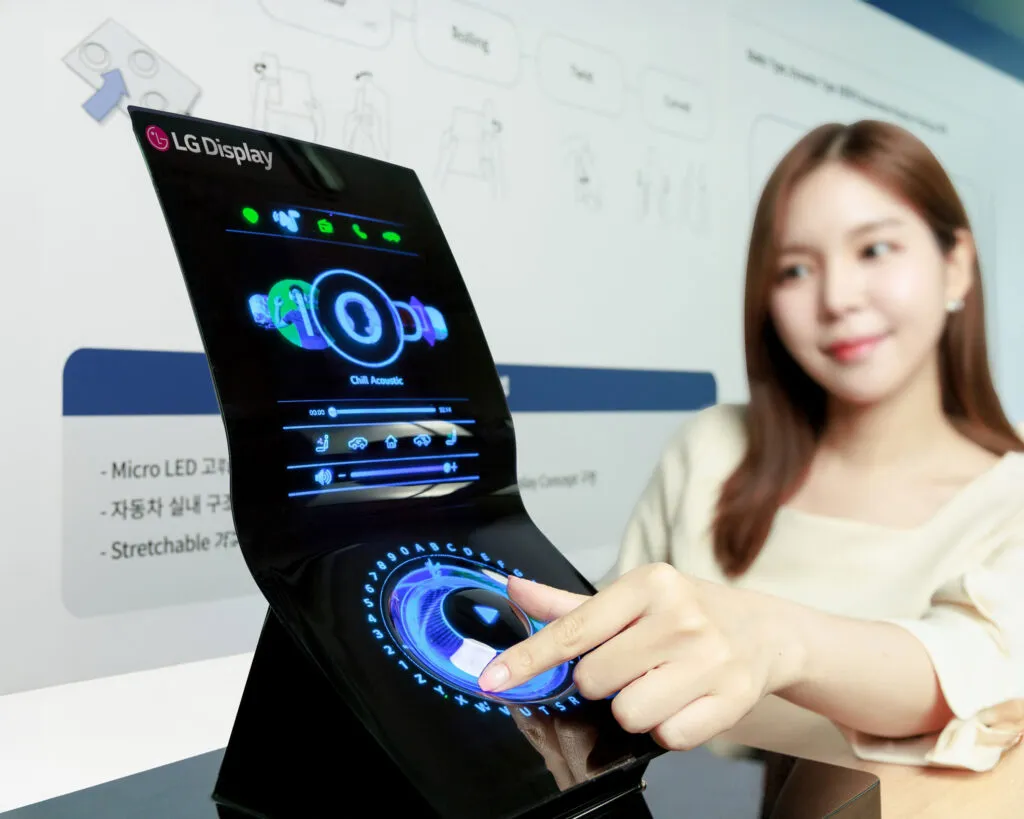
LG's New Stretchable Display Can Grow By 50% (tomshardware.com) 26

An anonymous reader quotes a report from Tom's Hardware: LG Display, one of the global leaders in display technologies, unveiled a new stretchable display prototype that can expand by up to 50%. This makes it the most stretchable display in the industry, more than doubling the previous record of 20% elongation. [...] The prototype being flexed in [this image] is a 12-inch screen with a 100-pixel-per-inch resolution and full RGB color that expands to 18-inches when pulled. LG Display said that it based the stretchable display on a "special silicon material substrate used in contact lenses" and then improved its properties for better "stretchability and flexibility." It also used a new wiring design structure and a micro-LED light source, allowing users to repeatedly stretch the screen over 10,000 times with no effect on image quality.
Power

Can AI-Enabled Thermostats Create a 'Virtual Power Plant' in Texas? (yahoo.com) 113

Renew Home says they're building a "virtual power plant" in Texas by "enabling homes to easily reduce and shift the timing of energy use." Thursday they announced a 10-year project distributing hundreds of thousands of smart thermostats to customers of Texas-based power utility NRG Energy, starting next spring. (Bloomberg calls them "AI-enabled thermostats that use Alphabet Inc.'s Google Cloud technology.") The ultimate goal? "Create a nearly 1-gigawatt, AI-powered virtual power plant" — equivalent to 1.9 million solar panels, enough to power about 200,000 homes during peak demand.

One NRG executive touted the move as "cutting-edge, AI-driven solutions that will bolster grid resilience and contribute to a more sustainable future." [Residential virtual power plants] work by aggregating numerous, small-scale distributed energy resources like HVAC systems controlled by smart thermostats and home batteries and coordinating them to balance supply and demand... NRG, in partnership with Renew Home, plans to offer Vivint and Nest smart thermostats, including professional installation, at no cost to eligible customers across NRG's retail electricity providers and plans. These advanced thermostats make subtle automatic HVAC adjustments to help customers shift their energy use to times when electricity is less constrained, less expensive, and cleaner... Over time, the parties expect to add devices like batteries and electric vehicles to the virtual power plant, expanding energy savings opportunities for customers...

Through the use of Google Cloud's data, analytics, and AI technology, NRG will be able to do things like better predict weather conditions, forecast wind and solar generation output, and create predictive pricing models, allowing for more efficient production and ultimately ensuring the home energy experience is seamless for customers.

Google Cloud will also offer "its AI and machine learning to determine the best time to cool or heat homes," reports Bloomberg, "based on a household's energy usage patterns and ambient temperatures."

It was less than a year ago that Renew Home was formed when Google spun off the load-shifting service for its "Google Nest" thermostats, which merged with load-shift management startup OhmConnect. Bloomberg describes this week's announcement as "Three of the biggest names in US home energy automation... coming together to offer some relief to the beleaguered Texas electrical grid."

But they point out that 1 gigawatt is roughly 1% of the record summer demand seen in Texas this year. Still, "The entire industry has been built to serve the peak load on the hottest day of the year," said Rasesh Patel, president of NRG's consumer unit. "This allows us to be a lot more smarter about demand in shaving the peak."
Power

Cuba's Power Grid Collapses Again After Second Hurricane. And Then an Earthquake Hit (cnn.com) 96

Wednesday Cuba was hit by a major hurricane which took down its entire power grid again, this time for about 24 hours, according to CNN: Videos of the aftermath showed power infrastructure turned into a mangled mess and power poles down on streets. Hundreds of technicians were mobilized Thursday to reestablish power connections, according to state media... Operations at two electrical plants were partially restored and parts of eastern and central Cuba had electricity back up by Thursday afternoon, state media reported... The country's power grid has collapsed multiple times, including when Hurricane Oscar hit in October and killed at least 7 people.
In the capital of Havana, where 2 million people live, power had been restored to less than 20% of the city by late Friday afternoon, . "Authorities had not yet given an estimate for when power would be fully restored..."

Then tonight, CNN reported: A 6.8 magnitude earthquake struck off the coast of eastern Cuba on Sunday, causing material damage in several regions as the island continues to recover from widespread blackouts and the impact of two hurricanes over the past few weeks. The earthquake was reported about 39 km (24 miles) south of Bartolomé Masó before noon local time, about an hour after a 5.9 magnitude quake rocked the area, the United States Geological Survey (USGS) said.

"There have been landslides, damage to homes and power lines," Cuban President Miguel Díaz-Canel said, adding that authorities are evaluating the situation to start recovery efforts.

Power

America's First Sodium-Ion Battery Gigafactory Announced. Cost: $1.4 Billion (msn.com) 154

Sodium-ion batteries are cheaper than lithium-ion batteries — and they're also more environmentally friendly. And "In the past few years, sodium-ion battery production has increased in the United States," reports the Washington Post, with a new factory planned to manufacture them "in the same way as lithium-ion batteries, just with different ingredients. Instead of using expensive materials like lithium, nickel and cobalt, these will be made of sodium, iron and manganese..." Last month, sodium-ion battery manufacturer Natron Energy announced it would open a "gigafactory" in North Carolina that would produce 24 gigawatt hours of batteries annually, enough energy to charge 24,000 electric vehicles. But sodium-ion batteries are still early in their development compared with lithium-ion, and they have yet to hit the market on a massive scale.

"It's unlikely sodium-ion could displace lithium-ion anytime soon," said Keith Beers, polymer science and materials chemistry principal engineer at technical consultancy firm Exponent... The biggest limitation of sodium-ion batteries is their weight. Sodium weighs nearly three times as much as lithium, and it cannot store the same amount of energy. As a result, sodium-ion batteries tend to be larger. Jens Peters, an economics professor at the University of Alcalá in Madrid, said the energy density could be improved over time in sodium-ion batteries. But, he added, "what we found out so far in our assessments is that it is not a game changer."

Sodium-ion batteries are touted to be the environmentally friendly alternative to their lithium-ion counterparts, thanks to their raw materials. Sodium, iron and manganese are all abundant elements on the planet, so they require less energy to extract and cost less... Sodium-ion batteries also last longer than lithium-ion ones because they can withstand more charge cycles, said Wendell Brooks, co-CEO of Natron Energy. "Our product can have millions of cycles," said Brooks, "where lithium-ion would have three to five thousand cycles and wear out a lot faster...." Sodium-ion batteries aren't the best fit for smartphones or electric vehicles, which need to store lots of energy. However, one advantage is their low cost. And they could be a good candidate in situations where the size of the battery isn't a concern, like energy storage. "When something is built out to support grid or backup storage, it doesn't need to be very dense. It's staying put," Beers said.

Natron will invest nearly $1.4 billion in the factory "to meet the rapidly expanding demand for critical power, industrial and grid energy storage solutions," according to their announcement.

"Natron's high-performance sodium-ion batteries outperform lithium-ion batteries in power density and recharging speed, do not require lithium, cobalt, copper, or nickel, and are non-flammable... Natron's batteries are the only UL-listed sodium-ion batteries on the market today, and will be delivered to a wide range of customer end markets in the industrial power space, including data centers, mobility, EV fast charging, microgrids, and telecom, among others."
AI

How Samsung Fell Behind in the AI Boom - and Lost $126 Billion in Market Value (cnbc.com) 14

After missing a chance to capitalize on the AI boom, "Samsung's profit has plunged," reports CNBC, and "around $126 billion has been wiped off its market value, according to data from S&P Capital IQ."

It's gotten so bad that "an executive issued a rare public apology about the company's recent financial performance." [A]s AI applications such as OpenAI's ChatGPT rose in popularity, the underlying infrastructure required to train the huge models they rely on became a bigger focus. Nvidia has emerged as the top player in this space with its graphics processing units (GPUs) that have become the gold standard used by tech giants for AI training. A crucial part of that semiconductor architecture is high-bandwidth memory, or HBM. This next generation of memory involves stacking multiple dynamic random access memory (DRAM) chips, but it had a small market before the AI boom. That's where Samsung got caught out and failed to invest...

SK Hynix saw this opportunity. The company aggressively launched HBM chips which were approved for use in Nvidia architecture and, in the process, the South Korean firm established a close relationship with the U.S. giant. Nvidia's CEO even asked the company to speed up supply of its next generation chip, underscoring the importance of HBM to its products. SK Hynix posted record quarterly operating profit in the September quarter...

Analysts said that Samsung is lagging behind competitors for a number of reasons, including underinvestment in HBM and the fact that it is not a first-mover. "It is fair to say that Samsung has not been able to close the gap with SK Hynix on the HBM development roadmap," said Kazunori Ito [director of equity research at Morningstar]. Samsung's ability to make a comeback in the short term appears to be closely linked to Nvidia. A company must pass a strict qualification process before Nvidia approves it as a HBM supplier — and Samsung has not yet completed this verification. But a green light from Nvidia could open the door for Samsung to return to growth and compete more effectively with SK Hynix, according to analysts.

China

TSMC Halts Advanced Chip Shipments To Chinese AI Companies 18

Starting November 11, TSMC plans to stop supplying 7 nm and smaller chips to Chinese companies working on AI processors and GPUs. "The move is reportedly to ensure it remains compliant with US export restrictions," reports The Register. From the report: This will not affect Chinese customers wanting 7 nm chips from TSMC for other applications such as mobile and communications, according to Nikkei, which said the overall impact on the chipmaker's revenue is likely to be minimal. TrendForce further cites another China-based source who claims the move was at the behest of the US Department of Commerce, which informed TSMC that any such shipments should not proceed unless approved and licensed by its BIS (Bureau of Industry and Security). We asked the agency for confirmation.

Any moves by the silicon supremo is likely to be out of caution to pre-empt accusations from Washington that it isn't doing enough to prevent advanced technology from getting into the hands of Chinese entities that have been sanctioned. As TrendForce notes, it "highlights the foundry giant's delicate position in the global semiconductor supply chain amid the heating chip war between the world's two superpowers."
Data Storage

New Mac Mini Has Modular Storage, 256GB Model Will Have Faster SSD (macrumors.com) 24

According to a partial teardown video of Apple's new Mac mini, the new machine features modular storage that can be removed. "As we saw with the Mac Studio, however, replacing the modular storage is complicated," notes MacRumors. The teardown also reveals two 128GB storage chips in the 256GB model, enabling faster SSD speeds comparable to higher-capacity versions. From the report: The criticism surrounding Apple's decision to use a single 256GB chip in some base-model Macs a few years ago primarily came from a vocal contingent of tech enthusiasts, and the average customer is unlikely to even notice the slower speeds in common day-to-day tasks. Nevertheless, it appears that customers who do want the fastest SSD speeds do not need to worry about which storage capacity they choose when ordering the new Mac mini.
AMD

'A New Gaming CPU King': AMD's New Ryzen 7 9800X3D Reviewed 52

"AMD's Ryzen 7 9800X3D debuts with impressive performance gains, powered by advanced 3D V-Cache technology and improved thermal efficiency," writes Slashdot reader jjslash. "While the CPU shines as a top choice right out of the gate, AMD's history of quick price cuts suggests waiting could yield even better value for savvy buyers." TechSpot reports: Today we're finally able to show you how AMD's new Ryzen 7 9800X3D performs, and spoiler alert -- it's a real weapon that solves the issues we encountered with the non-3D Zen 5 chips before this. Without question, this is the best CPU released since the 7800X3D, making this launch particularly exciting. [...] For now, the 9800X3D is mighty impressive, the undisputed king of gaming, and it marks a historic milestone. We don't think AMD has ever been this dominant over Intel, certainly not in the last 15 years.
Power

Oil Giant BP is Killing 18 Hydrogen Projects, Chilling the Nascent Industry (techcrunch.com) 52

An anonymous reader shares a report: Tucked inside a 32-page earnings report, oil and gas giant BP revealed it was killing 18 early-stage hydrogen projects, a move that could have a chilling effect on the nascent hydrogen industry. The decision, along with the sale of the company's U.S. on-shore wind power operations, will save BP $200 million annually and help boost its bottom line. The hydrogen industry, which has relied on oil and gas companies both financially and through lobbying efforts, is preparing for a grimmer outcome.

BP has been a supporter of hydrogen. The company's venture capital arm has invested in several green hydrogen startups, including Electric Hydrogen and Advanced Ionics. Earlier this year, BP said it would develop "more than 10" hydrogen projects in the U.S., Europe, and Australia. Now, BP is scaling back those plans, saying it'll develop between five and ten projects. The company is keeping quiet about which ones will receive the green light.

Power

US Regulator Rejects Bid To Boost Nuclear Power To Amazon Data Center (thehill.com) 29

The Federal Energy Regulatory Commission (FERC) blocked Amazon's bid to access more power from the Susquehanna nuclear plant for its Pennsylvania data center, citing grid reliability and consumer cost concerns. The Hill reports: In a 2-1 decision, the FERC found the regional grid operator, PJM Interconnection, failed to prove that the changes to the transmission agreement with Susquehanna power plant were necessary. The regulator's two Republican commissioners, Mark Christie and Lindsay See, outvoted Democratic chair Willie Phillips. The chair's two fellow Democratic commissioners, David Rosner and Judy Chang, sat out the vote. "Co-location arrangements of the type presented here present an array of complicated, nuanced and multifaceted issues, which collectively could have huge ramifications for both grid reliability and consumer costs," Christie wrote in a concurring statement.

In a dissenting statement, Phillips argued the deal with Amazon "represents a 'first of its kind' co-located load configuration" and that Friday's decision is a "step backward for both electric reliability and national security." "We are on the cusp of a new phase in the energy transition, one that is characterized as much by soaring energy demand, due in large part to AI, as it is by rapid changes in the resource mix," Phillips wrote.

Amazon purchased a 960-megawatt data center next to the Susquehanna power plant for $650 million earlier this year. Following the announcement, PJM sought to increase the amount of power running directly to the co-located data center. However, the move faced pushback from regional utilities, including Exelon and American Electric Power (AEP).

Power

Sweden Scraps Plans For 13 Offshore Windfarms Over Russia Security Fears (theguardian.com) 139

An anonymous reader quotes a report from The Guardian: Sweden has vetoed plans for 13 offshore windfarms in the Baltic Sea, citing unacceptable security risks. The country's defence minister, Pal Jonson, said on Monday that the government had rejected plans for all but one of 14 windfarms planned along the east coast. The decision comes after the Swedish armed forces concluded last week that the projects would make it more difficult to defend Nato's newest member.

The proposed windfarms would have been located between Aland, the autonomous Finnish region between Sweden and Finland, and the Sound, the strait between southern Sweden and Denmark. The Russian exclave of Kaliningrad is only about 310 miles (500km) from Stockholm. Wind power could affect Sweden's defence capabilities across sensors and radars and make it harder to detect submarines and possible attacks from the air if war broke out, Jonson said. The only project to receive the green light to was Poseidon, which will include as many as 81 wind turbines to produce 5.5 terawatt hours a year off Stenungsund on Sweden's west coast.
"Both ballistic robots and also cruise robots are a big problem if you have offshore wind power," Jonson said. "If you have a strong signal detection capability and a radar system that is important, we use the Patriot system for example, there would be negative consequences if there were offshore wind power in the way of the sensors."
Displays

visionOS 2.2 Beta Adds Wide and Ultrawide Modes To Mac Virtual Display (macrumors.com) 10

Apple released the first beta of visionOS 2.2, introducing new "Wide" and "Ultrawide" modes for the Mac Virtual Display feature on the Vision Pro headset. MacRumors reports: Apple has previously said the ultra-wide version of Mac Virtual Display is equivalent to having two physical 4K displays sitting side by side on a desk. Mac Virtual Display is now available in three sizes: Normal, Wide, and Ultrawide. visionOS 2.2 will likely be released to the public in December alongside iOS 18.2, iPadOS 18.2, macOS Sequoia 15.2, watchOS 11.2, tvOS 18.2, and other updates. Further reading: Apple Delays Cut-price Vision Headset Until 2027, Analyst Ming-Chi Kuo Says
Media

FFmpeg Devs Boast of Up To 94x Performance Boost After Implementing Handwritten AVX-512 Assembly Code (tomshardware.com) 135

Anton Shilov reports via Tom's Hardware: FFmpeg is an open-source video decoding project developed by volunteers who contribute to its codebase, fix bugs, and add new features. The project is led by a small group of core developers and maintainers who oversee its direction and ensure that contributions meet certain standards. They coordinate the project's development and release cycles, merging contributions from other developers. This group of developers tried to implement a handwritten AVX512 assembly code path, something that has rarely been done before, at least not in the video industry.

The developers have created an optimized code path using the AVX-512 instruction set to accelerate specific functions within the FFmpeg multimedia processing library. By leveraging AVX-512, they were able to achieve significant performance improvements -- from three to 94 times faster -- compared to standard implementations. AVX-512 enables processing large chunks of data in parallel using 512-bit registers, which can handle up to 16 single-precision FLOPS or 8 double-precision FLOPS in one operation. This optimization is ideal for compute-heavy tasks in general, but in the case of video and image processing in particular.

The benchmarking results show that the new handwritten AVX-512 code path performs considerably faster than other implementations, including baseline C code and lower SIMD instruction sets like AVX2 and SSSE3. In some cases, the revamped AVX-512 codepath achieves a speedup of nearly 94 times over the baseline, highlighting the efficiency of hand-optimized assembly code for AVX-512.

Cellphones

Will Charging Cables Ever Have a Single Standardzed Port? (msn.com) 194

The Atlantic complains that our chaos of different plug types "was supposed to end, with USB-C as our savior." But part of the problem is what they call "the second circle of our cable hell: My USB-C may not be the same as yours. And the USB-C you bought two years ago may not be the same as the one you got today. And that means it might not do what you now assume it can." A lack of standardization is not the problem here. The industry has designed, named, and rolled out a parade of standards that pertain to USB and all its cousins. Some of those standards live inside other standards. For example, USB 3.2 Gen 1 is also known as USB 3.0, even though it's numbered 3.2. (What? Yes.) And both of these might be applied to cables with USB-A connectors, or USB-B, or USB-Micro B, or — why not? — USB-C. The variations stretch on and on toward the horizon.

Hope persists that someday, eventually, this hell can be escaped — and that, given sufficient standardization, regulatory intervention, and consumer demand, a winner will emerge in the battle of the plugs. But the dream of having a universal cable is always and forever doomed, because cables, like humankind itself, are subject to the curse of time, the most brutal standard of them all. At any given moment, people use devices they bought last week alongside those they've owned for years; they use the old plugs in rental cars or airport-gate-lounge seats; they buy new gadgets with even better capabilities that demand new and different (if similar-looking) cables. Even if Apple puts a USB-C port in every new device, and so does every other manufacturer, that doesn't mean that they will do everything you will expect cables to do in the future. Inevitably, you will find yourself needing new ones.

Back in 1998, the New York Times told me, "If you make your move to U.S.B. now, you can be sure that your new devices will have a port to plug into." I was ready! I'm still ready. But alas, a port to plug into has never been enough.

Obligatory XKCD.
Power

Can Heat Pumps Still Save the Planet from Climate Change? (msn.com) 310

"One technology critical to fighting climate change is lagging," reports the Washington Post, "thanks to a combination of high interest rates, rising costs, misinformation and the cycle of home construction. Adoption of heat pumps, one of the primary ways to cut emissions from buildings, has slowed in the United States and stalled in Europe, endangering the switch to clean energy.

"Heat pump investment in the United States has dropped by 4 percent in the past two years, even as sales of EVs have almost doubled, according to data from MIT and the Rhodium Group. In 13 European countries, heat pump sales dropped nearly in half in the first half of 2024, putting the European Union off-track for its climate goals." "Many many markets are falling," said Paul Kenny, the director general of the European Heat Pump Association. "It takes time to change people's minds about a heating system." Heat pumps — essentially air conditioners that can also work in reverse, heating a space as well as cooling it — are crucial to making buildings more climate-friendly. Around 60 percent of American homes are still heated with furnaces running on oil, natural gas, or even propane; to cut emissions from homes, all American houses and apartments will need to be powered by electricity...

In the United States, experts point to lags in construction, high interest rates, and general belt-tightening from inflation... [Cora Wyent, director of research for the electrification advocacy group Rewiring America] added, heat pumps are still growing as a share of overall heating systems, gaining ground on gas furnaces. In 2023, heat pumps made up 55 percent of all heating systems sold, while gas furnaces made up just 45 percent. "Heat pumps are continuing to increase their total market share," she said.

Homeowners may also run into trouble when trying to find contractors to install heat pumps. Barton James, the president and CEO of the Air Conditioning Contractors of America, says many contractors don't have training on how to properly install heat pumps; if they install them incorrectly, the ensuing problems can sour consumers on the technology... In the United States, low gas prices also make the economics of heat pumps more challenging. Gas is around three times cheaper than electricity — while heat pumps make up most of that ground with efficiency, they aren't the most cost-effective option for every household.

The Post also spoke to the manager for the carbon-free buildings team at the clean energy think tank RMI. They pointed out that heating systems need to be replaced roughly every 15 years — and the next cycle doesn't start until 2035.

The article concludes that "even with government policies and subsidies, many parts of the move to clean energy will require individual people to make changes to their lives. According to the International Energy Agency, the number of heat pumps will have to triple by 2030 to stay on track with climate goals. The only way to do that, experts say, is if incentives, personal beliefs, and technology all align."

Slashdot Top Deals