OS X

Is Apple Silicon Ready? (thenextweb.com) 132

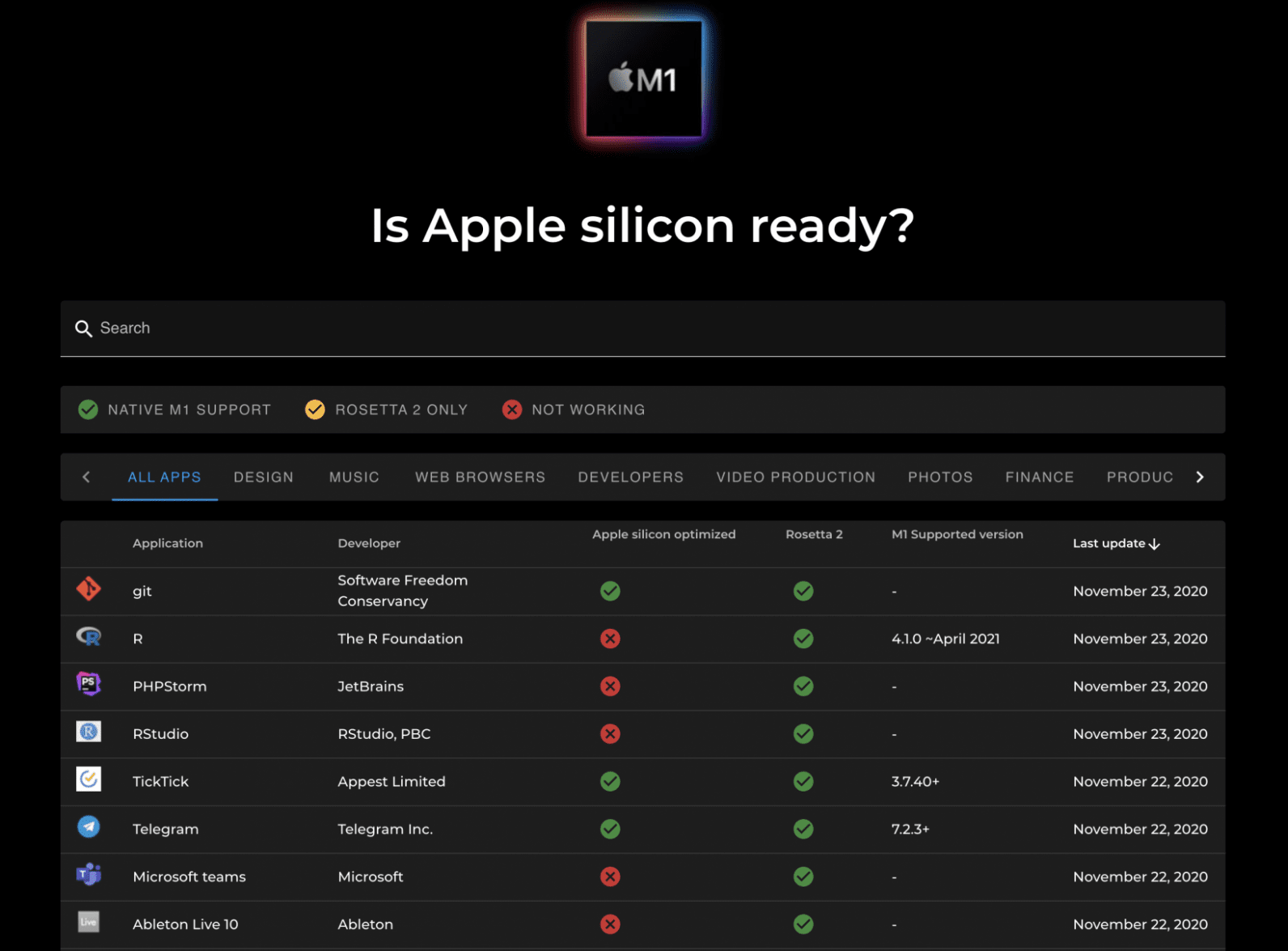
Programmer Abdullah Diaa has put together a website to help determine if your favorite apps work on Apple Silicon yet. An anonymous reader shares a report from The Next Web: ... [P]lease say hello to Is Apple silicon ready? The idea behind the site is simple: it shows you if specific apps will work on laptops and desktops with Apple's in-house chip. Easy to get your head around, right? It shows you a list of software and, if they have native M1 support, they're given a green tick.

Here's an image that shows you what's going on far clearer than lots of words could. As you can see, the site also shows you if the app you're after has Rosetta 2 support. Effectively, Rosetta 2 is an emulator, allowing a large number of apps designed for Intel machines to run on Apple Silicon. If this is supported, you will still be able to use that software on an M1-toting machine.
Further reading: Linus Torvalds Would Like To Use An M1 Mac For Linux, But...
Desktops (Apple)

Linus Torvalds Would Like To Use An M1 Mac For Linux, But... (zdnet.com) 246

Yes, Torvalds said he'd love to have one of the new M1-powered Apple laptops, but it won't run Linux and, in an exclusive interview he explains why getting Linux to run well on it isn't worth the trouble. Steven J. Vaughan-Nichols writes via ZDNet: Recently, on the Real World Technologies forum, Linux's creator Linus Torvalds was asked what he thought of the new M1-powered Apple laptops. Torvalds replied, "I'd absolutely love to have one if it just ran Linux." You may think, "what's the problem? Doesn't Linux run on practically every processor on the planet from 80386s to IBM s390x to the ARM family of which Apple's M1 chip is a child?" Well, yes, yes it does. But it takes more than a processor to run a computer.

Torvalds would like to run Linux on these next-generation Macs. As he said, "I've been waiting for an ARM laptop that can run Linux for a long time. The new Air would be almost perfect, except for the OS. And I don't have the time to tinker with it, or the inclination to fight companies that don't want to help." Aye, there's the rub. In an exclusive interview, Torvalds expanded on why he can't see porting Linux to the M1-based Macs. "The main problem with the M1 for me is the GPU and other devices around it, because that's likely what would hold me off using it because it wouldn't have any Linux support unless Apple opens up."

Still, while Torvalds knows Apple opening up their chipsets "seems unlikely, but hey, you can always hope." Even if that "wasn't an issue," Torvalds continued, "My personal hope would be more cores. Even in a laptop, I don't care about 20-hour battery life (and I wouldn't get it building kernels anyway). I'd rather plug it in a bit more often, and have 8 big cores." As for the Mac's limited RAM -- no more than 16GBs on current models -- he can live with that. "16GBs is actually ok by me because I don't tend to do things that require a lot more RAM. All I do is read email, do git and kernel compiles. And yes, I have 64GB in my desktop, but that's because I have 32 cores and 64 threads, and I do hugely parallel builds. Honestly, even then 32GB would be sufficient for my loads." That said, other developers and power users may want more from the new Macs, Torvalds thinks. "The people who really want tons of memory are the ones doing multiple VMs or huge RAW file photography and video."

Power

EU Says It Could Be Self-Sufficient In Electric Vehicle Batteries By 2025 (reuters.com) 87

The European Union could produce enough batteries by 2025 to power its fast-growing fleet of electric vehicles without relying on imported cells, European Commission Vice President Maros Sefcovic said on Tuesday. Reuters reports: As part of its plan to become climate neutral by 2050, the EU wants to boost local production of the building blocks for green industries -- including hydrogen fuel to make low-carbon steel and batteries to power clean vehicles. "I am confident that by 2025, the EU will be able to produce enough battery cells to meet the needs of the European automotive industry, and even to build our export capacity," Sefcovic told the online European Conference on Batteries. Today, China hosts roughly 80% of the world's lithium-ion cell production, but Europe's capacity is set to expand fast.

Europe has 15 large-scale battery cell factories under construction, including Swedish company Northvolt's plants in Sweden and Germany, Chinese battery maker CATL's German facility, and South Korean firm SK Innovation's second plant in Hungary. Sefcovic said by 2025 planned European facilities would produce enough cells to power at least 6 million electric vehicles.

EU

Elon Musk Talks New Tesla Model In Europe (electrek.co) 102

Elon Musk made rare comments about a new Tesla vehicle to be designed in Berlin, adding that the reason behind the new vehicle program is to attract new talent from Europe: "I think there's a lot of talent, talented designers and engineers, in Europe. And a lot of the best people, they want to work somewhere where they are doing original design work. They don't want to just be doing the European version of something that was designed in California. So, I think it's important in order to attract the best talent to do original design." Electrek reports: Tesla has been putting a lot of efforts into attracting top talent and it has been successful at it in its home country. Furthermore, Musk commented on the vehicle segment that Tesla plans to address with a locally designed vehicle: "In Europe, I think it would make sense to do I guess a compact car -- perhaps a hatchback or something like that. Something that answers "what do most people want?' in a given region. In the US, cars tend to be bigger for personal taste reasons and in Europe, it tends to be smaller. If you try to park in dense urban environments, having a car that fits in tight parking spaces is important."

Musk didn't offer a timeline for Tesla to design and build the new electric car in Germany, but it's not expected to hit the market for at least a few more years as Tesla focuses on bringing the European Model Y to production at Gigafactory Berlin next year.
You can watch the interview where Musk makes the new comments here.
Data Storage

Memory vs. Disk vs. CPU: How 35 Years Has Changed the Trade-Offs (wordpress.com) 103

Long-time Slashdot reader 00_NOP is a software engineer (with a PhD in real-time computing) re-visits a historic research paper on the financial trade-offs between disk space (then costing about $20,000 per kilobyte) and (volatile) memory (costing about $5 per kilobyte): Thirty-five years ago that report for Tandem computers concluded that the cost balance between memory, disk and CPU on big iron favoured holding items in memory if they were needed every five minutes and using five bytes to save one instruction.

Update the analysis for today and what do you see?

Well my estimate is that we should aim to hold items that we have to access 10 times a second.

And needless to say, some techniques for saving data space are more efficient than they were 35 years ago, their article points out.

"The cost of an instruction per second and the cost of a byte of memory are approximately equivalent — that's tipped the balance somewhat towards data compression (eg., perhaps through using bit flags in a byte instead of a number of booleans for instance), though not by a huge amount."
Power

Tesla Model 3 Crash Hurls Battery Cells Into Nearby Home (extremetech.com) 232

According to a facebook post from the police department of Corvallis, Oregon, a Tesla Model 3 crashed at over 100mph, causing batteries from the Tesla to enter two different residences by breaking through the windows, one landing on a person's lap and the second landing on a bed, catching the bedding on fire. "A tire was ripped from the car during the collision and struck the second story siding of a nearby apartment complex with such force that it ruptured the water pipes within the wall, destroying the bathroom to the apartment and flooding the downstairs portion of the apartment as well," adds ExtremeTech. From the report: Tesla goes to some trouble to make certain that the battery cells in its vehicles don't go flying in the event of a collision. But the nature of this impact was obviously sufficient to break whatever solution the manufacturer has developed for dealing with the problem. Previous teardowns of the Model 3 battery pack have shown that the cells are sealed in place with high-strength epoxy.

With that said, there does appear to be a unique problem for BEVs in a situation like this. According to a follow-up post, the Model 3 battery cells can remain hot to the touch and might cause burns for up to 24 hours following involuntary dispersal. That kind of hazard -- specifically, the length of time you might be at risk from harm due to leftover detritus -- seems a potentially significant issue in certain situations. Tesla's epoxy solution shows it has considered the problem, but there may be reason to revisit things. It is unclear if individual cells remain at significant risk for secondary ignition after being separated from the main battery for any length of time or if the majority of fire risk is in the immediate period post-impact. The driver, incidentally, survived, which seems to say something good about Tesla's crash survival measures, at the least. The vehicle, needless to say, did not.

The Internet

Flash Animations Live Forever At the Internet Archive (archive.org) 29

The Internet Archive is now emulating Flash animations, games and toys in our software collection. Jason Scott writes in a blog post: Utilizing an in-development Flash emulator called Ruffle, we have added Flash support to the Internet Archive's Emularity system, letting a subset of Flash items play in the browser as if you had a Flash plugin installed. While Ruffle's compatibility with Flash is less than 100%, it will play a very large portion of historical Flash animation in the browser, at both a smooth and accurate rate.

We have a showcase of the hand-picked best or representative Flash items in this collection. If you want to try your best at combing through a collection of over 1,000 flash items uploaded so far, here is the link. You will not need to have a flash plugin installed, and the system works in all browsers that support Webassembly. For many people: See you later! Enjoy the Flash stuff!

Graphics

Cerebras' Wafer-Size Chip Is 10,000 Times Faster Than a GPU (venturebeat.com) 123

An anonymous reader quotes a report from VentureBeat: Cerebras Systems and the federal Department of Energy's National Energy Technology Laboratory today announced that the company's CS-1 system is more than 10,000 times faster than a graphics processing unit (GPU). On a practical level, this means AI neural networks that previously took months to train can now train in minutes on the Cerebras system.

Cerebras makes the world's largest computer chip, the WSE. Chipmakers normally slice a wafer from a 12-inch-diameter ingot of silicon to process in a chip factory. Once processed, the wafer is sliced into hundreds of separate chips that can be used in electronic hardware. But Cerebras, started by SeaMicro founder Andrew Feldman, takes that wafer and makes a single, massive chip out of it. Each piece of the chip, dubbed a core, is interconnected in a sophisticated way to other cores. The interconnections are designed to keep all the cores functioning at high speeds so the transistors can work together as one. [...] A single Cerebras CS-1 is 26 inches tall, fits in one-third of a rack, and is powered by the industry's only wafer-scale processing engine, Cerebras' WSE. It combines memory performance with massive bandwidth, low latency interprocessor communication, and an architecture optimized for high bandwidth computing.

Cerebras's CS-1 system uses the WSE wafer-size chip, which has 1.2 trillion transistors, the basic on-off electronic switches that are the building blocks of silicon chips. Intel's first 4004 processor in 1971 had 2,300 transistors, and the Nvidia A100 80GB chip, announced yesterday, has 54 billion transistors. Feldman said in an interview with VentureBeat that the CS-1 was also 200 times faster than the Joule Supercomputer, which is No. 82 on a list of the top 500 supercomputers in the world. [...] In this demo, the Joule Supercomputer used 16,384 cores, and the Cerebras computer was 200 times faster, according to energy lab director Brian Anderson. Cerebras costs several million dollars and uses 20 kilowatts of power.

Graphics

Radeon RX 6800 and 6800 XT Performance Marks AMD's Return To High-End Graphics (hothardware.com) 62

MojoKid writes: AMD officially launched its Radeon RX 6800 and Radeon RX 6800 XT graphics cards today, previously known in the PC gaming community as Big Navi. The company claimed these high-end GPUs would compete with NVIDIA's best GeForce RTX 30 series and it appears AMD made good on its claims. AMD's new Radeon RX 6800 XT and Radeon 6800 are based on the company's RDNA 2 GPU architecture, with the former sporting 72 Compute Units (CUs) and 2250MHz boost clock, while the RX 6800 sports 60 CUs at a 2105MHz boost clock. Both cards come equipped with 16GB of GDDR6 memory and 128MB of on-die cache AMD calls Infinity Cache, that improves bandwidth and latency, feeding the GPU in front of its 256-bit GDDR6 memory interface.

In the benchmarks, it is fair to say the Radeon RX 6800 is typically faster than an NVIDIA GeForce RTX 3070 just as AMD suggested. Things are not as cut and dry for the Radeon RX 6800 XT though, as the GeForce RTX 3080 and Radeon RX 6800 XT trade victories depending on the game title or workload, but the RTX 3080 has an edge overall. In DXR Ray Tracing performance, NVIDIA has a distinct advantage at the high-end. Though the Radeon RX 6800 wasn't too far behind and RTX 3070, neither the Radeon RX 6800 XT or 6800 card came close the GeForce RTX 3080. Pricing is set at $649 and $579 for the AMD Radeon RX 6800 XT and Radeon RX 6800, respectively and the cards are on sale as of today. However, demand is likely to be fierce as this new crop of high-end graphics cards from both companies have been quickly evaporating from retail shelves.

EU

EU Plans To Increase Offshore Windfarm Capacity By 250% (theguardian.com) 111

The capacity of the EU's offshore windfarms in the North Sea, the Baltic, the Atlantic, the Mediterranean and the Black Sea will be increased by 250% under a draft plan drawn up by the European commission. The Guardian reports: The total energy generating capacity in Europe's seas stands at 23 gigawatts (GW), from 5,047 grid-connected wind turbines across 12 countries, including the UK. Under a European commission strategy, the 27 EU member states alone would achieve a capacity of 60GW by 2030 and 300GW by 2050, with Germany set to hugely increase its investment in the sector.

According to the leaked paper, the commission "estimates that an installed capacity of 300GW of offshore wind [and around 60GW of ocean energies] by 2050 would be needed in the integrated, greener and climate neutral energy system of 2050." The commission writes: "This is feasible for a sector where Europe has gained unrivalled technological, scientific and industrial experience and where strong capacity exists already across the supply chain, from manufacturing to shipping and installation. Nonetheless, it is a very challenging horizon. It means that offshore renewable energy capacity should be multiplied by 25 times by 2050. The investment needed is estimated up to 789 billion pounds."

The UK, which left the EU in January, has the largest amount of offshore wind capacity in Europe, with 45% of all installations. Germany is second with 34%, followed by Denmark (8%), Belgium (7%) and the Netherlands (5%). Over the summer, the German government said it would also increase its current 7.5GW of capacity to 20GW by 2030, with a target of 40GW by 2040. But the European commission has called for a more "resolute" approach across the bloc. According to a leak of the strategy obtained by the Euractiv news website, the "very challenging" target for new windfarms would come with an expected price tag of 789 billion pounds, creating 62,000 jobs in the offshore wind industry.

Transportation

China Built the First Electric Car Designed Exclusively For Ride-Hailing (theverge.com) 15

Two of China's top companies have joined forces to design, develop, and build an electric car for the express purpose of ride-hailing. The Verge reports: The vehicle is an adorable green hatchback called the D1, and it was developed by Didi Chuxing, the top ride-hailing company in China that notoriously defeated Uber in 2016, and BYD, one of the leading electric vehicle manufacturers. The D1 will have a range of 418 km (260 miles) as judged by NEDC (New European Driving Cycle). They also explained some of the more interesting design touches that make this vehicle particularly well-suited for app-based ride-hailing.

There is a medium-sized screen on the dashboard as well as two more touchscreens on the back of both headrests for passengers to access navigation and other information. There is one more smaller screen behind the steering wheel that serves as an instrument cluster. The car comes with sliding doors to prevent riders from accidentally hitting passengers or cyclists. The driver's seat is extra comfy for extended use, and there's added legroom in the back seat. The paint job is described as "avocado green," which is similar to Didi's shared bikes.

The D1 will come with a Level 2 driver assistance system that includes lane-departure warning, automatic braking, and pedestrian collision warning. There will also be a driver monitoring system to ensure that drivers keep their hands on the wheel and stay focused on the road. Didi says it used data gathered from its 550 million registered passengers and 31 million drivers to design the D1.

Desktops (Apple)

Apple's M1 Is Exceeding Expectations (extremetech.com) 274

Reviews are starting to pour in of Apple's MacBook Pro, MacBook Air and Mac Mini featuring the new M1 ARM-based processor -- and they're overwhelmingly positive. "As with the Air, the Pro's performance exceeds expectations," writes Nilay Patel via The Verge.

"Apple's next chapter offers strong performance gains, great battery and starts at $999," says Brian Heater via TechCrunch.

"When Apple said it would start producing Macs with its own system-on-chip processors, custom CPU and GPU silicon (and a bunch of other stuff) to replace parts from Intel and AMD, we figured it would be good. I never expected it would be this good," says Jason Cross in his review of the MacBook Air M1.

"The M1 is a serious, serious contender for one of the all-time most efficient and highest-performing architectures we've ever seen deploy," says ExtremeTech's Joel Hruska.

"Spending a few days with the 2020 Mac mini has shown me that it's a barnburner of a miniature desktop PC," writes Chris Welch via The Verge. "It outperforms most Intel Macs in several benchmarks, runs apps reliably, and offers a fantastic day-to-day experience whether you're using it for web browsing and email or for creative editing and professional work. That potential will only grow when Apple inevitably raises the RAM ceiling and (hopefully) brings back those missing USB ports..."

"Quibbling about massively parallel workloads -- which the M1 wasn't designed for -- aside, Apple has clearly broken the ice on high-performance ARM desktop and laptop designs," writes Jim Salter via Ars Technica. "Yes, you can build an ARM system that competes strongly with x86, even at very high performance levels."

"The M1-equipped MacBook Air now packs far better performance than its predecessors, rivaling at times the M1-based MacBook Pro. At $999, it's the best value among macOS laptops," concludes PCMag.

"For developers, the Apple Silicon Macs also represent the very first full-fledged Arm machines on the market that have few-to-no compromises. This is a massive boost not just for Apple, but for the larger Arm ecosystem and the growing Arm cloud-computing business," writes Andrei Frumusanu via AnandTech. "Overall, Apple hit it out of the park with the M1."

Japan

Japan's ARM-Based Supercomputer Leads World In Top500 List; Exascale Expected In 2021 (techtarget.com) 25

dcblogs writes: Japan's Fugaku ARM-based supercomputer is the world's most powerful in the latest Top500 list, setting a world record of 442 petaflops. But this was otherwise an unremarkable year for supercomputers, with a "flattening performance curve," said Jack Dongarra, one of the academics behind the twice-a-year ranking and director of the Innovative Computing Laboratory at the University of Tennessee. This is a result of Moore's Law slowing down as well as a slowdown in the replacement of older systems, he said. But the U.S. is set to deliver an exascale system -- 1,000 petaflops -- next year and China as well. Meanwhile, the EU has a 550 petaflop system in development in Finland. "On the Top500 list, the second-ranked system was IBM Power Systems at nearly 149 petaflops using its Power9 CPUs and Nvidia Tesla GPUs. It is at the Oak Ridge National Lab in Tennessee," adds TechTarget.

"Third place went to Sierra supercomputer, which also uses Power9 and Nvidia GPUs, at about 95 petaflops. It is at Lawrence Livermore National Laboratory in Livermore, Calif."
Data Storage

Ask Slashdot: What's the Ultimate Backup System? Cloud? Local? Sync? Dupes? Tape...? (bejoijo.com) 289

Long-time Slashdot reader shanen noticed a strange sound in one of their old machines, prompting them to ponder: what is the ultimate backup system? I've researched this topic a number of times in the past and never found a good answer...

I think the ultimate backup would be cloud-based, though I can imagine a local solution running on a smart storage device — not too expensive, and with my control over where the data is actually stored... Low overhead on the clients with the file systems that are being backed up. I'd prefer most of the work to be done on the server side, actually. That work would include identifying dupes while maintaining archival images of the original file systems, especially for my searches that might be based on the original folder hierarchies or on related files that I can recall being created around the same time or on the same machine...

How about a mail-in service to read old CDs and floppies and extract any recoverable data? I'm pretty sure I spotted an old box of floppies a few months ago. Not so much interested in the commercial stuff (though I do feel like I still own what I paid for) as I'm interested in old personal files — but that might call for access to the ancient programs that created those files.

Or maybe you want to share a bit about how you handle your backups? Or your version of the ultimate backup system...?

Slashdot reader BAReFO0t recommends "three disks running ZFS mirroring with scraping and regular snapshots, and two other locations running the same setup, but with a completely independent implementation. Different system, different PSU, different CPU manufacturer, different disks, different OS, different file system, different backup software, different building construction style, different form of government, etc."

shanen then added "with minimal time and effort" to the original question — but leave your own thoughts and suggestions in the comments.

What's your ultimate backup solution?
Intel

Celebrate Intel's 4004 Microprocessor Turning 49 Today (4004.com) 29

Tim McNerney is the project leader at 4004.com, a site commemorating Intel's original 4004 microprocessor. He's also long-time Slashdot reader mcpublic, and shares news of a new open source adapter — plus a great moment chip history: Even though Intel debuted its groundbreaking 4004 on November 15th, 1971, 49 years ago today, in the pages of Electronics News, there is something about Intel's very first microprocessor that keeps inspiring engineers to pay tribute to this historic chip.

Turkish iPhone engineer, Erturk Kocalar, (now at Google) and the force behind 8bitforce.com, just added this 4-bit granddaddy to his open-source lineup of 8-bit "Retroshields." These elegant little adapters let you score your favorite, vintage microprocessor on eBay and actually play around with it without having to wire up a multi-chip memory and the peripherals needed to make your little "engine" jolly fun. An Arduino emulates the rest of the system for you in software and lets you program and poke at your relic via USB from the comfort of a modern laptop.

Before FPGAs and yes, even before electronic CAD, there was a tradition of emulating hardware using software. In fact, it is central to the 4004 Genesis story. Busicom, a Japanese maker of mechanical adding machines, had designed its own electronic calculator chip-set and eagerly approached the now-famous Silicon Valley chip-maker to manufacture it. Back in 1969 Intel was just a tiny startup hoping to obsolete core memory with commodity semiconductors, and they didn't have extra logic designers on-staff. But Intel did have a prescient counter-proposal: we'll build you a general purpose computer-on-a-chip and emulate your custom calculator architecture using a ROM-conserving byte-code interpreter. Busicom agreed, and Intel managed to hire Italian superstar Federico Faggin away from Fairchild to craft a novel, customer-programmable microprocessor, which later, in 1975, German mechanical taxi meter maker Argo Kienzle would go on to launch the world's first electronic taxi meter. Starting to see a pattern of progress in everyday automation?

For photos, schematics, mask artwork, code, graphical simulators, more history, and the findings of a dedicated team of "digital archeologists," visit 4004.com

Power

Iron Powder Passes First Industrial Test As Renewable, Carbon Dioxide-Free Fuel (ieee.org) 103

An anonymous reader quotes a report from IEEE Spectrum: While setting fire to an iron ingot is probably more trouble than it's worth, fine iron powder mixed with air is highly combustible. When you burn this mixture, you're oxidizing the iron. Whereas a carbon fuel oxidizes into CO2, an iron fuel oxidizes into Fe2O3, which is just rust. The nice thing about rust is that it's a solid which can be captured post-combustion. And that's the only byproduct of the entire business -- in goes the iron powder, and out comes energy in the form of heat and rust powder. Iron has an energy density of about 11.3 kWh/L, which is better than gasoline. Although its specific energy is a relatively poor 1.4 kWh/kg, meaning that for a given amount of energy, iron powder will take up a little bit less space than gasoline but it'll be almost ten times heavier. It might not be suitable for powering your car, in other words. It probably won't heat your house either. But it could be ideal for industry, which is where it's being tested right now.

Researchers from TU Eindhoven have been developing iron powder as a practical fuel for the past several years, and last month they installed an iron powder heating system at a brewery in the Netherlands, which is turning all that stored up energy into beer. Since electricity can't efficiently produce the kind of heat required for many industrial applications (brewing included), iron powder is a viable zero-carbon option, with only rust left over. So what happens to all that rust? This is where things get clever, because the iron isn't just a fuel that's consumed -- it's energy storage that can be recharged. And to recharge it, you take all that Fe2O3, strip out the oxygen, and turn it back into Fe, ready to be burned again. It's not easy to do this, but much of the energy and work that it takes to pry those Os away from the Fes get returned to you when you burn the Fe the next time. The idea is that you can use the same iron over and over again, discharging it and recharging it just like you would a battery.

To maintain the zero-carbon nature of the iron fuel, the recharging process has to be zero-carbon as well. There are a variety of different ways of using electricity to turn rust back into iron, and the TU/e researchers are exploring three different technologies based on hot hydrogen reduction (which turns iron oxide and hydrogen into iron and water). [...] Both production of the hydrogen and the heat necessary to run the furnace or the reactors require energy, of course, but it's grid energy that can come from renewable sources. [...] Philip de Goey, a professor of combustion technology at TU/e, told us that he hopes to be able to deploy 10 MW iron powder high-temperature heat systems for industry within the next four years, with 10 years to the first coal power plant conversion.

Google

Google Is Reportedly Working On Linking Up Nest Audio Speakers With Chromecast Streaming Devices (theverge.com) 16

In a Wall Street Journal article comparing Apple's HomePod Mini against the competition, a Google spokesperson hinted that the company is working on integrating its Chromecast streaming devices and Nest Audio speakers. The Verge reports: Being able to combine a streaming platform with a smart phone speaker makes a lot of sense for these companies. After all, customers already have all the hardware in their living room -- why not repurpose those speakers to improve the sound of your Netflix movies? Plus, there's the added bonus of inciting customers to stay within a company's ecosystem. You're more likely to buy a HomePod mini if it works with the Apple TV you already have. The ability to link smart speakers to streaming boxes is also something that both Apple and Amazon already offer.

Google's plans are extremely vague for now -- The Wall Street Journal makes no mention of which devices the company is looking to link together, when the feature will arrive, or what sort of use cases it's looking to achieve. But with Google increasingly looking to push users toward its smart home devices, making them all work better together just makes good sense.

Transportation

GM Recalling Nearly 69,000 Bolt EVs For Fire Risks (reuters.com) 73

General Motors said on Friday it was recalling 68,677 electric cars worldwide that pose a fire risk after five reported fires and two minor injuries. Reuters reports: The recall is for 2017-2019 model-year Chevrolet Bolt EVs with high voltage batteries produced at LG Chem's Ochang, Korea facility. The National Highway Traffic Safety Administration (NHTSA) last month opened a preliminary investigation into the Bolt EVs after reports of three Bolts catching fire under the rear seat while parked and unattended.

GM said the vehicles pose a fire risk when charged to full, or nearly full capacity. GM said it has developed software that will limit vehicle charging to 90% of full capacity to mitigate the risk while GM works to determine the appropriate final repair. NHTSA said in a consumer alert on Friday that Bolt owners âoeshould park their cars outside and away from homes until their vehicles have been repaired, due to a new recall for the risk of fire.â The recall includes 50,932 U.S. Bolt vehicles.

AI

Amazon Begins Shifting Alexa's Cloud AI To Its Own Silicon (arstechnica.com) 19

An anonymous reader quotes a report from Ars Technica: On Thursday, an Amazon AWS blogpost announced that the company has moved most of the cloud processing for its Alexa personal assistant off of Nvidia GPUs and onto its own Inferentia Application Specific Integrated Circuit (ASIC). Amazon dev Sebastien Stormacq describes the Inferentia's hardware design as follows: "AWS Inferentia is a custom chip, built by AWS, to accelerate machine learning inference workloads and optimize their cost. Each AWS Inferentia chip contains four NeuronCores. Each NeuronCore implements a high-performance systolic array matrix multiply engine, which massively speeds up typical deep learning operations such as convolution and transformers. NeuronCores are also equipped with a large on-chip cache, which helps cut down on external memory accesses, dramatically reducing latency and increasing throughput."

When an Amazon customer -- usually someone who owns an Echo or Echo dot -- makes use of the Alexa personal assistant, very little of the processing is done on the device itself. [...] According to Stormacq, shifting this inference workload from Nvidia GPU hardware to Amazon's own Inferentia chip resulted in 30-percent lower cost and 25-percent improvement in end-to-end latency on Alexa's text-to-speech workloads. Amazon isn't the only company using the Inferentia processor -- the chip powers Amazon AWS Inf1 instances, which are available to the general public and compete with Amazon's GPU-powered G4 instances. Amazon's AWS Neuron software development kit allows machine-learning developers to use Inferentia as a target for popular frameworks, including TensorFlow, PyTorch, and MXNet.

Hardware

Samsung Announces Exynos 1080 -- 5nm Premium-Range SoC with A78 Cores (anandtech.com) 15

Samsung LSI today announced the new Exynos 1080 SoC (system on chip), a successor to last year's Exynos 980. This year's 1080 is seemingly positioned a little above the 980 in terms of performance as we're seeing some quite notable gains in features compared to the 980. From a report: It's to be remembered that this is a "premium" SoC, meaning it's not a flagship SoC, but it's also not quite a mid-range SoC, fitting itself in-between those two categories, a niche which has become quite popular over the last 1-2 years. The new SoC is defined by having a new 1+3+4 CPU configuration, as reasonably large GPU, and full 5G connectivity integrated, and is the first publicly announced SoC to be manufactured on Samsung's new 5LPE process node. On the CPU side of things, this is the first time we've seen Samsung adopt a 1+3+4 CPU configuration, now adopting the Cortex-A78 architecture on the part of the performance cores. One core is clocked at 2.8GHz while the three others are running at 2.6GHz. Qualcomm had first introduced such a setup and it seems it's become quite popular as it gives the benefit of both performance and power efficiency. The four big cores are accompanied by four Cortex-A55 cores at 2.0GHz.
Biotech

Researchers 3-D Print Biomedical Parts With Supersonic Speed (phys.org) 14

schwit1 shares a report from Phys.Org: Forget glue, screws, heat or other traditional bonding methods. A Cornell University-led collaboration has developed a 3-D printing technique that creates cellular metallic materials by smashing together powder particles at supersonic speed. This form of technology, known as "cold spray," results in mechanically robust, porous structures that are 40% stronger than similar materials made with conventional manufacturing processes. The structures' small size and porosity make them particularly well-suited for building biomedical components, like replacement joints.

The team's paper, "Solid-State Additive Manufacturing of Porous Ti-6Al-4V by Supersonic Impact," published Nov. 9 in Applied Materials Today. "If we make implants with these kind of porous structures, and we insert them in the body, the bone can grow inside these pores and make a biological fixation," Moridi said. "This helps reduce the likelihood of the implant loosening. And this is a big deal. There are lots of revision surgeries that patients have to go through to remove the implant just because it's loose and it causes a lot of pain." Moridi added: "We only focused on titanium alloys and biomedical applications, but the applicability of this process could be beyond that. Essentially, any metallic material that can endure plastic deformation could benefit from this process. And it opens up a lot of opportunities for larger-scale industrial applications, like construction, transportation and energy."

United Kingdom

Rolls Royce Plans 16 Mini-Nuclear Plants For UK (bbc.com) 213

A consortium led by Rolls Royce has announced plans to build up to 16 mini-nuclear plants in the UK. The BBC reports: It says the project will create 6,000 new jobs in the Midlands and the North of England over the next five years. The prime minister is understood to be poised to announce at least 200 million pounds for the project as part of a long-delayed green plan for economic recovery. Rolls argues that as well as producing low-carbon electricity, the concept could become a new export industry.

The company's UK "small modular reactor" (SMR) group includes the National Nuclear Laboratory and the building company Laing O'Rourke. The government says new nuclear is essential if the UK is to meet its target of reaching net zero emissions by 2050 -- where any carbon released is balanced out by an equivalent amount absorbed from the atmosphere. But there is a nuclear-sized hole opening up in the energy network. Six of the UK's seven nuclear reactor sites are due to go offline by 2030 and the remaining one, Sizewell B, is due to be decommissioned in 2035. Together they account for around 20% of the country's electricity.

Each plant would produce 440 megawatts of electricity -- roughly enough to power Sheffield -- and the hope is that, once the first few have been made, they will cost around 2 billion pounds each. The consortium says the first of these modular plants could be up and running in 10 years, after that it will be able to build and install two a year. By comparison, the much larger nuclear plant being built at Hinkley Point in Somerset is expect to cost some 22 billion pounds but will produce more than 3 gigawatts of electricity -- over six times as much.

Power

A Self-Taught Garage Inventor Sees His Liquid Air Storage Idea Make the Big Time (cnbc.com) 129

Anmar Frangoul writes via CNBC: Work has started on a liquid air energy storage site in the northwest of England, with the team behind the project stating it will be one of the largest energy storage systems in Europe. Highview Power's 50 megawatt facility in Greater Manchester will harness technology that uses something called "air liquefaction." The system involves a number of steps: excess or off peak electricity powers an air liquefier. This cleans, compresses then cools ambient air, turning it into a liquid at -196 degrees Celsius (around -320 Fahrenheit). According to the company, this liquid air is "stored at low pressure and later heated and expanded to drive a turbine and generate power."

The technology being deployed by Highview Power stems from an idea developed by Peter Dearman, the brains behind the concept of a "liquid air engine." According to the U.K. government, Dearman -- who's been described by the BBC as a "self-taught backyard inventor" -- worked alongside a team from the University of Leeds to develop the idea of "using air as a form of energy storage" when compressed and liquefied. The new site, which is scheduled to open in 2023, will be operated by Highview Power in partnership with another firm called Carlton Power.

Data Storage

Western Digital's Ultrastar DC ZN540 Is the World's First ZNS SSD (tomshardware.com) 30

An anonymous reader quotes a report from Tom's Hardware: Western Digital is one of the most vocal proponents of the Zoned Namespaces (ZNS) storage initiative, so it is not surprising that the company this week became the first SSD maker to start sampling of a ZNS SSD. When used properly, the Ultrastar DC ZN540 drive can replace up to four conventional SSDs, provide higher performance and improve quality of service (QoS).

ZNS SSDs have a number of advantages over traditional block-based SSDs. For one, they place data sequentially into zones and have better control over write amplification, since the software 'knows' what it is dealing with. This means that ZNS SSDs don't need as much overprovisioning as traditional enterprise drives. Many enterprise drives rated for 3DWPD (drive writes per day) reserve up to 28% of their raw capacity for overprovisioning. ZNS needing as little as a tenth of that significantly increases usable SSD capacity. Second, since ZNS manages large zones rather than a bunch of 4KB blocks and doesn't need to perform garbage collection as often as traditional SSDs, it also improves real-world read and write performance. Finally, ZNS substantially reduces DRAM requirements.

Hardware

Raspberry Pi 4 Can Be Safely Overclocked To 2.15 GHz (hackaday.com) 16

szczys writes: When the Raspberry Pi 400 (a keyboard form-factor single board computer) was released last week, the company hinted at overclocking. Testing has now shown that the heat spreader used in that design does an excellent job. The chip was already clocked at 1.8 GHz, versus the stock 1.5 GHz in the original Raspberry Pi 4 Model B board. But it can be safely overclocked to 2.15 GHz, as can the Compute Module 4 with an adequate heat sink.

At 2.0 GHz, the Pi 400 got up above 60 C and showed signs of continuing to warm up even after 50 minutes, but it was nowhere near throttling. So I tried 2.2 GHz, at which speed the CPU refused to boot entirely. Backing down to 2.15 GHz, it ran just fine, so I left it for three hours. It settled in at a cozy 62.5 C, which is warm, but well within specs.

I ran the CM4 with the larger heatsink at 1.8 GHz to give some basis for comparison to the cheap heatsinks. What a big difference a big hunk of aluminum makes! It settled in at a comfortable 68 C or so. Even pushing it up to 2.15 GHz and leaving it for a couple hours, it stayed just a hair below 70C (158F) -- a safe margin on the throttling threshold -- and only a few degrees warmer than that huge heat spreader in the Pi 400.

Further reading: The Verdict After Hackaday's Teardown of a Raspberry Pi 400: 'Very, Very Slick'.


Cloud

Come June 1, All of Your New Photos Will Count Against Your Free Google Storage (techcrunch.com) 63

Come June 1, 2021, Google will change its storage policies for free accounts -- and not for the better. Basically, if you're on a free account and a semi-regular Google Photos user, get ready to pay up next year and subscribe to Google One. From a report: Currently, every free Google Account comes with 15 GB of online storage for all your Gmail, Drive and Photos needs. Email and the files you store in Drive already counted against those 15 GB, but come June 1, all Docs, Sheets, Slides, Drawings, Forms or Jamboard files will count against the free storage as well. Those tend to be small files, but what's maybe most important here, virtually all of your Photos uploads will now count against those 15 GB as well. That's a bid deal because today, Google Photos lets you store unlimited images (and unlimited video, if it's in HD) for free as long as they are under 16MP in resolution or you opt to have Google degrade the quality. Come June of 2021, any new photo or video uploaded in high quality, which currently wouldn't count against your allocation, will count against those free 15 GB. [...] In addition to these storage updates, there's a few additional changes worth knowing about. If your account is inactive in Gmail, Drive or Photos for more than two years, Google 'may' delete the content in that product.
Businesses

Hyundai Reportedly In Talks To Buy Softbank-Owned Boston Dynamics (bloomberg.com) 15

An anonymous reader quotes a report from TechCrunch: SoftBank Group Corp. is in talks to sell robot maker Boston Dynamics to Hyundai, people familiar with the matter said. Proposed terms of the deal would give the South Korean automaker control of the robotics company in a transaction valued at as much as $1 billion, said one of the people, all of whom asked not to be identified because the discussions are private. The terms have yet to be finalized, and the deal could fall apart, said the people.

A sale of Boston Dynamics would mark another twist in the trajectory of a company that spun out of the Massachusetts Institute of Technology in the early 1990s and operated independently until Google bought it in 2013. It was sold again in 2017, that time to SoftBank. At times, Boston Dynamics has functioned more like a research organization than a business, churning out machines that are technologically advanced and whimsical but unprofitable. That includes Spot, a maneuverable dog-like robot. Videos of its creations regularly rack up millions of views on YouTube; however, the company has said it is not currently generating profits. By contrast, Hyundai makes highly practical industrial robots intended for factory use.

Television

Dish To Shut Down Slingbox, Devices Will Become 'Inoperable' In 2022 (variety.com) 52

Dish Network announced that it will permanently shut down all of Sling Media's Slingbox services and end support for the devices in two years, at which point they'll no longer work. Variety reports: On Monday, Dish's Sling Media unit announced that Slingbox servers will be permanently taken offline 24 months from Nov. 9, 2020. "Until then, most Slingbox models will continue to work normally, but the number of supported devices for viewing will steadily decrease as versions of the SlingPlayer apps become outdated and/or lose compatibility," the company said in a message posted Monday.

In an FAQ about the shutdown, Dish said Slingbox is being discontinued because "We've had to make room for new innovative products so that we can continue to serve our customers in the best way possible." Sling will not be releasing any new products; most authorized resellers have been out of stock of the Slingbox devices "for a couple years," according to the company. Sling Media was acquired by EchoStar in 2007 for $380 million, which at the time was Dish's parent company. Years before Netflix became a streaming powerhouse, the Slingbox "place-shifting" devices let customers watch pay-TV channels over the internet. But the products never became a mainstream category in the way streaming-media players like Roku and Amazon's Fire TV have.

Data Storage

SSDs Are Primed To Get Bigger and Faster With Micron's New NAND Memory Tech (pcworld.com) 48

Micron has announced it's shipping 176-layer TLC NAND flash memory to customers, a move that portends larger, faster and even cheaper SSD drives for all. From a report: The company said its 5th-gen 3D NAND memory should put its density about 40 percent higher than its nearest competitors, which are using 128-layer NAND. Micron said read and write latencies are reduced by 35 percent compared to its 96-layer NAND, and by 25 percent compared its 128-layer NAND. Micron isn't the only NAND memory manufacturer that has 176 layers, but it is the first to start volume shipments. The Micron NAND is TLC, or three-bits per cell, and is said to have 33 percent faster transfer rates, as well as a 35 percent improvement in read and write latencies. And because it's TLC NAND instead of QLC, the new memory should offer better drive endurance, too. The 176-layer design comes from stacking two 88-layer stacks together, which isn't a new thing for Micron. You might think that's a trick, but the end result is still the same: far better density for larger drives. Micron said the new 176-layer NAND is about as thick as one-fifth of a sheet of printer paper, and works out to be as thick its previous 64-layer NAND despite having more than twice as many layers. In the end, this will lead to larger SSDs and potentially cheaper ones, too.
Apple

Apple Introduces M1 Chip To Power Its New Arm-Based Macs (theverge.com) 155

Apple has introduced the new M1 chip that will power its new generation of Arm-based Macs. It's a 5nm processor, just like the A14 Bionic powering its latest iPhones. From a report: Apple says the new processor will focus on combining power efficiency with performance. It has an eight-core CPU, which Apple says offers the world's best performance per watt of an CPU. Apple says it delivers the same peak performance as a typical laptop CPU at a quarter of the power draw. It says this has four of the world's fastest CPUs cores, paired with four high-efficiency cores. It pairs this with up to an eight-core GPU, which Apple claims offers the world's fastest integrated graphics, and a 16-core Neural Engine. In addition, the M1 processor has a universal memory architecture, a USB 4 controller, media encode and decode engines, and a host of security features. These include hardware-verified secure boot, encryption, and run-time protections.
Printer

Scientists 3D Print Microscopic Star Trek Spaceship That Moves On Its Own (cnn.com) 52

fahrbot-bot shares a report from CNN: A team of physicists at a university in the Netherlands have 3D-printed a microscopic version of the USS Voyager, an Intrepid-class starship from Star Trek. The miniature Voyager, which measures 15 micrometers (0.015 millimeters) long, is part of a project researchers at Leiden University conducted to understand how shape affects the motion and interactions of microswimmers.

Microswimmers are small particles that can move through liquid on their own by interacting with their environment through chemical reactions. The platinum coating on the microswimmers reacts to a hydrogen peroxide solution they are placed in, and that propels them through the liquid. "By studying synthetic microswimmers, we would like to understand biological microswimmers," Samia Ouhajji, one of the study's authors, told CNN. "This understanding could aid in developing new drug delivery vehicles; for example, microrobots that swim autonomously and deliver drugs at the desired location in the human body." In their project, the physicists also printed shapes like boats, trimers and helices, with each object's shape affecting their swimming behaviors.

United Kingdom

As UK Military Begins Mass Coronavirus Testing, Head of Armed Forces Ponders Robot Soldiers (sky.com) 47

Remembrance Sunday is the day of commemoration for British and Commonwealth servicemen, and the head of the British Armed Forces marked the occasion with a special interview on Sky News.

And he shared a thoughtful answer when asked whether the army might try to recruit fewer soldiers. "[W]hat I'm hinting at is that we need to be thinking about how we measure effects in a different way. I mean I suspect we can have an army of 120,000 of which 30,000 might be robots, who knows. But the answer is we need to open our minds to perhaps numbers not determining what we should be doing but rather the effect that we can achieve, is really what we should be looking for."

The armed forces are playing a key role in the government's response to the pandemic, with some 2,000 personnel deployed to Liverpool to help with a mass coronavirus testing programme for the city. "I suspect if that works successfully we might find there are other areas where we need to help in a similar sort of fashion," General Carter said. He said using the military to take over the entire coronavirus testing programme was an option but added that he had confidence in the current set-up at the moment.

The Guardian focused on the robots: Thirty thousand "robot soldiers" could form an integral part of the British army in the 2030s, working alongside humans in and around the frontline, the head of the armed forces said in a television interview on Sunday...

All Britain's armed forces have been engaged in a string of research projects involving small drones or remotely powered land or underwater vehicles, some of which are armed and others for reconnaissance. The Ministry of Defence says its policy is that only humans will be able to fire weapons, although there is growing concern about the potential danger of unrestricted robot warfare, led by the Campaign to Stop Killer Robots.

Technology under development includes the i9 drone, which is powered by six rotors and carries two shotguns. Remotely operated, it is intended to be used to storm buildings, typically an urban warfare situation that generates some of the highest casualties.

Electronic Frontier Foundation

HP Replaces 'Free Ink for Life' Plan With '99 Cents a Month Or Your Printer Stops Working' (eff.org) 193

In a new essay at EFF.org, Cory Doctorow re-visits HP's anti-consumer "security updates" that disabled third-party ink cartridges (while missing real vulnerabilities that could actually bypass network firewalls).

Doctorow writes that it was just the beginning: HP's latest gambit challenges the basis of private property itself: a bold scheme! With the HP Instant Ink program, printer owners no longer own their ink cartridges or the ink in them. Instead, HP's customers have to pay a recurring monthly fee based on the number of pages they anticipate printing from month to month; HP mails subscribers cartridges with enough ink to cover their anticipated needs. If you exceed your estimated page-count, HP bills you for every page (if you choose not to pay, your printer refuses to print, even if there's ink in the cartridges). If you don't print all your pages, you can "roll over" a few of those pages to the next month, but you can't bank a year's worth of pages to, say, print out your novel or tax paperwork. Once you hit your maximum number of "banked" pages, HP annihilates any other pages you've paid for (but continues to bill you every month).

Now, you may be thinking, "All right, but at least HP's customers know what they're getting into when they take out one of these subscriptions," but you've underestimated HP's ingenuity. HP takes the position that its offers can be retracted at any time. For example, HP's "Free Ink for Life" subscription plan offered printer owners 15 pages per month as a means of tempting users to try out its ink subscription plan and of picking up some extra revenue in those months when these customers exceeded their 15-page limit. But Free Ink for Life customers got a nasty shock at the end of last month: HP had unilaterally canceled their "free ink for life" plan and replaced it with "a $0.99/month for all eternity or your printer stops working" plan...

For would-be robber-barons, "smart" gadgets are a moral hazard, an irresistible temptation to use those smarts to reconfigure the very nature of private property, such that only companies can truly own things, and the rest of us are mere licensors, whose use of the devices we purchase is bound by the ever-shifting terms and conditions set in distant boardrooms. From Apple to John Deere to GM to Tesla to Medtronic, the legal fiction that you don't own anything is used to force you to arrange your affairs to benefit corporate shareholders at your own expense. And when it comes to "razors and blades" business-model, embedded systems offer techno-dystopian possibilities that no shaving company ever dreamed of: the ability to use law and technology to prevent competitors from offering their own consumables. From coffee pods to juice packets, from kitty litter to light-bulbs, the printer-ink cartridge business-model has inspired many imitators.

HP has come a long way since the 1930s, reinventing itself several times, pioneering personal computers and servers. But the company's latest reinvention as a wallet-siphoning ink grifter is a sad turn indeed, and the only thing worse than HP's decline is the many imitators it has inspired.

Hardware

The Verdict After Hackaday's Teardown of a Raspberry Pi 400: 'Very, Very Slick' (hackaday.com) 71

"You can't send Hackaday a piece of gear without us taking it apart," warns an article shared by Slashdot reader beggarwoman.

Hackady's verdict? The new Raspberry Pi 400 "is very, very slick." Inside, there's a flat-flex that connects the keyboard, and you see that big aluminum heat sink. It's almost the full size of the keyboard, and it's thick and heat-taped to the CPU. You know it means business. It's also right up against the aluminum bottom of the keyboard, suggesting it could get radiative help that way, and maybe keep your fingers warm in the winter. (I didn't feel any actual heat, but it's gotta go somewhere, right? There are also vents in the underside of the case.)

Four PZ1 screws and a little bit of courage to unstick the pad get you underneath the heat spreader to find, surprise!, a Raspberry Pi 4. This was a little anticlimactic, as I've just spent a couple weeks looking over the schematics for my review of the new Compute Module 4, and it's just exactly what you'd expect. It's a Raspberry Pi 4, with all the ports broken out, inside a nice keyboard, with a beefy heat spreader. Ethernet magnetics sit on one side, and the wireless module sits on the other. That's it!

"[C]ombine this with a small touch screen, and run it all off of a 5 V power pack, and you've got a ton of portable computing in a very small package.

"If you're not mousing around all the time anyway, there's a certain streamlined simplicity here that's mighty tempting."
Earth

A Biden Victory Positions America For a 180-Degree Turn On Climate Change (seattletimes.com) 251

"Joe Biden, the projected winner of the U.S. presidency, will move to restore dozens of environmental safeguards President Donald Trump abolished," reports the Washington Post, "and launch the boldest climate change plan of any president in history."

destinyland shares their report: While some of Biden's most sweeping programs will encounter stiff resistance from Senate Republicans and conservative attorneys general, the United States is poised to make a 180-degree turn on climate change and conservation policy. Biden's team already has plans on how it will restrict oil and gas drilling on public lands and waters; ratchet up federal mileage standards for cars and SUVs; block pipelines that transport fossil fuels across the country; provide federal incentives to develop renewable power; and mobilize other nations to make deeper cuts in their own carbon emissions... Biden has vowed to eliminate carbon emissions from the electric sector by 2035 and spend $2 trillion on investments ranging from weatherizing homes to developing a nationwide network of charging stations for electric vehicles.

That massive investment plan stands a chance only if his party wins two Senate runoff races in Georgia in January; otherwise, he would have to rely on a combination of executive actions and more-modest congressional deals to advance his agenda.

Still, a number of factors make it easier to enact more-ambitious climate policies than even four years ago. Roughly 10% of the globe has warmed by 2 degrees Celsius (3.6 degrees Fahrenheit), a temperature rise the world has pledged to avoid. The price of solar and wind power has dropped, the coal industry has shrunk, and Americans increasingly connect the disasters they're experiencing in real time — including more-intense wildfires, hurricanes and droughts — with global warming. Biden has made the argument that curbing carbon will produce high-paying jobs while protecting the planet...

Some of the new administration's rules could be challenged in federal court, which have a number of Trump appointees on the bench. But even some conservative activists said that Biden could enact enduring policies, whether by partnering with Congress or through regulation... The new administration may be able to broker compromises with key industries that have experienced regulatory whiplash in the past decade, including the auto industry and power sector, while offering tax breaks for renewable energy that remain popular with both parties. And Biden can rebuild diplomatic alliances that will spur foreign countries to pursue more-ambitious carbon reductions...

Biden's advisers have said that they plan to elevate climate change as a priority in departments that have not always treated it as one, including the Transportation, State and Treasury departments. It will influence key appointments, affecting everything from overseas banking and military bases to domestic roads and farms.... Biden's pledge to achieve a carbon-free U.S. power sector within 15 years would mean the closing or revamping of nearly every coal- and gas-fired power plant around the country, and the construction of an unprecedented number of new wind turbines and solar farms. On top of that, engineers still need to devise a better way of storing energy when the sun is not shining or the wind is not blowing.

"If I were advising Biden on energy, my first three priorities would be storage, storage and storage," said Sen. Angus King, I-Maine, who worked in the alternative energy businesses before running for office.

Power

Tesla Project To Install Another Giant Battery In Australia (bloomberg.com) 63

An anonymous reader quotes a report from Bloomberg: France's Neoen SA will partner with Tesla Inc. to install one of the world's biggest lithium-ion batteries in Australia after reaching a grid connection deal with the power market operator. The 300-megawatt Victorian Big Battery will be located in the southeastern city of Geelong and use Tesla's Megapack technology. It will be double the size of Neoen's Hornsdale site in South Australia, which was the largest facility when it began operation in 2017.

Installing the new system in Australia's second-most populous state will help to modernize and stabilize the local grid, which is targeting 50% of its power to come from renewable sources by 2030, Neoen said Thursday in a media release. The Paris-based company is targeting the battery to be operational by the end of 2021. [...] Victoria's grid still relies heavily on aging coal-fired plants, which have become increasingly unreliable during periods of extreme heat. The state has experienced power outages in recent summers as the system struggled to cope with a surge in demand as businesses and households cranked up air conditioners. Neoen's new project in Victoria will be supported by a 250 megawatt grid services contract with the Australian Energy Market Operator, and will also partner with network provider AusNet Services, the company said.

Transportation

Bentley Will Ditch Internal Combustion Engines By 2030 (arstechnica.com) 114

An anonymous reader quotes a report from Ars Technica: Time is starting to run out for vehicles powered purely by international combustion engines, and the auto industry knows it. This week Bentley, that bastion of British luxury, became the latest OEM to set a date for that happening -- the year 2030. As the company moves into its second century, it has revealed a new plan called "Beyond 100" that it says will "reinvent every aspect of its business to become an end-to-end carbon neutral organization.

Bentley already introduced a plug-in hybrid EV version of the Bentayga SUV and next year it plans to add another pair of PHEVs to its roster -- presumably the Continental GT coupe and Flying Spur sedan. In 2025, the company plans to introduce a battery electric vehicle; Bentley CEO Adrian Hallmark told Autoweek that "you've got to pick a point in time where battery power density, especially for bigger cars, is the liberator for us. We've always said that the mid-2020s is the time when you can expect to see 120-plus kilowatt-hour batteries coming through the supply chain." 2025 will also be the last year you'll be able to buy a Bentley that doesn't plug in, because in 2026 the brand is dropping everything other than PHEVs and BEVs. In 2030, those PHEVs will be gone, too, leaving just BEVs to wear the winged B badge with pride. Along the way, Bentley is also pledging to reduce its factory's environmental impact and go plastic neutral.

Apple

A14X Bionic Allegedly Benchmarked Days Before Apple Silicon Mac Event (appleinsider.com) 88

The chip expected to be at the core of the first Apple Silicon Mac -- the "A14X" -- may have been benchmarked just days before the next Apple event. From a report: The alleged CPU benchmarks for the "A14X" show a 1.80GHz processor capable of turbo-boosting to 3.10GHz marking this the first custom Apple Silicon to ever clock above 3GHz. It is an 8-core processor with big-little arrangement. The GPU results show 8GB of RAM will be included with the processor. The single-core benchmark for the "A14X" scored 1634 vs the A12Z at 1118. The A14 scored 1,583 points for single-core tests, which is expected as single-core results shouldn't change much between the regular and "X" models. The multi-core benchmark for the "A14X" scored 7220 vs the A12Z at 4657. The A14 scored 4198 for multi-core, which means the "A14X" delivers a marked increase in performance in the sorts of environments that the GeekBench test suite focuses on. The additional RAM and graphics capabilities boost this result much higher than the standard iPhone processor. For comparison, a 16-inch MacBook Pro with the Intel Core-i9 processor scores 1096 for single and 6869 for multi-core tests. This means the alleged "A14X" outperforms the existing MacBook Pro lineup by a notable margin.
Power

Several US Utilities Back Out of Deal To Build Novel Nuclear Power Plant (sciencemag.org) 207

Eight of the 36 public utilities that had signed on to help build an innovative new nuclear power plant in the U.S. have backed out of the deal. Science Magazine reports: The withdrawals come just months after the Utah Associated Municipal Power Systems (UAMPS), which intends to buy the plant containing 12 small modular reactors from NuScale Power, announced that completion of the project would be delayed by 3 years to 2030. It also estimates the cost would climb from $4.2 billion to $6.1 billion. "The project is still very much going forward," says LaVarr Webb, a spokesperson for UAMPS, which has nearly four dozen members in Utah, California, Idaho, Nevada, New Mexico, and Wyoming. Although some UAMPS members have dropped out, "promising discussions are ongoing with a number of utilities to join the project or enter into power-purchase agreements," Webb says.

However, critics of the project say the developments underscore that the plant, which is designed by NuScale Power and would be built at the Department of Energy's (DOE's) Idaho National Laboratory, will be untenably expensive. M. V. Ramana, a physicist who works on public policy at the University of British Columbia, Vancouver, says he's not surprised that so many utilities have opted out of the project. The question, he says, is why so many are sticking with it. "They ought to be seeing the writing on the wall and getting out by the dozens," he says.

Transportation

Volvo Trucks To Launch Full Range of Electric Trucks In Europe In 2021 (reuters.com) 48

Volvo Trucks, Sweden's AB Volvo's main truck brand, will sell a complete range of electric, heavy-duty trucks in Europe starting in 2021, the company said in a statement on Thursday. Reuters reports: Volvo said it was currently running tests of the electric heavy-duty Volvo FH, Volvo FM and Volvo FMX trucks, to be used for regional transport and urban construction operations in Europe. The trucks will have a gross combination weight of up to 44 tons, and, depending on the battery configuration, the range could be up to 300 kilometers, Volvo said. Sales will begin in 2021 and volume production will start in 2022.
Printer

Why Do Printers Still Suck? (wired.com) 287

Just when we need them the most, with print shops locked down, online schooling in session, and everyone working from home, they fail to step up. From a column: Printers have been my enemy ever since I can remember. My first office job involved an evil printer that suffered daily paper jams. Tasked with fixing it, I suffered frequent burns and paper cuts. It had a door you had to close just so, or it would immediately break again with the dreaded phantom paper jam. It tormented me for months, completely indifferent to my cries. There isn't even any paper in it! More than two decades later, printers haven't improved at all. It feels like printer companies stopped innovating sometime in the '90s when sales stopped climbing. In fact, it's almost as if they've regressed. Manufacturers tempt with unbelievably cheap deals on printers and then nail you on expensive ink. To make sure they get their pound of flesh, they focus an inordinate effort on making sure printers only work with proprietary ink cartridges.

[...] Three years and a couple of printers later, sick of being gouged for ink cartridges that always seem to run out at the worst moment, I optimistically signed up for a printing subscription plan. The idea is you are charged a flat fee based on how many pages you print each month, and the printer automatically orders ink refills when it's running low. Reading this back, I can only cringe at my naivety. Things were fine for the first few weeks. Then I made the mistake of turning the printer off. It doesn't like to be turned off. It started emailing me, insisting that it needs to be turned on and connected to the internet so the subscription plan can work properly. Every time I turn it on, it prints an ink-heavy test page. It is incredibly good at printing test pages -- it just won't print the document you want. Things got worse when I made the mistake of changing my internet service provider. I forgot about the printer for a while. Then I suddenly needed it. I didn't have time to set up the Wi-Fi, so I plugged directly into the printer with a good old-fashioned cable. It refused to print. I refused to connect it to the internet, so it refused to print for me. To get it working again I had to completely uninstall everything related to the printer, update my drivers, install three separate programs, carry it to another room to plug directly into my desktop, carry it back again, hold down the correct button sequence at the stroke of midnight, spin around three times, and recite the printer incantation into a mirror. It's finally connected and working ... for now. But I know it's only a matter of time before it betrays me again.

Hardware

Razer's First Mainstream Laptop Still Has an RGB Keyboard (engadget.com) 46

Gaming hardware makers have been diversifying their laptops recently, and Razer is the latest to join that trend. From a report: The company is announcing the Razer Book 13 today, which it's calling a "hyper focused productivity laptop." It's not just a subtler version of a Blade laptop, either. The emphasis on productivity means Razer also strove to include a generous array of ports, as well as interesting lighting features that could help highlight keyboard shortcuts. The Book 13 is also the company's first Intel Evo-certified notebook, meaning it meets certain requirements for performance, battery life and wake time. As its name indicates, the Book 13 has a 13.4-inch IPS display that comes in touch or nontouch configurations. If you opt for the matte nontouch version, you'll only get Full HD+ resolution, while the touch models also come in UHD+ (3,840 x 2,400). The touchscreens are also covered in Gorilla Glass for better durability and you can add an anti-reflective coating to reduce glare. All configurations feature a 16:10 aspect ratio, which is new to Razer's family of laptops and lets you see more on the screen at once than older 16:9 devices.

The Book 13 also houses a 720p webcam in its slim bezels, and it's Windows Hello-compatible. There isn't a fingerprint scanner here, though. That's understandable -- Razer's already crammed a lot into the Book 13, which is impressive for a device thatâ(TM)s 0.6 inches thick and weighs 2.95 pounds. Plus, despite that sharp profile, the company managed to offer two Thunderbolt 4 USB-C ports, a USB-A socket (at USB 3.2 speeds), a microSD card reader, a 3.5mm audio jack and an HDMI 2.0 slot. [...] The slim, lightweight package is something Razer fans are already accustomed to, and they'll also appreciate some other familiar features. The most prominent of these is Razer Chroma integration which allows users to customize the colors of individual buttons on the keyboard.
Starts at $1,199. Pre-order starts today, with shipping to be followed later this month.
Operating Systems

Dell Adding Hardware Privacy Driver For Linux (phoronix.com) 46

According to Phoronix, a Dell privacy driver is is being prepared for the Linux kernel. From the report: Beginning in Dell's 2021 laptop models they are providing hardware-based "privacy buttons" to disable microphone and camera support. These new Dell privacy buttons are basically hardware kill switches for the microphone and web camera video stream. The Dell privacy driver sent out on Tuesday for the Linux kernel is about manipulating the relevant LEDs and tracking the status of the hardware-based controls where as the actual toggling of the audio/video support is handled by the hardware.

The Dell privacy driver in its current form is talked about for the camera and microphone support but the patch does also note a "PRIVACY_SCREEN_STATUS" bit as well. Presumably they will be extending this privacy driver as well for privacy screen handling around reducing the horizontal/vertical viewing angles of the display. The dell-privacy Linux driver in its initial form can be found via the kernel mailing list. It's great seeing Dell working on this driver punctually for Linux ahead of their next-gen laptops.

Intel

Intel Enters the Laptop Discrete GPU Market With Xe Max (arstechnica.com) 32

An anonymous reader quotes a report from Ars Technica: This weekend, Intel released preliminary information on its newest laptop part -- the Xe Max discrete GPU, which functions alongside and in tandem with Tiger Lake's integrated Iris Xe GPU. We first heard about Xe Max at Acer's Next 2020 launch event, where it was listed as a part of the upcoming Swift 3x laptop -- which will only be available in China. The new GPU will also be available in the Asus VivoBook Flip TP470 and the Dell Inspiron 15 7000 2-in-1.

During an extended product briefing, Intel stressed to us that the Xe Max beats Nvidia's entry-level MX 350 chipset in just about every conceivable metric. In another year, this would have been exciting -- but the Xe Max is only slated to appear in systems that feature Tiger Lake processors, whose Iris Xe integrated GPUs already handily outperform the Nvidia MX 350 in both Intel's tests and our own. The confusion here largely springs from mainstream consumer expectations of a GPU versus what Intel's doing with the Xe Max. Our GPU tests largely revolve around gaming, using 3DMark's well-known benchmark suite, which includes gaming, fps-focused tests such as Time Spy and Night Raid. Intel's expectations for the Xe Max instead revolve, almost entirely, around content creation with a side of machine learning and video encoding.

Xe Max is, roughly speaking, the same 96 Execution Unit (EU) GPU to be found in the Tiger Lake i7-1185G7 CPU we've tested already this year -- the major difference, beyond not being on-die with the CPU, is a higher clock rate, dedicated RAM, and separate TDP budget. Tiger Lake's Iris Xe has a peak clock rate of 1.35GHz, and it shares the CPU's TDP constraints. Iris Xe Max has its own 25W TDP and a higher peak clock rate of 1.65GHz. It also has its own 4GiB of dedicated RAM -- though that RAM is the same LPDDR4X-4266 that Tiger Lake itself uses, which is something of a first for discrete graphics and might lead to better power efficiency.

Sony

Apple Glasses Will Reportedly Use Sony's 'Cutting-Edge' OLED Micro-Displays To Deliver 'Real AR Experience' (macrumors.com) 32

An anonymous reader quotes a report from Mac Rumors: Earlier this week, Japanese publication Nikkan Kogyo Shimbun reported that Sony will supply Apple with OLED microdisplays for its widely rumored AR/VR glasses, as spotted by Mac Otakara. The report has since been corroborated by display industry analyst Ross Young, who said multiple sources have informed him that Apple is indeed planning to use Sony's microdisplay technology for its head-mounted accessory. According to FRAMOS, a supplier of embedded vision technologies, Sony's OLED microdisplays are small, cutting-edge displays with an ultra-fast response rate, ultra-high contrast, a wide color gamut for precise color reproduction, high luminance, low reflectance, and other benefits that would be ideal for Apple's glasses. Sony's microdisplays also have integrated drivers for a thin and light design, and power-saving modes are available for longer battery life.

Young said the glasses will use a 0.5-inch display with a 1,280x960 resolution, and these specs appear to correspond with Sony's ECX337A component. According to Sony's website, this microdisplay in particular has a max brightness of 1,000 nits, an ultra-high contrast of 100,000:1, and an ultra-fast response rate of 0.01 ms or less. The high contrast provided by Sony's microdisplays allows an additional information layer to appear seamlessly, and not as an overlay. "This information is simply added to the background for a 'real AR' experience," according to FRAMOS. According to the Nikkan Kogyo Shimbun, Apple plans to release its AR/VR glasses in 2021, but analyst Ming-Chi Kuo does not expect a release until 2022 at the earliest. Young also believes that the glasses will be introduced in the first half of 2022.

Intel

Intel Contemplates Outsourcing Advanced Production, Upending Oregon's Central Role (oregonlive.com) 108

According to The Oregonian, Intel is "openly flirting with the notion of moving leading-edge production from Oregon to Asia and hiring one of its top rivals to make Intel's most advanced chips." The decision is likely in January. From the report: It's a momentous choice that follows a string of manufacturing setbacks at the Ronler Acres campus near Hillsboro Stadium, failures that have cost Intel its cherished leadership in semiconductor technology -- perhaps forever. Outsourcing wouldn't shutter Intel's Oregon factories or close down its Hillsboro research labs. The company says it's committed to maintaining its advanced research and retaining internal production capacity. It's continuing a massive expansion of its D1X factory in Hillsboro.

In time, though, Oregon's central role in Intel's technology would almost surely erode if the company cedes manufacturing leadership to rivals overseas. Chip industry analyst Dan Hutcheson of VLSI Research believes that transition could render Oregon "irrelevant" if Intel gradually shifts away from integrated research and manufacturing. "Companies say they're making a transition. What they find is they're stepping off a cliff," Hutcheson said. "They're going down a road that you can't easily go back on."

CEO Bob Swan told Wall Street analysts on a conference call earlier this month that it may outsource advanced production to its rivals -- he named Taiwan Semiconductor Manufacturing Co., specifically -- to ensure "a predictable cadence of leadership products." Swan told investors to expect a decision by late January. Intel already outsources as much as a fifth of its production but has kept the leading edge in Oregon. And whatever it decides on outsourcing, Swan said Intel will maintain its advanced research -- science performed in Hillsboro -- which he described as "a powerful force in creating future differentiation for our products." On this month's analyst call, Swan said Intel believes it can have it both ways -- sending advanced production overseas while retaining internal production for components and older products that don't require the most sophisticated technology. And Swan said Intel believes it could restore advanced manufacturing to its own factories sometime in the future, if it chooses to.

Linux

SiFive Unveils Plan For Linux PCs With RISC-V Processors (venturebeat.com) 42

SiFive today announced it is creating a platform for Linux-based personal computers based on RISC-V processors. VentureBeat reports: Assuming customers adopt the processors and use them in PCs, the move might be part of a plan to create Linux-based PCs that use royalty-free processors. This could be seen as a challenge to computers based on designs from Intel, Advanced Micro Devices, Apple, or Arm, but giants of the industry don't have to cower just yet. The San Mateo, California-based company unveiled HiFive Unmatched, a development design for a Linux-based PC that uses its RISC-V processors. At the moment, these development PCs are early alternatives, most likely targeted at hobbyists and engineers who may snap them up when they become available in the fourth quarter for $665.

The SiFive HiFive Unmatched board will have a SiFive processor, dubbed the SiFive FU740 SoC, a 5-core processor with four SiFive U74 cores and one SiFive S7 core. The U-series cores are Linux-based 64-bit application processor cores based on RISC-V. These cores can be mixed and matched with other SiFive cores, such as the SiFive FU740. These components are all leveraging SiFive's existing intellectual property portfolio. The HiFive Unmatched board comes in the mini-ITX standard form factor to make it easy to build a RISC-V PC. SiFive also added some standard industry connectors -- ATX power supplies, PCI-Express expansion, Gigabit Ethernet, and USB ports are present on a single-board RISC-V development system.

The HiFive Unmatched board includes 8GB of DDR4 memory, 32MB of QSPI flash memory, and a microSD card slot on the motherboard. For debugging and monitoring, developers can access the console output of the board through the built-in microUSB type-B connector. Developers can expand it using PCI-Express slots, including both a PCIe general-purpose slot (PCIe Gen 3 x8) for graphics, FPGAs, or other accelerators and M.2 slots for NVME storage (PCIe Gen 3 x4) and Wi-Fi/Bluetooth modules (PCIe Gen 3 x1). There are four USB 3.2 Gen 1 type-A ports on the rear, next to the Gigabit Ethernet port, making it easy to connect peripherals. The system will ship with a bootable SD card that includes Linux and popular system developer packages, with updates available for download from SiFive.com. It will be available for preorders soon.

For some more context: Could RISC-V processors compete with Intel, ARM, and AMD?
Robotics

Walmart Ends Contract With Robotics Company, Opts For Human Workers Instead (cnbc.com) 46

According to The Wall Street Journal, Walmart has cut ties with Bossa Nova Robotics, opting for human workers instead. CNBC reports: A Walmart spokesperson told the Journal that about 500 robots were in Walmart's more than 4,700 stores when the contract ended. According to the Journal's report, Walmart has come up with simple and cost-effective ways to manage the products on its shelves with the help of its workers rather than using the robots. The report said Walmart U.S. Chief Executive John Furner also worried about shoppers' reactions to the robots. Walmart is pressing ahead with other tech-based experimentation, however. Last week, the retailer said it would turn four stores into e-commerce laboratories that test digital tools and different strategies that could speed up restocking shelves and fulfilling online orders.
Hardware

The Raspberry Pi 400 is a Compact Keyboard With a Built-in Computer (theverge.com) 151

The Raspberry Pi Foundation has announced the Raspberry Pi 400, a compact keyboard with an ARM-based computer built in. Just plug it into a TV or monitor using one of its two micro HDMI ports, insert a microSD card, attach a power cord and mouse, and you've got yourself a basic computer for day-to-day tasks, coding, or media playback. It's available starting today as a standalone machine for $70 or in a bundle including a mouse, power supply, microSD card, HDMI cable, and beginner's guide for $100. From a report: The hope is the Pi 400's form factor, plus these optional bundled items, makes it more approachable and user-friendly. That's important when you're selling an affordable computer, and it's especially important when you're selling an accessible device to help children learn to code. It looks more like a piece of consumer electronics than the basis for a DIY project. [...] Aside from its keyboard and form factor, the Raspberry Pi 400 is a very similar computer to last year's Raspberry Pi 4. It's got a slightly faster quad-core 1.8GHz ARM Cortex-A72 CPU, up from 1.5GHz in the Pi 4, 4GB of RAM, Gigabit Ethernet, Bluetooth 5.0, and 802.11ac Wi-Fi. There are a pair of micro HDMI ports that can each output up to 4K / 60Hz, two USB 3.0 ports, and a single USB 2.0 port. Power is provided via a USB-C port, there's a microSD card slot for storage, and there's a GPIO header for attaching a variety of more niche devices.
China

New Huawei Chip Factory May Help It Avoid US Trade Ban (engadget.com) 22

In August the U.S. announced restrictions aimed at preventing Huawei from obtaining semiconductors without a special license.

It might work, reports Engadget: Huawei might have a way to avoid some of the worst consequences of tightening U.S. trade restrictions, provided it's willing to be patient. Financial Times sources claim Huawei is planning a dedicated chip factory in Shanghai that would make parts for its core telecom infrastructure business. It would be run by a partner, the city-backed Shanghai IC R&D Center, and would be considered experimental until it's ready to make chips Huawei can use.

The plant would start by making chips based on a very old 45-nanometer process before moving to 28nm chips by late 2021. That would be advanced enough to make chips for smart TVs and Internet of Things devices, the tipsters said. It would reach 20nm by late 2022, when it could make "most" of its 5G cellular hardware.

Between this and a stockpile of chips, Huawei could theoretically keep its telecom hardware business running with relatively little disruption.

Slashdot Top Deals