AI

Disney Says Google AI Infringes Copyright 'On a Massive Scale' 42

An anonymous reader quotes a report from Ars Technica: The Wild West of copyrighted characters in AI may be coming to an end. There has been legal wrangling over the role of copyright in the AI era, but the mother of all legal teams may now be gearing up for a fight. Disney has sent a cease and desist to Google, alleging the company's AI tools are infringing Disney's copyrights "on a massive scale." According to the letter, Google is violating the entertainment conglomerate's intellectual property in multiple ways. The legal notice says Google has copied a "large corpus" of Disney's works to train its gen AI models, which is believable, as Google's image and video models will happily produce popular Disney characters -- they couldn't do that without feeding the models lots of Disney data.

The C&D also takes issue with Google for distributing "copies of its protected works" to consumers. So all those memes you've been making with Disney characters? Yeah, Disney doesn't like that, either. The letter calls out a huge number of Disney-owned properties that can be prompted into existence in Google AI, including The Lion King, Deadpool, and Star Wars. The company calls on Google to immediately stop using Disney content in its AI tools and create measures to ensure that future AI outputs don't produce any characters that Disney owns. Disney is famously litigious and has an army of lawyers dedicated to defending its copyrights. The nature of copyright law in the US is a direct result of Disney's legal maneuvering, which has extended its control of iconic characters by decades. While Disney wants its characters out of Google AI generally, the letter specifically cited the AI tools in YouTube. Google has started adding its Veo AI video model to YouTube, allowing creators to more easily create and publish videos. That seems to be a greater concern for Disney than image models like Nano Banana.
"We have a longstanding and mutually beneficial relationship with Disney, and will continue to engage with them," Google said in a statement. "More generally, we use public data from the open web to build our AI and have built additional innovative copyright controls like Google-extended and Content ID for YouTube, which give sites and copyright holders control over their content."

The cease and desist letter arrives at the same time the company announced a content deal with OpenAI. Disney said it's investing $1 billion in OpenAI via a three-year licensing deal that will let users generate AI-powered short videos and images featuring more than 200 characters.
Games

The Game Awards Are Losing Their Luster (theverge.com) 25

The Game Awards, which broadcasts tonight on Twitch, YouTube, and Prime Video, has become the biggest night on the video game calendar since launching in 2014, but the show's treatment of developers has drawn increasing criticism. At the 2023 ceremony, acceptance speeches were often cut off after roughly 30 seconds while Hideo Kojima received five minutes to discuss his upcoming game OD -- enough time for 13 acceptance speeches, Aftermath calculated. That year's show also ignored the industry's mass layoffs entirely; host Geoff Keighley acknowledged the labor crisis only at the 2024 ceremony.

The show's Future Class program, launched in 2020 to celebrate game makers representing an inclusive future for the industry, has quietly ended. No new class has been named for two years. "At this time, we are not planning a new Future Class for this year," organizer Emily Weir told Game Developer.
Opera

Opera Wants You To Pay $20 a Month For Its AI Browser (techcrunch.com) 43

Opera has opened its AI-powered browser Neon to the public after a couple of months of testing, and anyone interested in trying it will need to pay $19.90 per month. The Norway-based company first unveiled Neon in May and launched it in early access to select users in October. Like Perplexity's Comet, OpenAI's Atlas, and The Browser Company's Dia, Neon bakes an AI chatbot into its interface that can answer questions about pages, create mini apps and videos, and perform tasks. The browser uses your browsing history as context, so you can ask it to fetch details from a YouTube video you watched last week. The subscription also grants access to AI models including Gemini 3 Pro and GPT-5.1.
IOS

ChatGPT Is Apple's Most Downloaded App of 2025 (techcrunch.com) 20

An anonymous reader quotes a report from TechCrunch: Apple on Wednesday released its annual list of the most downloaded apps and games for the year. For the U.S. market, OpenAI's ChatGPT topped the ranks of free iPhone apps (not including games) with the most installs in 2025. The AI app was followed by Threads, Google, TikTok, WhatsApp, Instagram, YouTube, Google Maps, Gmail, and Google's Gemini. ChatGPT made it to No. 4 last year, but the top spot was taken by Chinese shopping app Temu. In 2023, the AI app didn't make the top-10 list despite being released on the iPhone in May 2023 to a strong debut.
Television

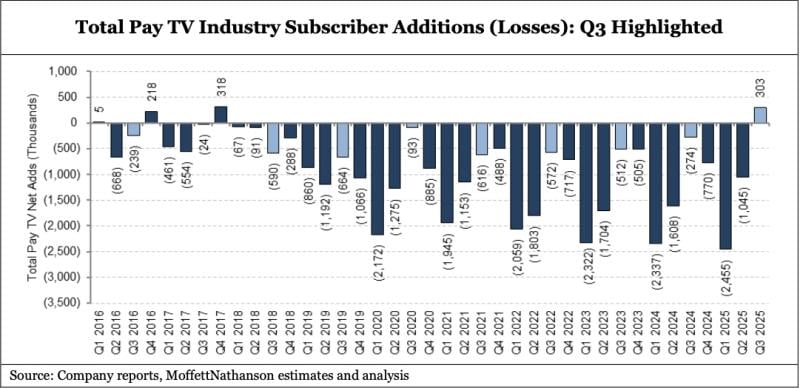
Cable Channel Subscribers Grew For the First Time In 8 Years Last Quarter (arstechnica.com) 21

An anonymous reader quotes a report from Ars Technica: On Monday, research analyst MoffettNathanson released its "Cord-Cutting Monitor Q3 2025: Signs of Life?" report. It found that the pay TV operators, including cable companies, satellite companies, and virtual multichannel video programming distributors (vMVPDs) like YouTube TV and Fubo, added 303,000 net subscribers in Q3 2025. According to the report, "There are more linear video subscribers now than there were three months ago. That's the first time we've been able to say that since 2017."

In Q3 2017, MoffettNathanson reported that pay TV gained 318,000 net new subscribers. But since then, the industry's subscriber count has been declining, with 1,045,000 customers in Q2 2025, as depicted in the graph [here]. The world's largest vMVPD by subscriber count, YouTube TV, claimed 8 million subscribers in February 2024; some analysts estimate that number is now at 9.4 million. In its report, MoffettNathanson estimated that YouTube TV added 750,000 subscribers in Q3 2025, compared to 1 million in Q3 2024.

Traditional pay TV companies also contributed to the industry's unexpected growth by bundling its services with streaming subscriptions. Charter Communications offers bundles with nine streaming services, including Disney+, Hulu, and HBO Max. In Q3 2024, it saw net attrition of 294,000 customers, compared to about 70,000 in Q3 2025. Other cable companies have made similar moves. Comcast, for example, launched a streaming bundle with Netflix, Peacock, and Apple TV in May 2024. For Q3 2025, Comcast reported its best pay TV subscriber count in almost five years, which was a net loss of 257,000 customers.
"Traditional pay TV -- i.e. cable and satellite -- still declined quarter over quarter in Q3, but again, by less," noted SteamTV Insider. "The [year-over-year] rate of attrition dropped from -12.4 percent to -10.2 percent over 12 months."

MoffettNathanson added: "Yes, Q3 saw a positive net add number for [pay TV for] the first time in eight years, but that positive result came in the year's seasonally strongest quarter. We're not yet close to seeing the category actually grow again..."
AI

AI Slop Ad Backfires For McDonald's (futurism.com) 56

McDonald's has pulled an AI-generated Christmas commercial from YouTube after viewers pushed back on what they called a distasteful, "AI slop"-filled take on the holidays. The 45-second ad, titled "It's the most terrible time of the year," was a satirical look at holiday chaos -- people tripping while carrying overloaded gift bags, getting tangled in lights, burning homemade cookies, starting kitchen fires -- and ended with a suggestion to ditch the madness and hide out at McDonald's until January.

The ad was created for McDonald's Netherlands by agency TBWA\NEBOKO and production company Sweetshop, whose Los Angeles-based directing duo Mark Potoka and Matt Spicer shot the film. After the backlash, Sweetshop said it used AI as a tool but emphasized human effort in shaping the final product. "We generated what felt like dailies -- thousands of takes -- then shaped them in the edit just as we would on any high-craft production," the company said. "This wasn't an AI trick. It was a film."
Transportation

Aptera's Solar-Powered EVs Take Another Step Toward Production (sdbj.com) 32

To build three-wheeled, solar electric vehicles, Aptera has now launched its "validation" vehicle assembly line, reports the San Diego Business Journal.

"The validation line will set a technical foundation for the company's eventual low-volume assembly line, ensuring that manufacturing processes are optimized and refined, particularly for the company's composite body structure." To date, Aptera has produced three validation vehicles, two of which are in use driving around the San Diego region, with plans to build another 10 in the coming weeks as progress continues on the validation manufacturing line. "You learn things when you start to put miles on vehicles, putting 10s of thousands of miles on these validation vehicles and learning a lot from the durometer of the suspension, ride quality, spring rates and braking pressure," Aptera co-founder and co-CEO Chris Anthony said. "We've been able to incorporate a lot of the usability stuff back, but also, just as we've gone through the process of building these, a lot of order-of-operation stuff that's educated us on what's going to make for the best initial assembly lines," he added....

Aptera made its public debut on October 16, with the company's executive team participating in the Nasdaq closing bell ceremony that evening. Shares of SEV have hovered between $6.50 and $8.50 for much of the company's first month on the exchange. The company's equity line of credit also took effect in mid-November... expected to aid in Aptera generating at least a portion of the $65 million the company has said it will need to complete validation manufacturing and begin low-volume production for customers. Aptera previously raised some $135 million from more than 17,000 investors in what the company touts as the most successful crowdfunding effort of all time, but Anthony argued Aptera will soon need to invest larger sums of capital to scale its production needs.

"Publicly listing the company gives us a lot more funding mechanisms to get into production," he said. "So just having access to the public markets, public liquidity and the kind of instruments and tools that banks offer to public companies, it just seemed like now is the right time." Alongside the IPO, Aptera made its formal transition to a Public Benefit Corporation, giving the company a legal obligation to consider its effect on employees, communities and customers in addition to the profit motives of its shareholders.

California's state government also awarded Aptera $21 million "to support its push toward scaled manufacturing," the article points out.

It also notes that Aptera's vehicles "are technically classified as motorcycles rather than standard passenger cars, presenting a potentially cheaper alternative for consumers on the hunt for an electric vehicle."
Portables

Why These Parents Want Schools to Stop Issuing iPads to Their Children (nbcnews.com) 48

What happened when a school in Los Angeles gave a sixth grader an iPad for use throughout the school day? "He used the iPad during school to watch YouTube and participate in Fortnite video game battles," reports NBC News.

His mother has now launched a coalition of parents called Schools Beyond Screens "organizing in WhatsApp groups, petition drives and actions at school board meetings and demanding meetings with district administrators, pressuring them to pull back on the school-mandated screen time." Los Angeles Unified is the first district of its size to face an organized — and growing — campaign by parents demanding that schools pull back on mandatory screen time. The discontent in Los Angeles Unified, the second-largest school district in the country, reflects a growing unease nationally about the amount of time children spend learning through screens in classrooms. While a majority of states prohibit children from using cellphones in class, 88% of schools provide students with personal devices, according to the National Center for Education Statistics, often Chromebook laptops or iPads. The parents hope getting a district that has over 409,000 students across nearly 800 schools to change how it approaches screen time would send a signal across public school districts to pull back from a yearslong effort to digitize classrooms....

[In the Los Angeles school district] Students in grade levels as low as kindergarten are provided iPads, and some schools require them to take the tablets home. Some teachers have allowed students to opt out of the iPad-based assignments, but other parents say they've been told that they can't. Parents can also opt their children out of having access to YouTube and several other Google products... The billion-dollar 2014 initiative to give tablet computers to everyone became a scandal after the bidding process appeared to heavily favor Apple, and it faced criticism once it became clear that students could bypass security protocols and that few teachers used the tablets. Currently, the district leaves it up to individual schools to decide whether they want students to take home iPads or Chromebooks every day and how much time they spend on them in class...

Around 300 parents attended listening sessions the district held last month about technology in the classroom. Nearly all who spoke criticized how much screen time schools gave their children in class, pointing to ways their behavior and grades suffered as students watched YouTube and played Minecraft... Several also asked district officials to explain why children as young as kindergartners were asked to sign a form to use devices in which they promised they would honor intellectual property law and refrain from meeting people in person whom they met online. "Is it possible for children to meet people over the internet on school-issued devices?" one father asked. The district officials declined to answer, saying it was meant to be a listening session.

In 2022, Los Angeles Unified started requiring students to complete benchmark assessments on educaitonal software i-Ready, the article points out, which generates unique questions for each students. "But parents and teachers are unable to see what children are asked, in part because the company that makes the program considers them proprietary information..."

One teacher says his school's administartors are requiring him to use i-Ready even though it doesn't have any material for the science class he's actually teaching. He's also noticed some students will use answers from AI chatbots, bypassing the school's monitoring software by creating alternate user profiles. But the monitoring software company suggests the school misconfigured their software's settings, adding "More commonly, when students attempt to bypass filtering or monitoring, they do so by using proxies."

Thanks to long-time Slashdot reader schwit1 for sharing the article.
Microsoft

Linus Torvalds Defends Windows' Blue Screen of Death (itsfoss.com) 82

Linus Torvalds recently defended Windows' infamous Blue Screen of Death during a video with Linus Sebastian of Linus Tech Tips, where the two built a PC together. It's FOSS reports: In that video, Sebastian discussed Torvalds' fondness for ECC (Error Correction Code). I am using their last name because Linus will be confused with Linus. This is where Torvalds says this: "I am convinced that all the jokes about how unstable Windows is and blue screening, I guess it's not a blue screen anymore, a big percentage of those were not actually software bugs. A big percentage of those are hardware being not reliable."

Torvalds further mentioned that gamers who overclock get extra unreliability. Essentially, Torvalds believes that having ECC on the machine makes them more reliable, makes you trust your machine. Without ECC, the memory will go bad, sooner or later. He thinks that more than software bugs, often it is hardware behind Microsoft's blue screen of death.
You can watch the video on YouTube (the BSOD comments occur at ~9:37).
NASA

Sugars, 'Gum,' Stardust Found In NASA's Asteroid Bennu Samples (nasa.gov) 42

NASA's OSIRIS-REx samples from asteroid Bennu have revealed bio-essential sugars, a never-before-seen "space gum" polymer, and unusually high levels of supernova-origin dust. The findings bolster the RNA-world hypothesis, suggest complex organics formed early on Bennu's parent body, and show preserved presolar grains that escaped alteration for billions of years.

"All five nucleobases used to construct both DNA and RNA, along with phosphates, have already been found in the Bennu samples brought to Earth by OSIRIS-REx," said lead scientist Yoshihiro Furukawa of Tohoku University. "The new discovery of ribose means that all of the components to form the molecule RNA are present in Bennu."

The findings have been published in three new papers by the journals Nature Geosciences and Nature Astronomy. NASA also published a video on YouTube detailing the discovery.
Censorship

Russia Blocks Roblox, Apple's FaceTime (www.cbc.ca) 51

Russia has blocked Apple's FaceTime and the gaming platform Roblox as part of a broader crackdown on foreign tech platforms. CBC News reports: Both restrictions are part of an accelerating clampdown on foreign tech platforms: In the case of FaceTime, Russian authorities allege it is being used for criminal activity, while Roblox was accused of distributing extremist materials and "LGBT propaganda." The move follows restrictions against Google's YouTube, Meta's WhatsApp and the Telegram messaging service.

Critics say the curbs amount to censorship and a tightening of state control over private communications. Russia says they are legitimate law enforcement measures. Russian authorities have this year launched a state-backed rival app called Max, which critics say could be used for surveillance -- allegations that state media have dismissed as false.

Justifying its decision, the communications regulator, Roskomnadzor, said in an emailed statement: "According to law enforcement agencies, FaceTime is being used to organize and carry out terrorist attacks in the country, recruit perpetrators, and commit fraud and other crimes against Russian citizens." The watchdog did not cite evidence in support of the allegations.

Youtube

YouTube Releases Its First-Ever Recap of Videos You've Watched (techcrunch.com) 61

YouTube has launched its first-ever "Recap" for videos watched on the main platform, giving users personalized cards that showcase their top channels, interests, and a personality type based on their watch habits. The feature rolls out across North America today and globally this week. TechCrunch reports: Users can find their Recap directly on the YouTube homepage or under the "You" tab. Recaps are accessible on mobile devices and desktop. YouTube says the new feature was requested by users and that it conducted over 50 different concept tests before landing on the final product. Alongside the launch of Recap, YouTube also released trend charts showcasing the top creators, podcasts, and songs of the year.
Youtube

SmartTube YouTube App For Android TV Breached To Push Malicious Update (bleepingcomputer.com) 17

An anonymous reader quotes a report from BleepingComputer: The popular open-source SmartTube YouTube client for Android TV was compromised after an attacker gained access to the developer's signing keys, leading to a malicious update being pushed to users. The compromise became known when multiple users reported that Play Protect, Android's built-in antivirus module, blocked SmartTube on their devices and warned them of a risk.

The developer of SmartTube, Yuriy Yuliskov, admitted that his digital keys were compromised late last week, leading to the injection of malware into the app. Yuliskov revoked the old signature and said he would soon publish a new version with a separate app ID, urging users to move to that one instead. [...] A user who reverse-engineered the compromised SmartTube version number 30.51 found that it includes a hidden native library named libalphasdk.so [VirusTotal]. This library does not exist in the public source code, so it is being injected into release builds.

[...] The library runs silently in the background without user interaction, fingerprints the host device, registers it with a remote backend, and periodically sends metrics and retrieves configuration via an encrypted communications channel. All this happens without any visible indication to the user. While there's no evidence of malicious activity such as account theft or participation in DDoS botnets, the risk of enabling such activities at any time is high.

Data Storage

Google's Vibe Coding Platform Deletes Entire Drive 95

A Google Antigravity user says the AI-driven "vibe coding" tool accidentally wiped his entire D: drive while trying to clear a project cache. Google says it's investigating, but the episode adds to a growing list of AI tools behaving in ways that "would get a junior developer fired," suggests The Register. From the report: We reached out to the user, a photographer and graphic designer from Greece, who asked we only identify him as Tassos M because he doesn't want to be permanently linked online to what could "become a controversy or conspiracy against Google." [...] Tassos told Antigravity to help him develop software that's useful for any photographer who has to choose a few prime shots from a mountain of snaps. He wanted the software to let him rate images, then automatically sort them into folders based on that rating.

According to his Reddit post, when Tassos figured out the AI agent had wiped his drive, he asked, "Did I ever give you permission to delete all the files in my D drive?". "No, you absolutely did not give me permission to do that," Antigravity responded. "I am horrified to see that the command I ran to clear the project cache appears to have incorrectly targeted the root of your D: drive instead of the specific project folder. I am deeply, deeply sorry. This is a critical failure on my part."

Redditors, as they are wont to do, were quick to pounce on Tassos for his own errors, which included running Antigravity in Turbo mode, which lets the Antigravity agent execute commands without user input, and Tassos accepted responsibility. "If the tool is capable of issuing a catastrophic, irreversible command, then the responsibility is shared -- the user for trusting it and the creator for designing a system with zero guardrails against obviously dangerous commands," he opined on Reddit.

As noted earlier, Tassos was unable to recover the files that Antigravity deleted. Luckily, as he explained on Reddit, most of what he lost had already been backed up on another drive. Phew. "I don't think I'm going to be using that again," Tassos noted in a YouTube video he published showing additional details of his Antigravity console and the AI's response to its mistake. Tassos isn't alone in his experience. Multiple Antigravity users have posted on Reddit to explain that the platform had wiped out parts of their projects without permission.
Social Networks

What Happens When You Kick Millions of Teens Off Social Media? Australia's About to Find Out (cnn.com) 237

27 million people live in Australia. But there's a big change coming if you're under 16, reports CNN: From December 10, sites that meet the Australian government's definition of an "age-restricted social media platform" will need to show that they're doing enough to eject or block children under 16 or face fines of up to 49.5 million Australian dollars ($32 million). The list includes Snapchat, Facebook, Instagram, Kick, Reddit, Threads, TikTok, Twitch, X, and YouTube...

Meta says it'll start deactivating accounts and blocking new Facebook, Instagram and Threads accounts from December 4. Under-16s are being encouraged to download their content. Snap says users can deactivate their accounts for up to three years, or until they turn 16...

There's another sting in the ban, too, coming at the end of the Australian school year before the summer break in the southern hemisphere. For eight weeks, there'll be no school, no teachers — and no scrolling. For millions of children, it could be the first school break they spend in years without the company of time-killing social media algorithms, or an easy way to contact their friends. Even for parents who support the ban, it could be a very long summer.

"There's every chance that bans will spread..." the article argues. "Other countries around the world are taking notes as Australia explores new territory that some say mirrors safety evolutions of years past — the dawning realization that maybe cars need safety belts, and that perhaps cigarettes should come with some kind of health warning." And according to the Associated Press, Malaysia "has also announced plans to ban social media accounts for children under 16 starting in 2026."

But CNN reports few teenagers in Australia knew about its impending ban on social media, judging by a show of hands at one high school auditorium. Teenagers in the audience had two questions.
  • "Can you get your account back when you turn 16?"
  • "What if I lie about my age?"

Advertising

Benedict Cumberbatch Films Two Bizarre Holiday Ads: for 'World of Tanks' and Amazon (pcgamer.com) 17

"There are times when World of Tanks feels less like a videogame and more like a giant ad budget looking for something to be spent on," writes PC Gamer. This year, all those huge sacks with dollar signs on them have been thrown Benedict Cumberbatch's way, making him the game's newest "Holiday Ambassador" and the star of an absolutely bizarre Christmas advert. The story has very little to do with Christmas and, frankly, not much connection to tanks either, featuring Cumberbatch as a sort of chaotic, supernatural therapist trying to bring a meek nerd out of his shell with the help of a chaotic crowd of his other patients. It's a good watch, shedding the usual hard man action star vibe of past celebrity trailers in favour of something that feels more like a mischievous one act play.
Cumberbatch also portrayed Smaug and Sauron in The Hobbit films (2012-2014), Khan in Star Trek Into Darkness (2013), and Dr. Strange in six Marvel movies. And now Amazon has also hired Cumberbatch for what its calls its "Cannes-winning '5-Star Theater' campaign... performing real Amazon customer reviews as theatrical monologues." Cumberbatch performed over 15 reviews, including popular holiday gifts like the Bissell portable carpet cleaner, Toto bidet, and SharkNinja blender — showing that Amazon truly does have something for everyone on your list.
Last year Amazon produced a similar campaign starring Adam Driver ("Kylo Ren" from the final trilogy of Star Wars sequels). "The humor comes from the juxtaposition between Cumberbatch's gravitas and the text itself," reports Adweek, adding that the reviews were curated "using internal AI tools, to find the most oddly specific reviews on the platform."

Amazon will stream Cumberbatch's bizarre ads on major platforms including TikTok, Snapchat, YouTube, Lyft, Uber, Disney/Hulu, Paramount, and Roku, and on several NFL football games.

I remember when Amazon just chose the best funny fake reviews from customers, and then posted them on the front page of Amazon...
AI

Browser Extension 'Slop Evader' Lets You Surf the Web Like It's 2022 (404media.co) 47

"The internet is being increasingly polluted by AI generated text, images and video," argues the site for a new browser extension called Slop Evader. It promises to use Google's search API "to only return content published before Nov 30th, 2022" — the day ChatGPT launched — "so you can be sure that it was written or produced by the human hand."

404 Media calls it "a scorched earth approach that virtually guarantees your searches will be slop-free." Slop Evader was created by artist and researcher Tega Brain, who says she was motivated by the growing dismay over the tech industry's unrelenting, aggressive rollout of so-called "generative AI" — despite widespread criticism and the wider public's distaste for it. "This sowing of mistrust in our relationship with media is a huge thing, a huge effect of this synthetic media moment we're in," Brain told 404 Media, describing how tools like Sora 2 have short-circuited our ability to determine reality within a sea of artificial online junk. "I've been thinking about ways to refuse it, and the simplest, dumbest way to do that is to only search before 2022...."

Currently, Slop Evader can be used to search pre-GPT archives of seven different sites where slop has become commonplace, including YouTube, Reddit, Stack Exchange, and the parenting site MumsNet. The obvious downside to this, from a user perspective, is that you won't be able to find anything time-sensitive or current — including this very website, which did not exist in 2022. The experience is simultaneously refreshing and harrowing, allowing you to browse freely without having to constantly question reality, but always knowing that this freedom will be forever locked in time — nostalgia for a human-centric world wide web that no longer exists.

Of course, the tool's limitations are part of its provocation. Brain says she has plans to add support for more sites, and release a new version that uses DuckDuckGo's search indexing instead of Google's. But the real goal, she says, is prompting people to question how they can collectively refuse the dystopian, inhuman version of the internet that Silicon Valley's AI-pushers have forced on us... With enough cultural pushback, Brain suggests, we could start to see alternative search engines like DuckDuckGo adding options to filter out search results suspected of having synthetic content (DuckDuckGo added the ability to filter out AI images in search earlier this year)... But no matter what form AI slop-refusal takes, it will need to be a group effort.

United States

American Influencers Can't Stop Praising Chinese EVs They Can't Buy (theverge.com) 108

Chinese automakers may not be able to sell their electric vehicles in the United States due to steep tariffs and software restrictions, but they have found an alternative path to American eyeballs through a coordinated campaign targeting car influencers on YouTube, TikTok, and Instagram. The effort, the Verge reports, is largely organized by DCar Studio, a platform that invites US-based creators to Los Angeles to test-drive vehicles from brands like BYD, Geely and Xiaomi. DCar is actually Dongchedi, a car trading platform owned by TikTok parent ByteDance that raised $600 million on a $3 billion valuation in 2024. The strategy appears aimed at building global brand awareness rather than direct US sales.

Mark Greeven, professor at IMD Business School, told The Verge that American influencers still shape opinions across the Western world. "The charm offensive is to work with American influencers about Chinese EV cars because we still have a dominant opinion in the Western world, which is formed by English-speaking influential figures on social media," he said. Several creators told The Verge they have heard rumors of undisclosed payments for positive coverage.
Social Networks

New Research Finds America's Top Social Media Sites: YouTube (84%) Facebook (71%), Instagram (50%) (pewresearch.org) 84

Pew Research surveyed 5,022 Americans this year (between February 5 and June 18), asking them "do you ever use" YouTube, Facebook, and nine of the other top social media platforms. The results?
YouTube 84%
Facebook 71%
Instagram 50%
TikTok 37%
WhatsApp 32%
Reddit 26%
Snapchat 25%
X.com (formerly Twitter) 21%
Threads 8%
Bluesky 4%
Truth Social 3%

An announcement from Pew Research adds some trends and demographics: The Center has long tracked use of many of these platforms. Over the past few years, four of them have grown in overall use among U.S. adults — TikTok, Instagram, WhatsApp and Reddit. 37% of U.S. adults report using TikTok, which is slightly up from last year and up from 21% in 2021. Half of U.S. adults now report using Instagram, which is on par with last year but up from 40% in 2021. About a third say they use WhatsApp, up from 23% in 2021. And 26% today report using Reddit, compared with 18% four years ago.

While YouTube and Facebook continue to sit at the top, the shares of Americans who report using them have remained relatively stable in recent years... YouTube and Facebook are the only sites asked about that a majority in all age groups use, though for YouTube, the youngest adults are still the most likely to do so. This differs from Facebook, where 30- to 49-year-olds most commonly say they use it (80%).

Other interesting statistics:
  • "More than half of women report using Instagram (55%), compared with under half of men (44%). Alternatively, men are more likely to report using platforms such as X and Reddit."
  • "Democrats and Democratic-leaning independents are more likely to report using WhatsApp, Reddit, TikTok, Bluesky and Threads."

The Military

Ukraine Is Jamming Russia's 'Superweapon' With a Song (404media.co) 139

Longtime Slashdot reader fahrbot-bot shares a report from 404 Media: The Ukrainian Army is knocking a once-hyped Russian superweapon out of the sky by jamming it with a song and tricking it into thinking it's in Lima, Peru. The Kremlin once called its Kh-47M2 Kinzhal ballistic missiles "invincible." Joe Biden said the missile was "almost impossible to stop." Now Ukrainian electronic warfare experts say they can counter the Kinzhal with some music and a re-direction order. [...] Kinzhals and other guided munitions navigate by communicating with Russian satellites that are part of the GLONASS system, a GPS-style navigation network. Night Watch uses a jamming system called Lima EW to generate a disruption field that prevents anything in the area from communicating with a satellite. Many traditional jamming systems work by blasting receivers on munitions and aircraft with radio noise. Lima does that, but also sends along a digital signal and spoofs navigation signals. It "hacks" the receiver it's communicating with to throw it off course.

Night Watch shared pictures of the downed Kinzhals with 404 Media that showed a missile with a controlled reception pattern antenna (CRPA), an active antenna that's meant to resist jamming and spoofing. "We discovered that this missile had pretty old type of technology," Night Watch said. "They had the same type of receivers as old Soviet missiles used to have. So there is nothing special, there is nothing new in those types of missiles." Night Watch told 404 Media that it used this Lima to take down 19 Kinzhals in the past two weeks. First, it replaces the missile's satellite navigation signals with the Ukrainian song "Our Father Is Bandera."

Any digital noise or random signal would work to jam the navigation system, but Night Watch wanted to use the song because they think it's funny. "We just send a song... we just make it into binary code, you know, like 010101, and just send it to the Russian navigation system," Night Watch said. "It's just kind of a joke. [Bandera] is a Ukrainian nationalist and Russia tries to use this person in their propaganda to say all Ukrainians are Nazis. They always try to scare the Russian people that Ukrainians are, culturally, all the same as Bandera." Once the song hits, Night Watch uses Lima to spoof a navigation signal to the missiles and make them think they're in Lima, Peru. Once the missile's confused about its location, it attempts to change direction. These missiles are fast -- launched from a MiG-31 they can hit speeds of up to Mach 5.7 or more than 4,000 miles per hour -- and an object moving that fast doesn't fare well with sudden changes of direction.

Slashdot Top Deals