Google

Google's Pixel Watch 4 Has a Big Focus On AI (theverge.com) 8

An anonymous reader quotes a report from The Verge's Victoria Song: The original Pixel Watch was late to the game. For years, there had been rumors of a Google smartwatch that never materialized. Then, when it finally arrived, it was a quintessential first-gen device, with thicc bezels, dismal battery life, and a host of quirks that needed ironing out. My DMs were full of people wondering when the watch would be unceremoniously dumped into Google's infamous product graveyard. A part of me wondered if Google was going to spend the next decade playing catch-up. Fast forward to 2025, and I'm holding the Pixel Watch 4 at Google's office in New York City. On the surface (and my wrist), it doesn't look like much has changed. But after fiddling with a few menus, watching some demos, and talking over the updates, it's evident that Google has a clear vision about where smartwatches are going. [...]

Starting with hardware, the Pixel Watch 4 has a new domed "Actua 360" display -- as in, the display itself, not just the glass, is also domed. What this translates to is about 10 percent more visible screen space, 15 percent thinner bezels, and a 50 percent increase in maximum brightness to 3,000 nits. On a table, there's a lineup of the Pixel Watch 2, 3, and 4 with the flashlight app turned on. Side-by-side, the improvements are striking. Material 3 Expressive in Wear OS 6also helps emphasize the Pixel Watch's roundness. (No squircles here, folks.) The widgets have more rounded edges, and each screen has been redesigned to be more glanceable, fitting more complications. It's not Liquid Glass, but there are subtle animations when flitting through menus that call your attention to the Pixel Watch's rain droplet-inspired design. Altogether, it's a design tweak that makes senseandis aesthetically pleasing. Google also says battery life has improved. The 41mm watch gets an estimated 30 hours on a single charge, while the 45mm gets 40 hours. That can stretch up to two days in battery saver mode for the smaller watch and three days for the larger one. I couldn't test that at a hands-on, but I did get to see the improved fast charging in action.

As with theGalaxy Watch 8, Gemini has a big presence on the Pixel Watch 4. It replaces Google Assistant and is capable of more complex queries -- even if none have been able to blow my mind yet. But, in a bid to make interacting with Gemini as smooth as possible, the speaker and haptic engines have also been updated so you can hear and interact more easily. There's also a new raise-to-talk gesture that lets you speak to Gemini without having to use the wake word. The processor has been upgraded to the Snapdragon W5 Gen 2 to enable more on-device AI features, as well, like smart replies. On the Pixel Watch 4, you'll get more smart reply options to texts that refer to the content of your conversations. They're not confined to the default Messages app, either. But the major AI update this time around is a Gemini-powered health coach that's slated to arrive alongside a revamped Fitbit app in October. ... The gist is the health coach will act more like a personal trainer than a Captain Obvious summary generator. If you sleep poorly, it'll adjust workout suggestions. (This is also why Google is also introducing an improved sleep algorithm.) You can tell it that you've been injured, and that too will be taken into consideration when generating weekly fitness plans. [...]

Another big first is the Satellite SOS mode. If you're without your phone and in a remote area with no signal, you can still call emergency services. (So long as you have the LTE version of the watch.) The big thing here is that there's no extra subscription cost. The watch will also feature more accurate dual-frequency GPS -- a nice update given that I've had issues with the Pixel Watch's GPS maps in the past.
The Pixel Watch 4 is priced at $349.99 and is available for pre-order now.
Microsoft

Microsoft Readies Big Feature Updates For Next Month and Beyond (windowscentral.com) 43

Windows 11 users will receive significant UI refinements and AI improvements starting next month as Microsoft prepares its September feature drop followed by additional updates through fall. The update, Windows Central reports, will bring customizable lock screen widgets globally after months of European exclusivity, photo grid views in Windows Search, and a redesigned Windows Hello authentication interface.

Copilot+ PCs will gain a revamped Recall application with workflow suggestions and File Explorer AI integration through Click To Do. October and November releases will introduce a larger, customizable Start menu allowing removal of the Recommended section and expanded dark mode support for legacy File Explorer dialogs.
Wine

Wine 10.13 Released 16

Wine 10.13 has been released after a one-month break, introducing a Windows Gaming Input configuration tab for the Joystick Control Panel, new ECDSA_P521 and ECDH_P521 cryptographic algorithms, OpenGL WoW64 thunk generation, and expanded Windows Runtime metadata support. The update also delivers 32 bug fixes," which is more than normal given the month of time between releases," writes Phoronix's Michael Larabel. "There are fixes for Microsoft Office 365, Microsoft SQL Server Management Studio Express, Doom 3 BFG Edition, and a variety of other game and application fixes."

You can download and learn more about the release at WineHQ.org GitLab.
Operating Systems

Another Linux Distro Is Shutting Down (neowin.net) 48

An anonymous reader writes: Kaisen Linux, a Debian-based distro packed with tools for sysadmins, system rescue, and network diagnostics, is shutting down. This comes not long after Intel's Clear Linux also reached the end of the road.

Kaisen offered multiple desktop environments like KDE Plasma, LXQt, MATE, and Xfce, plus a "toram" mode that could load the whole OS into RAM so you could free up your USB port. The final release, Rolling 3.0, updates the base to Debian 13, defaults to KDE Plasma 6, replaces LightDM with SDDM, drops some packages like neofetch and hping3, and adds things like faster BTRFS snapshot restores, full ZFS support, and safer partitioning behavior.

Unlike Clear Linux, Kaisen will still get security updates for the next two years, giving current users time to migrate without rushing.

AI

Google Releases Pint-Size Gemma Open AI Model (arstechnica.com) 12

An anonymous reader quotes a report from Ars Technica: Google has announced a tiny version of its Gemma open model designed to run on local devices. Google says the new Gemma 3 270M can be tuned in a snap and maintains robust performance despite its small footprint. [...] Running an AI model locally has numerous benefits, including enhanced privacy and lower latency. Gemma 3 270M was designed with these kinds of use cases in mind. In testing with a Pixel 9 Pro, the new Gemma was able to run 25 conversations on the Tensor G4 chip and use just 0.75 percent of the device's battery. That makes it by far the most efficient Gemma model.

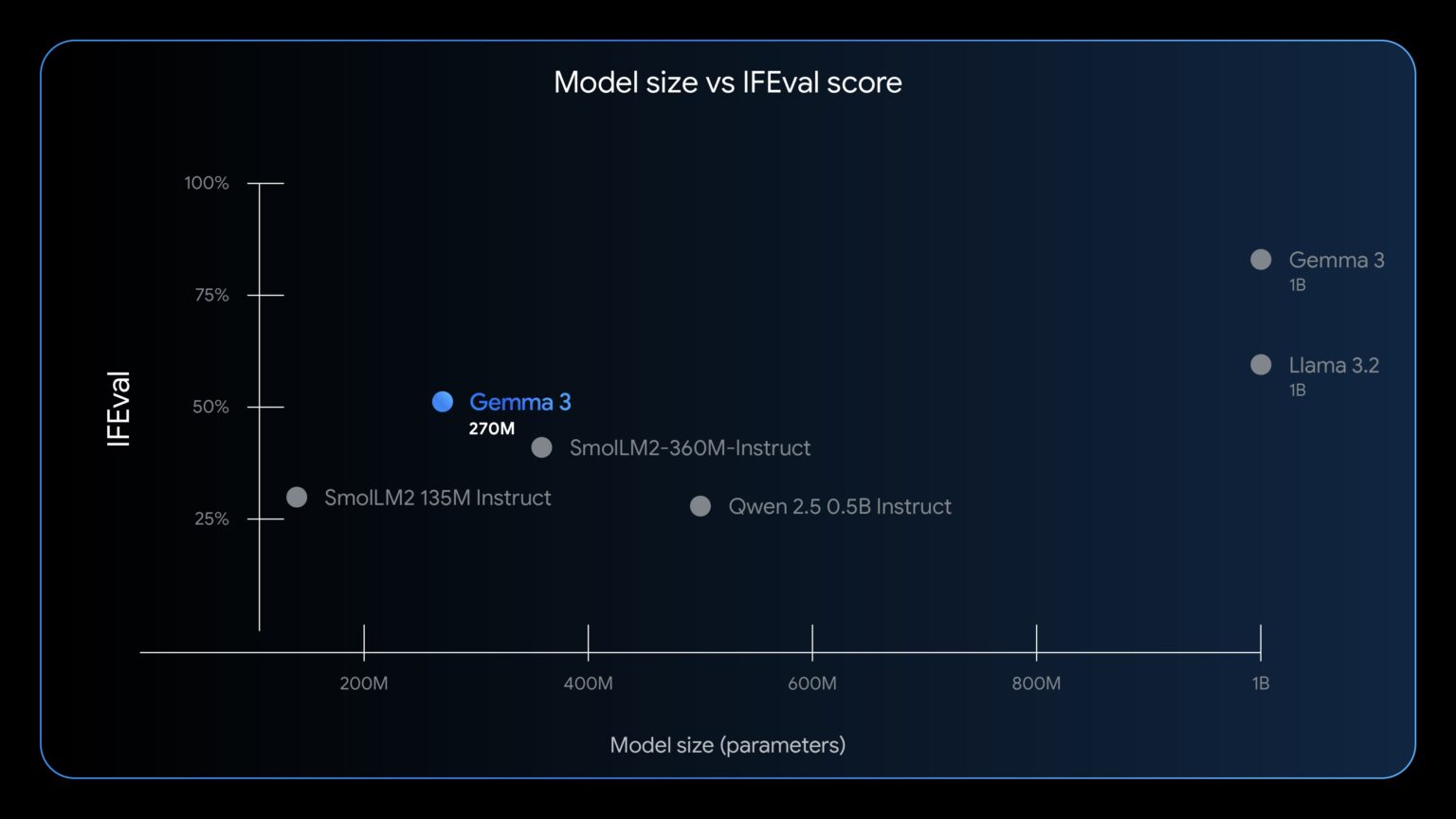
Developers shouldn't expect the same performance level of a multi-billion-parameter model, but Gemma 3 270M has its uses. Google used the IFEval benchmark, which tests a model's ability to follow instructions, to show that its new model punches above its weight. Gemma 3 270M hits a score of 51.2 percent in this test, which is higher than other lightweight models that have more parameters. The new Gemma falls predictably short of 1 billion-plus models like Llama 3.2, but it gets closer than you might think for having just a fraction of the parameters.

Google claims Gemma 3 270M is good at following instructions out of the box, but it expects developers to fine-tune the model for their specific use cases. Due to the small parameter count, that process is fast and low-cost, too. Google sees the new Gemma being used for tasks like text classification and data analysis, which it can accomplish quickly and without heavy computing requirements. You can download the new Gemma for free, and the model weights are available. There's no separate commercial licensing agreement, so developers can modify, publish, and deploy Gemma 3 270M derivatives in their tools.
You can download Gemma 3 270M from Hugging Face and Kaggle in both pre-trained and instruction-tuned versions.
Windows

Microsoft Says Voice Will Emerge as Primary Input for Next Windows (youtube.com) 138

The next version of Windows will become "more ambient, pervasive, and multi-modal" as AI transforms how users interact with computers, Microsoft's Windows chief Pavan Davuluri said in a company video. Davuluri, Corporate Vice President and head of Windows, said that voice will emerge as a primary input method alongside keyboard and mouse, with the operating system gaining context awareness to understand screen content and user intent through natural language.

Windows interfaces, he said, will appear fundamentally different within five years as the platform becomes increasingly agentic. The transformation will rely on both local processing power and cloud computing capabilities to deliver seamless experiences where users can speak to their computers while simultaneously typing or inking.
KDE

KDE's 'Other' Distro - KDE Linux - Now Available To Download In Pre-Alpha (theregister.com) 28

"KDE Linux is an all-new desktop Linux distro being developed as a showcase for the KDE desktop project," reports The Register.

"The project is still in a pre-alpha testing stage, but recently went public on the KDE website. Versions are available to download and try out." KDE Linux is an entirely new and experimental OS. There's lots of room for confusion here, because KDE already has a demonstration distro, KDE Neon. KDE Linux is a totally separate and far more ambitious project. In terms of its underlying design, it's intended to be a super-stable end-user distro. This is in contrast with Neon, which is an experimental showcase for the latest and greatest code. Neon isn't meant to be anyone's daily driver...

Several aspects of [KDE Linux's] design are clearly influenced by Valve's SteamOS 3. Like SteamOS 3, KDE Linux is an immutable distro, with dual read-only Btrfs-format root partitions that update each other alternately... KDE Linux isn't based on Ubuntu or Debian. It's built using Arch Linux, but it's different enough that it doesn't really count as an Arch variant. As an immutable distro, there's no package manager, for instance, so the user can't install Arch packages... You can only install sandboxed apps that go in their own corner of the OS, and here the plan is that users will install Flatpak (and possibly Snap, "if it's not too hard and the UX is OK") packages using the KDE Discover app store. Aside from them, you won't be able to update individual packages. OS updates come as a whole new system image, with all components updated at once.

"This is intended to one day be a bulletproof daily driver, not a demo system, which is the intended purpose of KDE Neon..." the article concludes.

And while their test of current work-in-progress/test version kept crashing, "the promise is considerable, and this could turn out to be one of the most radical end-user distros out there."

Thanks to Slashdot reader king*jojo for sharing the news.
Google

Google Ending Steam for Chromebook Support in 2026 (9to5google.com) 11

Google will discontinue Steam for Chromebook Beta on January 1, 2026, removing all installed games from devices after that date. The beta launched in March 2022 as an alpha before expanding to beta status in November 2022 with reduced hardware requirements of Intel Core i3 or AMD Ryzen 3 processors and 8GB RAM. The program never progressed beyond beta testing despite supporting 99 compatible Linux-based titles through its three-year run.
Operating Systems

Linux Desktop Share Tops 6% In 15 Million-System Analysis (zdnet.com) 62

An anonymous reader quotes a report from ZDNet: In an interview, Lansweeper, an IT asset discovery and inventory company, revealed to ZDNET that, in its analysis of over 15 million identified consumer desktop operating systems, it found that Linux desktops currently account for just over 6% of PC market share. This news comes after several other studies have shown the Linux desktop is right around the 6% mark. Indeed, according to the US Federal Government Website and App Analytics count, the Linux desktop market share over the last 90 days has reached 6.3%, a new high. In July, according to StatCounter, the Linux desktop also set a record high by its metrics with 5.24%.
Data Storage

RIP To the Macintosh HD Hard Drive Icon, 2000-2025 (arstechnica.com) 93

An anonymous reader quotes a report from Ars Technica: Apple released a new developer beta build of macOS 26 Tahoe today, and it came with another big update for a familiar icon. The old Macintosh HD hard drive icon, for years represented by a facsimile of an old spinning hard drive, has been replaced with something clearly intended to resemble a solid-state drive (the SSD in your Mac actually looks like a handful of chips soldered to a circuit board, but we'll forgive the creative license).

The Macintosh HD icon became less visible a few years back, when new macOS installs stopped showing your internal disk on the desktop by default. It has also been many years since Apple shifted to SSDs as the primary boot media for new Macs. It's not clear why the icon is being replaced now, instead of years ago -- maybe the icon had started clicking, and Apple just wanted to replace it before it suffered from catastrophic icon failure -- but regardless, the switch is logical (this is a computer storage pun).
Apple's iconic Macintosh HD hard drive icon was first introduced in a 2000 Mac OS X beta and remained largely unchanged for over two decades, with only subtle updates in 2012 and 2014.

The first SSD-equipped Mac was in 2008, "when the original MacBook Air came out," notes Ars. "By the time 'Retina' Macs began arriving in the early 2010s, SSDs had become the primary boot disk for most of them; laptops tended to be all-SSD, while desktops could be configured with an SSD or a hybrid Fusion Drive that used an SSD as boot media and an HDD for mass storage. Apple stopped shipping spinning hard drives entirely when the last of the Intel iMacs went away."
Windows

Microsoft Teases the Future of Windows as an Agentic OS 127

An anonymous reader shares a report: Microsoft has published a new video that appears to be the first in an upcoming series of videos dubbed "Windows 2030 Vision," where the company outlines its vision for the future of Windows over the next five years. It curiously makes references to some potentially major changes on the horizon, in the wake of AI.

This first episode features David Weston, Microsoft's Corporate Vice President of Enterprise & Security, who opens the video by saying "the world of mousing and keyboarding around will feel as alien as it does to Gen Z [using] MS-DOS."

Right out of the gate, it sounds like he's teasing the potential for a radical new desktop UX made possible by agentic AI. Weston later continues, "I truly believe the future version of Windows and other Microsoft operating systems will interact in a multimodal way. The computer will be able to see what we see, hear what we hear, and we can talk to it and ask it to do much more sophisticated things."
Operating Systems

New Steam on Linux Market Share Stats 'Likely the Largest Surveyed Figure Ever' (phoronix.com) 38

"The July 2025 results of the Steam Survey were posted a few minutes ago," Phoronix reported last night, "and show a healthy 0.32% increase to put the Linux gaming marketshare at 2.89%." That's a recent high in percentage terms and while Steam saw around 3% in the early days of Steam on Linux a decade ago, in absolute terms this is likely the largest surveyed figure ever for the Linux gaming population.

Linux was at 2.89% for July while macOS was at 1.88% and Windows at 95.23%.

There does seem to be a jagged line that's trending upward...

November: 2.03%
December: 2.29%
January: 2.06%
February: 1.45%
March: 2.33%
April: 2.27%
May: 2.69%
June: 2.57%
July: 2.89%
Windows

Microsoft Is Killing Windows 11 SE, Its Chrome OS Rival (windowscentral.com) 31

Microsoft has discontinued Windows 11 SE, its education-focused operating system designed for low-cost school PCs. The company confirmed that Windows 11 SE will not receive the upcoming version 25H2 update and support will end in October 2026, including security updates and technical assistance.

Launched in 2021 as a Chrome OS competitor, Windows 11 SE featured artificial limitations like reduced multitasking capabilities and restricted app installation to create a simplified experience for students. The discontinuation leaves Microsoft without a dedicated lightweight Windows edition for the education market, where Chromebooks have gained significant popularity over the past decade.
Operating Systems

Linux 6.16 Brings Faster File Systems, Improved Confidential Memory Support, and More Rust Support (zdnet.com) 50

ZDNet's Steven Vaughan-Nichols shares his list of "what's new and improved" in the latest Linux 6.16 kernel. An anonymous reader shares an excerpt from the report: First, the Rust language is continuing to become more well-integrated into the kernel. At the top of my list is that the kernel now boasts Rust bindings for the driver core and PCI device subsystem. This approach will make it easier to add new Rust-based hardware drivers to Linux. Additionally, new Rust abstractions have been integrated into the Direct Rendering Manager (DRM), particularly for ioctl handling, file/GEM memory management, and driver/device infrastructure for major GPU vendors, such as AMD, Nvidia, and Intel. These changes should reduce vulnerabilities and optimize graphics performance. This will make gamers and AI/ML developers happier.

Linux 6.16 also brings general improvements to Rust crate support. Crate is Rust's packaging format. This will make it easier to build, maintain, and integrate Rust kernel modules into the kernel. For those of you who still love C, don't worry. The vast majority of kernel code remains in C, and Rust is unlikely to replace C soon. In a decade, we may be telling another story. Beyond Rust, this latest release also comes with several major file system improvements. For starters, the XFS filesystem now supports large atomic writes. This capability means that large multi-block write operations are 'atomic,' meaning all blocks are updated or none. This enhances data integrity and prevents data write errors. This move is significant for companies that use XFS for databases and large-scale storage.

Perhaps the most popular Linux file system, Ext4, is also getting many improvements. These boosts include faster commit paths, large folio support, and atomic multi-fsblock writes for bigalloc filesystems. What these improvements mean, if you're not a file-system nerd, is that we should see speedups of up to 37% for sequential I/O workloads. If your Linux laptop doubles as a music player, another nice new feature is that you can now stream your audio over USB even while the rest of your system is asleep. That capability's been available in Android for a while, but now it's part of mainline Linux.

If security is a top priority for you, the 6.16 kernel now supports Intel Trusted Execution Technology (TXT) and Intel Trusted Domain Extensions (TDX). This addition, along with Linux's improved support for AMD Secure Encrypted Virtualization and Secure Memory Encryption (SEV-SNP), enables you to encrypt your software's memory in what's known as confidential computing. This feature improves cloud security by encrypting a user's virtual machine memory, meaning someone who cracks a cloud can't access your data.
Linux 6.16 also delivers several chip-related upgrades. It introduces support for Intel's Advanced Performance Extensions (APX), doubling x86 general-purpose registers from 16 to 32 and boosting performance on next-gen CPUs like Lunar Lake and Granite Rapids Xeon. Additionally, the new CONFIG_X86_NATIVE_CPU option allows users to build processor-optimized kernels for greater efficiency.

Support for Nvidia's AI-focused Blackwell GPUs has also been improved, and updates to TCP/IP with DMABUF help offload networking tasks to GPUs and accelerators. While these changes may go unnoticed by everyday users, high-performance systems will see gains and OpenVPN users may finally experience speeds that challenge WireGuard.
Android

Say Goodbye To Your Custom ROMs As Samsung's One UI 8 Kills Bootloader Unlock (sammobile.com) 32

Samsung's new One UI 8 update has quietly disabled the ability to unlock the bootloader on all Galaxy devices globally, ending the custom ROM and kernel era for Android enthusiasts. While most users won't notice, the developer community sees this as a major blow to modding freedom -- one that could potentially raise regulatory concerns within the EU. SamMobile reports: A new report highlights evidence found in the Galaxy S25 One UI 8 beta builds that the bootloader unlock option has been removed. A similar change has also been confirmed on the Galaxy Z Fold 7 and Z Flip 7 which are running stable versions of One UI 8. A deep dive into the stable version's code has also confirmed that regardless of the region, the bootloader unlock option will not be available on devices running One UI 8. The enthusiast community won't like it.

They won't be able to use custom ROMs to update devices when the official software support runs out or use custom kernels to extract more performance. However, with most Samsung phones now offering seven years of Android OS upgrades, one can argue that the utility of this capability is not as significant as it once was.

Technology

Pebble Is Officially Pebble Again (theverge.com) 12

Pebble smartwatches are officially reclaiming their iconic name after Core Devices CEO Eric Migicovsky successfully recovered the Pebble trademark. "Great news -- we've been able to recover the trademark for Pebble! Honestly, I wasn't expecting this to work out so easily," Core Devices CEO Eric Migicovsky writes in an update blog. "Core 2 Duo is now Pebble 2 Duo. Core Time 2 is now Pebble Time 2." The Verge reports: As a refresher, Pebble was one of the OG smartwatches. Despite a loyal customer base, however, it wasn't able to compete with bigger names like Fitbit, the Apple Watch, or Samsung. In 2016, Pebble was acquired by Fitbit for $23 million, marking the end of the first Pebble era. Along the way, Fitbit was acquired by Google. That's important because the tech giant agreed to open-source Pebble's software, and Migicovsky announced earlier this year that Pebble was making a comeback. However, because Migicovsky didn't have the trademark, the new Pebble watches were initially dubbed the Core 2 Duo and the Core Time 2.

"With the recovery of the Pebble trademark, that means you too can use the word Pebble for Pebble related software and hardware projects," Migicovsky writes, acknowledging Pebble's history of community development.

Operating Systems

Apple Releases Public Betas of Its New Software Updates With Liquid Glass (theverge.com) 29

Apple has released the first public betas of its upcoming operating systems with its new design language called Liquid Glass. The list of new betas includes iOS 26, iPadOS 26, macOS Tahoe 26, watchOS 26, and tvOS 26. The Verge's Jay Peters reports: The design language is inspired by visionOS and, as the name implies, features a lot of transparency. I felt it was a wild change to my iPhone when I tried the first developer beta, and Apple has already tweaked some of the translucency and changed how Control Center looks in subsequent betas.

The new operating systems also have an updated numbering scheme: they now all end with 26, taking cues from how the car industry names its cars after the following year. It's a simpler and better system, if you ask me, and it should make it easier to know if you're on the newest software.

Open Source

Intel Kills Clear Linux OS As Support Ends Without Warning (nerds.xyz) 95

BrianFagioli shares a report from NERDS.xyz: Intel has quietly pulled the plug on Clear Linux OS, officially ending support for the once-promising Linux distribution that it had backed for nearly a decade. Effective immediately, the company says it will no longer provide any updates, security patches, or maintenance for the operating system. In a final blow, the Clear Linux OS GitHub repository is now archived in read-only mode.

The move was announced with little fanfare, and for users still relying on Clear Linux OS, there's no sugarcoating it... you need to move on. Intel is urging everyone to migrate to an actively maintained Linux distribution as soon as possible to avoid running unpatched software.
"Rest assured that Intel remains deeply invested in the Linux ecosystem, actively supporting and contributing to various open-source projects and Linux distributions to enable and optimize for Intel hardware," the company said in a statement. "A heartfelt thank you to every developer, user, and contributor who helped shape Clear Linux OS over the last 10 years. Your feedback and contributions have been invaluable."
Open Source

Linux Reaches 5% On Desktop (ostechnix.com) 150

Longtime Slashdot reader bobdevine shares a report from OSTechNix: For the first time, Linux has officially broken the 5% desktop market share barrier in the United States of America! It's a huge milestone for open-source and our fantastic Linux community. While many might think of Linux as a niche choice, this new data shows a significant shift is happening.

According to the latest StatCounter Global Stats for June 2025, Linux now holds 5.03% of the desktop operating system market share in the United United States of America. This is fantastic news! [...] One truly satisfying detail for me? Linux has finally surpassed the "Unknown" category in the USA! It shows that our growth is clear and recognized.
"It took eight years to go from 1% to 2% (by April 2021), then just 2.2 years to reach 3% (June 2023), and a mere 0.7 years to hit 4% (February 2024)," notes the report. "Now, here we are, at over 5% in the USA! This exponential growth suggests that we're on a promising upward trend."
Firefox

'Firefox is Fine. The People Running It are Not' (theregister.com) 150

"Firefox is dead to me," wrote Steven J. Vaughan-Nichols last month for The Register, complaining about everything from layoffs at Mozilla to Firefox's discontinuation of Pocket and Fakespot, its small market share, and some user complaints that the browser might be becoming slower. But a new rebuttal (also published by The Register) argues instead that Mozilla just has "a management layer that doesn't appear to understand what works for its product nor which parts of it matter most to users..."

"Steven's core point is correct. Firefox is in a bit of a mess — but, seriously, not such a bad mess. You're still better off with it — or one of its forks, because this is FOSS — than pretty much any of the alternatives." Like many things, unfortunately, much of computing is run on feelings, tradition, and group loyalties, when it should use facts, evidence, and hard numbers. Don't bother saying Firefox is getting slower. It's not. It's faster than it has been in years. Phoronix, the go-to site for benchmarks on FOSS stuff, just benchmarked 21 versions, and from late 2023 to now, Firefox has steadily got faster and faster...

Ever since Firefox 1.0 in 2004, Firefox has never had to compete. It's been attached like a mosquito to an artery to the Google cash firehose... Mozilla's leadership is directionless and flailing because it's never had to do, or be, anything else. It's never needed to know how to make a profit, because it never had to make a profit. It's no wonder it has no real direction or vision or clue: it never needed them. It's role-playing being a business. Like we said, don't blame the app. You're still better off with Firefox or a fork such as Waterfox. Chrome even snoops on you when in incognito mode...

One observer has been spectating and commentating on Mozilla since before it was a foundation — one of its original co-developers, Jamie Zawinksi... Zawinski has repeatedly said: "Now hear me out, but What If...? browser development was in the hands of some kind of nonprofit organization?"

"In my humble but correct opinion, Mozilla should be doing two things and two things only:

— Building THE reference implementation web browser, and
— Being a jugular-snapping attack dog on standards committees.
— There is no 3."


Perhaps this is the only viable resolution. Mozilla, for all its many failings, has invented a lot of amazing tech, from Rust to Servo to the leading budget phone OS. It shouldn't be trying to capitalize on this stuff. Maybe encourage it to have semi-independent spinoffs, such as Thunderbird, and as KaiOS ought to be, and as Rust could have been. But Zawinski has the only clear vision and solution we've seen yet. Perhaps he's right, and Mozilla should be a nonprofit, working to fund the one independent, non-vendor-driven, standards-compliant browser engine.

Slashdot Top Deals