Robotics

Submission + - Linux for Navy Drone Ground Stations (suasnews.com)

garymortimer writes: "Raytheon will help the U.S. Navy transition to using Linux software at ground control stations for unmanned air vehicles, the Defense Department announced Wednesday.

The company’s intelligence and information systems unit won a $27,883,883 contract to implement the tactical control system software, used for directing vertical take-off UAVs."

Networking

Ask Slashdot: Enterprise-Grade Linux Networking Hardware? 140

An anonymous reader writes "In spite of Linux's great networking capabilities, there seems to be a shortage of suitable hardware for building an enterprise-grade networking platform. I've had success on smaller projects with the Soekris offerings but they are suboptimal for large-scale deployment due to their single-board non-redundant design (eg., single power supply, lack of backup 'controller'). What is the closest thing to a modular Linux-capable platform with some level of hardware redundancy and substantial bus/backplane throughput?"
Input Devices

Is Microsoft's Kinect a Gaming Failure? 130

MojoKid writes "E3 is well underway in Los Angeles, and Microsoft has already made a major splash with its 'SmartGlass' technology, game demos, and its announcement that a Kinect-powered version of Internet Explorer will debut on the Xbox 360. This is a marked change from last year, when Kinect was the unquestioned centerpiece of Microsoft's display and the company's demos focused on how Kinect-powered games used your full body as a controller. Kinect is in the interesting position of having sold extremely well while failing to move the bar forward in any of the ways Microsoft projected in the run up to its launch. Scroll through the ratings on Kinect-required titles, and the percentages are abysmal. Kinect's biggest problem is rooted in ergonomics. Gamepads with buttons may be crude approximations of real life, but they're simple and intuitive. They're also flexible — a great many games have conditional scenarios that allow the same button to perform different functions depending on what's going on within the game. Pure Kinect games don't have a simple mechanism to incorporate these features, and there's no easy way around them. The motion-controller's most enduring features may ultimately be its capabilities outside the gaming sphere."
Displays

John Carmack Is Building a Virtual Reality Headset 118

An anonymous reader writes "John Carmack, co-founder of id Software, is using his spare time to develop a modern virtual reality headset. After purchasing such a device last year, Carmack became frustrated with how slowly the technology has progressed over the past twenty years. So, he decided to push it forward himself. PCGamer reports that he's been showing off his prototype behind closed doors at E3 this year, and has an interview with him about the problems with VR and the technical challenges he needs to overcome. They even get a look at the prototype itself, which is currently held together with duct tape."
Displays

Submission + - John Carmack Is Building a Virtual Reality Headset (pcgamer.com)

An anonymous reader writes: John Carmack, co-founder of id Software, is using his spare time to develop a modern virtual reality headset. After purchasing such a device last year, Carmack became frustrated with how slowly the technology has progressed over the past twenty years. So, he decided to push it forward himself. PCGamer reports that he's been showing off his prototype behind closed doors at E3 this year, and has an interview with him about the problems with VR and the technical challenges he needs to overcome.
Transportation

Solar Impulse Completes First Intercontinental Solar Flight 56

An anonymous reader writes "Slashdotters may remember the Solar Impulse — the world's first 100% solar-powered airplane — from last year when it made its public debut. Today the airplane made news again as it successfully completed the world's first solar-powered intercontinental flight — a pivotal step that paves the way for the plane's first trip around the world in 2014."
Power

Submission + - Solar Impulse Completes First Solar Intercontinental Flight (solarimpulse.com)

An anonymous reader writes: Slashdotters may remember the Solar Impulse — the world's first 100% solar-powered airplane — from last year when it made its public debut. Today the Solar Impulse made news again as it successfully completed the world's first solar-powered intercontinental flight — a pivotal step that paves the way for the plane's first trip around the world in 2014.
Networking

Submission + - Ask Slashdot: Enterprise-grade linux networking hardware. (slashdot.org)

An anonymous reader writes: In spite of linux's great networking capabilities, there seems to be a shortage of suitable hardware for building an enterprise-grade networking platform. I've had success on smaller projects with the Soekris offerings but they are suboptimal for large-scale deployment due to their single-board non-redundant design (eg., single power supply, lack of backup 'controller'). What is the closest thing to a modular linux-capable platform with some level of hardware redundancy and substantial bus/backplane throughput?
Earth

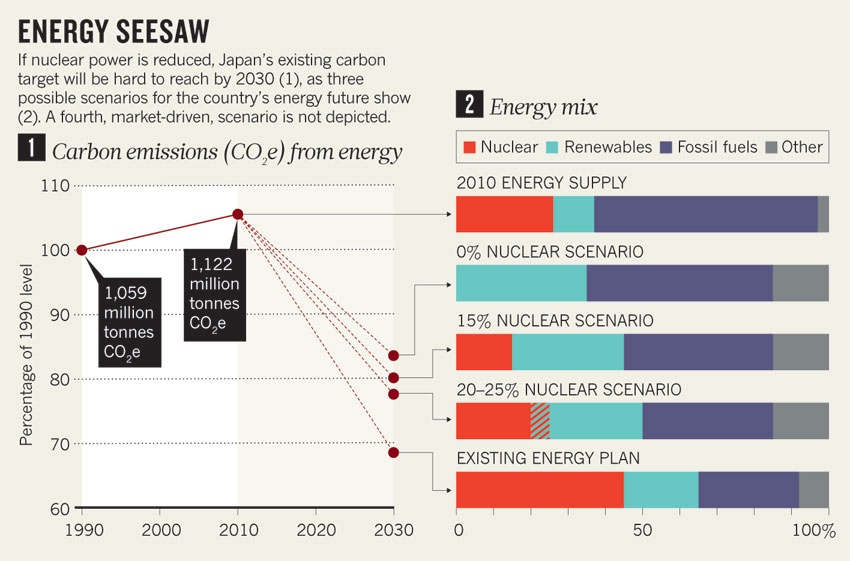
Committee Offers Scenarios for Japan's Energy Future 131

ananyo writes with a story about more concrete plans for a reduced or nuclear-free energy future for Japan. From the article: "It's official: nuclear power will have a much smaller role in Japan's energy future than was once thought. Since the meltdowns and gas explosions at the Fukushima Daiichi nuclear power station in March 2011, all of Japan's remaining reactors have been shut down for inspections and maintenance. The government offered a glimpse of their future, and that of the country's nuclear power in general, when it published an outline of four ways to satisfy Japan's future energy demands. One scenario recommends using a market mechanism to determine the nuclear contribution. Under the other three, nuclear power would supply at most one-quarter of Japan's energy by 2030 — and in one case, none at all. The scenarios come from a 25-person advisory committee to the industry ministry. The sharp reductions in the nuclear power part of the country's energy mix mean that Japan will struggle to reach the 31% reduction in carbon dioxide emissions that it had planned by 2030 (PDF)."
Cellphones

Buttons That Morph Out of Your Touchscreen 134

kkleiner writes "Wouldn't it be awesome if our tablets and smartphones could have buttons that morphed out of the touchscreen, and then went away again when we didn't need them? It sounds like magic, but now it is reality. Created by Tactus Technology, a Fremont, California-based start-up, Tactus is a deformable layer that sits on top of a touchscreen sensor and display. 'The layer is about 0.75mm to 1mm thick, and at its top sits a deformable, clear layer 200 nm thick. Beneath the clear layer a fluid travels through micro-channels and is pushed up through tiny holes, deforming the clear layer to create buttons or shapes. The buttons or patterns remain for however long they are needed, just for a few seconds or for hours when you’re using your iPad to write that novel. And because the fluid is trapped inside the buttons, they can remain for however long without additional power consumption. They come or go pretty quickly, taking only a second to form or disappear.'"
Networking

Netflix Launches Its Own Content Delivery Network 117

1sockchuck writes "Netflix has launched its own content delivery network to manage data delivery for its streaming video service. ISPs can choose to host caching appliances in their data centers, or peer with Netflix at Internet Exchanges. 'Netflix will provide either form of access at no cost to the ISP,' it said. As part of Open Connect, Netflix is sharing its hardware appliance design and the open source software components of the server. Does this mean Armageddon for the CDNs currently serving Akamai? Not really, according to analysts, citing the leverage Netflix had in dealing with providers."
Networking

Australian Company Promises Switching Hardware With Sub-130ns Latency 77

snowdon writes "The race for low-latency in finance and HPC has taken a major turn. A bunch of engineers from Australia have 'thrown away the air conditioning' in a traditional switch, to get a 10G fibre-to-fibre latency of less than 130ns! Way faster than more traditional offerings. This lady (video) would tell you that it's equivalent to just 26m of optical fibre. Does that mean we just lose money faster?"
Open Source

Submission + - Netflix Launches its own Content Delivery Network (netflix.com)

1sockchuck writes: Netflix has launched its own content delivery network to manage data delivery for its streaming video service. ISPs can choose to host caching appliances in their data centers, or peer with Netflix at Internet Exchanges. "Netflix will provide either form of access at no cost to the ISP," it said. As part of Open Connect, Netflix is sharing its hardware appliance design and the open source software components of the server. Does this mean Armageddon for the CDNs currently serving Akamai? Not really, according to analysts, citing the leverage Netflix had in dealing with providers.
Windows

Asus Announces x86 Transformer 203

MrSeb writes with the scoop on Asus's new Transformer tablet/laptop devices: "If you've ever looked at an Asus Transformer and wished that it was slightly bigger, had an x86 processor, and ran Windows, I have good news: At Computex in Taiwan, Asus has unveiled just that. Dubbed the Transformer Book, this isn't some wimpy Atom-powered thing either: This Transformer will ship with a range of Ivy Bridge Core i3/5/7 processors and discrete Nvidia graphics. Like its Android-powered predecessors, the Transformer Book is a touchscreen tablet computer that plugs into keyboard docking station, effectively becoming a laptop (or ultrabook, if you prefer). Rounding out the specs, the Transformer Book will come in a range of models (11.6, 13, and 14 inches), your choice of SSD or HDD, up to 4GB of RAM. All three models will have an IPS display capable of full HD (1920×1080). There's a webcam on the front of the tablet portion of the Transformer, and a 5-megapixel shooter on the back. There's no mention of wireless connectivity, but presumably there's Bluetooth and WiFi; on the wired side, there seems to be only a single micro-HDMI socket (on the tablet), and a USB socket (on the keyboard/dock). On the software side, the Transformer Book will of course run Windows 8. It all sounds great — but Asus kept one tiny tidbit out of its presentation: battery life." Aside from the Nvidia graphics (which, from the looks of it, can be disabled for the on-chip output), perhaps this could be the first "tablet" capable of running fully Free Software? (UEFI evil aside).

Slashdot Top Deals