Power

World Energy Hits a Turning Point: Solar That's Cheaper Than Wind (bloomberg.com) 220

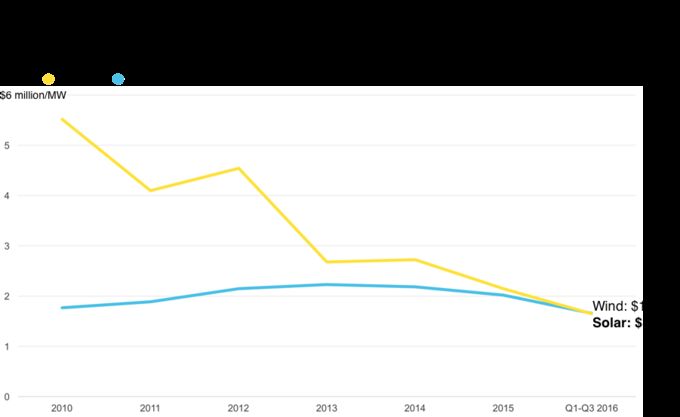
A transformation is happening in global energy markets that's worth noting as 2016 comes to an end: Solar power, for the first time, is becoming the cheapest form of new electricity. From a report on Bloomberg: This has happened in isolated projects in the past: an especially competitive auction in the Middle East, for example, resulting in record-cheap solar costs. But now unsubsidized solar is beginning to outcompete coal and natural gas on a larger scale, and notably, new solar projects in emerging markets are costing less to build than wind projects, according to fresh data from Bloomberg New Energy Finance. The chart shows the average cost of new wind and solar from 58 emerging-market economies, including China, India, and Brazil. While solar was bound to fall below wind eventually, given its steeper price declines, few predicted it would happen this soon.
Desktops (Apple)

A $300 Device Can Steal Mac FileVault2 Passwords (bleepingcomputer.com) 88

An anonymous reader writes: Swedish hardware hacker Ulf Frisk has created a device that can extract Mac FileVault2 (Apple's disk encryption utility) passwords from a device's memory before macOS boots and anti-DMA protections kick in. The extracted passwords are in cleartext, and they also double as the macOS logon passwords. The attack requires physical access, but it takes less than 30 seconds to carry out. A special device is needed, which runs custom software (available on GitHub), and uses hardware parts that cost around $300. Apple fixed the attack in macOS 10.12.2. The device is similar to what Samy Kamker created with Poison Tap.
The Almighty Buck

Apple Will Charge You $69 To Replace a Lost AirPod (macrumors.com) 253

Apple's AirPods finally went on sale earlier this week after being announced in September and delayed in October. Now that people are able to actually purchase these wireless earphones for $159, many are wondering what happens if they lose an AirPod. Apple has recently updated its repair and replacement costs for AirPods on its iPhone Service Pricing Page, mentioning a $69 fee for those who need to replace an AirPod or charging case. Mac Rumors reports: Apple doesn't appear to be offering AppleCare+ for AirPods, instead providing a standard one-year warranty that's available on all Apple products. If the AirPods need service during that one year period, all work will be covered for free. After the one-year warranty has expired, Apple will charge a $69 fee for out-of-warranty service repairs. Battery service for AirPods that lose battery capacity is free during the one-year warranty period or $49 out of warranty. If you lose or damage one of the AirPods or the charging case, Apple will charge $69 for a replacement, regardless of whether or not the AirPods are still under warranty. The pricing in Apple's support document is U.S. pricing, and will vary based on country.
AI

Google May Prevent Samsung From Adding Viv AI Assistant To Galaxy S8 (ibtimes.co.uk) 60

New submitter drunkdrone quotes a report from International Business Times: Samsung is reported to be equipping its upcoming Galaxy S8 flagship with all manner of technical marvels in its attempt to erase the Note 7 catastrophe from memory. However, Google may throw a wrench into the works by potentially prohibiting Samsung from imbuing the phone with one of its most compelling features (Warning: source may be paywalled; alternate source) -- its AI personal assistant. Reports have suggested that Samsung planned to load the Galaxy S8 with Viv, a smartphone-based digital assistant similar to Apple's Siri and Google Assistant. Because of an ongoing non-compete pact between Samsung and Google, however, Samsung may be forced to exclude Viv from its upcoming flagship as would challenge Google's digital helper. The report adds: "According to Recode, the restriction forms part of a patent-sharing agreement Samsung signed with Google in 2014. While the pact will allow the two companies to put up a stronger, united front against Apple, it may hinder Samsung's ambitions for independence and its attempts to differentiate itself from the wider Android crowd."
Android

Verizon Changes Its Mind and Will Kill Samsung's Galaxy Note 7 on January 5th (theverge.com) 96

Verizon has just announced that it plans to roll out Samsung's upcoming Note 7 update, which permanently stops the recalled smartphone from charging and disables its wireless radios, on January 5th. Only last week, the leading US carrier took a controversial stance when it said it would "not be taking part in this update because of the added risk this could pose to Galaxy Note 7 users that do not have another device to switch to." From a report on The Verge: The company was particularly concerned about nuking the Note 7 during the holiday travel season, something that its US rivals also seemed to take into consideration when scheduling a roll-out date for the update. AT&T is waiting until the very same day. Sprint will release it on January 8th. And T-Mobile's going first among major US carriers on December 27th. Verizon still seems to think it's making the right decision pushing things off a bit for the same reasons. "We want to make sure you can contact family, first responders, and emergency medical professionals during the holiday travel season."
Businesses

Fitbit Won't Kill Off Pebble Services At Least Until 2018 (thenextweb.com) 33

Earlier this week, Fitbit announced that it was buying up the assets of smartwatch maker Pebble, and a lot of questions still exist around exactly how Pebble's existing products will work. Today a member of Pebble's developer team attempted to address some of those questions. From a report on The Next Web: In a blog post, it noted that it will keep Pebble software and services running through 2017. Jon Barlow, who was previously on Pebble's Developer Evangelist team and is now part of Fitbit's transition effort, wrote: "To be clear, no one on this freshly-formed team seeks to brick Pebble watches in active service. The Pebble SDK, CloudPebble, Timeline APIs, firmware availability, mobile apps, developer portal, and Pebble appstore are all elements of the Pebble ecosystem that will remain in service at this time. Pebble developers are welcome to keep creating and updating apps. Pebble users are free to keep enjoying their watches."
Earth

Iceland Seeking 'Supercritical Steam' For Power Source (bbc.com) 160

New submitter FatdogHaiku writes: Already getting over 25% of its electrical power from geothermal sources, Iceland hopes to break new ground using "supercritical steam" from a 5 km deep borehole. Is it just me, or does this sound like the start of a movie where everything that can go wrong does in fact go wrong? It's not like they are new to the tech, but working with geologic sources at 450C to ~600C is a new ball game for anyone. It should be noted that Iceland also uses direct geothermal for most of its space heating. "In this area at Reykjanes, we typically drill to 2km or 3km depth to harness the steam, to run power plants and produce clean, renewable electricity," explained Asgeir Margeirsson, CEO of the Iceland Deep Drilling Project (IDDP). "We want to see if the resources go deeper than that." The "supercritical steam" holds more energy than a liquid or a gas. The team wants to bring it up to the surface to convert into electricity, as they believe it could produce up to 10 times as much energy as the steam from conventional geothermal wells.
United States

California To Adopt First US Energy-Saving Rules For Computers (reuters.com) 171

California regulators were poised on Wednesday to adopt the nation's first mandatory energy efficiency rules for computers and monitors -- devices that account for 3 percent of home electric bills and 7 percent of commercial power costs in the state. From a report on Reuters: The state Energy Commission said that when fully implemented, the plan will save consumers $373 million a year and conserve as much electricity annually as it takes to power all San Francisco's homes. Final approval of the standards, expected at a meeting in Sacramento of the five-member commission, caps a nearly two-year planning process that had input from environmentalists, industry, scientists and consumer groups. The Natural Resources Defense Council (NRDC), an environmental group that helped devise the standards, has said the new standards would cut greenhouse gas emissions from fossil fuel combustion in power generation by 700,000 tons a year. The California standards set a benchmark for a machine's overall energy use and leave manufacturers the flexibility to choose which efficiency measures to use to meet it -- an approach that the NRDC says fosters innovation.
Sony

150 Filmmakers and Photojournalists Call On Nikon, Sony, and Canon To Build in Encryption (zdnet.com) 229

Some of the world's leading photojournalists and filmmakers are calling on the manufacturers of the cameras they use to add encryption to their products, as the number of threats they face from having their devices seized is "literally too high to count." From a ZDNet report: Over 150 documentary makers and reporters signed an open letter by the Freedom of the Press Foundation, asking for camera makers -- including Nikon, Sony, and Canon -- to ensure that their work is protected while often "attempting to uncover wrongdoing in the interests of justice." "Documentary filmmakers and photojournalists work in some of the most dangerous parts of the world, often risking their lives to get footage of newsworthy events to the public," said Trevor Timm, the foundation's executive director. But, he said, "they face a variety of threats from border security guards, local police, intelligence agents, terrorists, and criminals when attempting to safely return their footage so that it can be edited and published." The filmmakers say that camera security has lagged behind the rest of the industry, leaving their work "dangerously vulnerable."
United States

First Offshore Wind Farm In US Waters Delivers Power To Rhode Island (arstechnica.com) 196

An anonymous reader quotes a report from Ars Technica: On Monday, energy company Deepwater Wind announced that its wind farm three miles off the coast of Block Island, Rhode Island, has the all-clear to sell electricity to the regional power grid. The Block Island Wind Farm is the first offshore wind energy plant in the U.S., and it's expected to produce 30 MW of electricity at full capacity. Deepwater Wind is slowly ramping up energy output and still must provide additional paperwork to the Rhode Island Coastal Resources Management Council, but the executive director of that organization, Grover Fugate, told the Providence Journal, "we don't anticipate any major issues" to getting the wind farm fully online. The one hitch in the Deepwater's plan is that one of the five turbines was recently damaged when a drill bit was left in a critical part of turbine. According to the Providence Journal, "the bit had caused damage to an unspecified number of the 128 magnet modules that line the circular generator and are critical to producing energy." Although the magnet modules can apparently be replaced easily, Deepwater needs to have the components shipped from France, where General Electric, the manufacturer of the wind turbines, makes them. For now, four turbines capable of churning out 6 MW of power each are operational. The Providence Journal notes that National Grid will pay Deepwater Wind 24.4 cents per kilowatt hour of power, with the price escalating over time to 47.9 cents per kilowatt hour. Because the residents of Block Island have some of the most expensive electricity rates in the nation, they will actually see energy savings, despite the price. Mainland Rhode Islanders, on the other hand, will pay an extra $1.07 per month on average.
Businesses

Oculus CEO Brendan Iribe Steps Down, Will Now Lead PC-Focused VR Team Within Facebook (uploadvr.com) 12

The co-founder and CEO of Oculus, Brendan Iribe, is stepping down from the company he helped create with Palmer Luckey over four years ago in Irvine, California. Iribe writes in a statement to UploadVR: "We've decided to establish new PC and mobile VR groups to be more focused, strengthen development and accelerate our roadmap. Looking ahead and thinking about where I'm most passionate, I've decided to lead the PC VR group -- pushing the state of VR forward with Rift, research and computer vision. As we've grown, I really missed the deep, day-to-day involvement in building a brand new product on the leading edge of technology. You do your best work when you love what you're working on. If that's not the case, you need to make a change. With this new role, I can dive back into engineering and product development. That's what gets me up every day, inspired to run to work." UploadVR adds: When we asked Oculus PR what this meant for Max Cohen, the current Head of Mobile at Oculus, we were told that, "he's still focused on mobile and growing the mobile ecosystem on Jon's team." After publication, Oculus PR also informed us of how this affects the roles of Nate Mitchell, VP of Product, and Michael Abrash, Cheif Scientist, upon further inquiry: "Nate will be leading Rift, on Brendan's PC VR team. Michael Abrash still leads Oculus Research on Brendan's team. When asked about John Carmack, CTO, and Michael Antonov, Chief Software Architect, Oculus PR informed us that, "they are both still at Oculus and they work on the mobile team. Michael Antonov is leading the Carmel and ReactVR effort today."
AMD

AMD Unveils First Zen Desktop Processor Details, Picks 'Ryzen' To Brand Zen CPU (hothardware.com) 113

MojoKid writes from a report via HotHardware: AMD has just officially unveiled that desktop variants of its Zen processor family will now be branded RYZEN. Zen-based processors will eventually target desktops, servers, and mobiles device, but the first wave of products will be targeted at the performance desktop market, where gamers and VR continue to spur growth. AMD is positioning RYZEN as a high-performance option and though there will be other core configurations as well, AMD has disclosed that one of the high-end options in the initial RYZEN line-up will feature 8 cores (16 threads with SMT) and at minimum a 3.4 GHz base clock, with higher turbo frequencies. That processor will also be outfitted with 20MB of cache -- 4MB of L2 and 16MB of L3 -- and it will be infused with what AMD is calling SenseMI technology. SenseMI is essentially fancy branding for the updated branch predictor, prefetcher, and power and control logic in Zen. AMD's upcoming AM4 platform for RYZEN will be outfitted with all of the features expected of a modern PC enthusiast platform. AM4 motherboards will use DDR4 memory and feature PCIe Gen 3 connectivity, and support for USB 3.1 Gen 2, NVMe, and SATA Express. Performance demos of RYZEN shown to members of the press pit a stock Intel Core i7-6900K (3.2GHz base, 3.7GHz turbo) with Turbo Boost that was enabled on the 6900K, versus RYZEN with boost disabled running at 3.4GHz flat. In the demo, the RYZEN system outpaced the Core i7-6900K by a few seconds.
Communications

Feds Unveil Rule Requiring Cars To 'Talk' To Each Other (thehill.com) 292

An anonymous reader quotes a report from The Hill: The Obama administration released a long-awaited rule on Tuesday requiring all new vehicles to have communication technology that allows them to "talk" to each another, which officials say could prevent tens of thousands of crashes each year. The proposal calls for all new light-duty cars and trucks to eventually be equipped with vehicle-to-vehicle (V2V) technology, a safety system that enables cars to send wireless signals to each other, anticipate each other's moves and thus avoid crashes. The rule would require 100 percent of new vehicle fleets to have V2V technology within four years of the final rule's enactment. The proposal will be open for public comment for 90 days. The connected vehicle rule builds on previous work by the outgoing administration to accelerate the deployment of innovative safety technology. The Department of Transportation released the first-ever federal guidelines for driverless cars in September. "We are carrying the ball as far as we can to realize the potential of transportation technology to save lives," said Transportation Secretary Anthony Foxx. "This long-promised V2V rule is the next step in that progression. Once deployed, V2V will provide 360-degree situational awareness on the road and will help us enhance vehicle safety." Officials say V2V has the potential to mitigate 80 percent of non-impaired crashes and can interact with other crash avoidance systems, like automatic braking. V2V uses dedicated short-range radio communications to exchange messages about a car's speed, direction and location. The system uses that information from other vehicles to identify potentials risks and warn its driver. A pair of Democratic senators called on the agency to ensure that vehicles have "robust" cybersecurity and privacy protections in place before automakers deploy V2V.
Portables (Apple)

Apple Removes the 'Time Remaining' Battery Indicator In New macOS Update (loopinsight.com) 164

Apple has removed the "time remaining" battery life indicator with the new macOS Sierra update following complaints from several users of new MacBook Pro models. Apple says it stands by its 10-hour battery life claim in the new MacBook Pro models, and adds that the battery life indicator didn't show accurate information. From a report on The Loop: You can still see the image on the top of the screen, and you can see the percentage, but you will no longer be able to see how much time is remaining before your battery dies. [...] Apple said the percentage is accurate, but because of the dynamic ways we use the computer, the time remaining indicator couldn't accurately keep up with what users were doing. Everything we do on the MacBook affects battery life in different ways and not having an accurate indicator is confusing. Besides the apps we are working on all the time, there are a lot of things that are happening in the background that users may not be aware of that affects battery life.
Android

Android Things Is Google's New OS For Smart Devices (theverge.com) 30

Google wants to put Android in the next wave of smart devices that'll be vying to fill up your home. It's launching a version of Android today called Android Things that can run on products like connected speakers, security cameras, and routers. A report adds: The OS is supposed to make it easier for companies to start shipping hardware, since they'll be able to work with the Android dev tools they already know. Android Things is a new name, but the operating system itself isn't strictly new. It's basically an update and a rebranding to Brillo, an Android-based OS for smart devices and Internet of Things products announced a little more than a year and a half ago. Brillo has -- publicly, at least -- gone close to nowhere. It was more or less a no-show at CES last year, and there's been little mention of it since. But today's rebranding marks a key update meant to make developing a product with this operating system much easier. Unlike Brillo, development on Android Things can be accomplished with "the same developer tools as standard Android," according to Google. The hope is that experienced developers will be able to quickly get up to speed and start work on a new product.ArsTechnica has more details.
Businesses

Apple Warns Of Counterfeit Power Adapters and Batteries Following Lawsuit (9to5mac.com) 101

Following a lawsuit revealed back in October in which Apple exposed an issue with a large percentage of fake Apple adapters being marketed as "genuine" online, today the company has posted an official warning to customers. From a report on 9to5Mac: The message, posted on the front page of the company's support webpage, warns customers that counterfeit power adapters and batteries could pose safety issues. The company also offers customers that might have had a recent battery replacement the option to bring in their devices to an Apple Store or authorized service provider to check if the battery is genuine.
Earth

Rapid Rise In Methane Emissions In 10 Years Surprises Scientists (theguardian.com) 293

An anonymous reader quotes a report from The Guardian: Emissions of the powerful greenhouse gas methane have surged in the past decade, threatening to thwart global attempts to combat climate change. Scientists have been surprised by the surge, which began just over 10 years ago in 2007 and then was boosted even further in 2014 and 2015. Concentrations of methane in the atmosphere over those two years alone rose by more than 20 parts per billion, bringing the total to 1,830ppb. This is a cause for alarm among global warming scientists because emissions of the gas warm the planet by more than 20 times as much as similar volumes of carbon dioxide. In the meantime, emissions of carbon dioxide -- the main component of manmade greenhouse gases in the atmosphere -- have been leveling off. The new research, published in the peer-review journal Environmental Research Letters, suggests that the world's attempts to control greenhouse gases have failed to take account of the startling rises in methane. The authors of the 2016 Global Methane Budget report found that in the early years of this century, concentrations of methane rose by only about 0.5ppb each year, compared with 10ppb in 2014 and 2015. The scientists speculate that agriculture may be the main source of the additional methane that has been recorded. However, they cannot be sure of all the sources, owing to a lack of monitoring. At least a third of methane comes from the exploitation of fossil fuels, including fracking and oil drilling and some coal mining, where methane is viewed as a waste gas and is frequently allowed to escape or, in some cases, flared off, which is less harmful. Unlike carbon dioxide emissions, however, which have been tracked in various ways since the 1950s, emissions of methane are poorly understood and could represent a threat that scientists have still not accounted for.
Power

Fossil Fuel Divestment Has Doubled In the Last 15 Months (vice.com) 263

An anonymous reader quotes a report from Motherboard: A little over a year ago, it was big news that thousands of people and hundreds of institutions controlling more than $2.6 trillion in total assets had pledged to remove their investments from stocks, mutual funds, and bonds that invest in fossil fuel companies. A year later, that number has doubled. According to a report by DivestInvest, a philanthropy helping to lead the movement, more than 688 institutions and 60,000 individual investors worth $5.2 trillion have pulled their investments from fossil fuel companies and have reinvested a portion of their assets into clean energy companies. In September 2015, 436 institutions and 2,040 individuals worth $2.6 trillion had divested. For comparison, the total net worth of investors who had pulled out of the fossil fuel market was just $52 billion in September 2014. Divestment is increasingly seen as one of the stronger moves that private citizens and companies can take to support the move to clean energy. The movement started in earnest in 2011 when college students began petitioning their institutions to remove their assets from stocks, bonds, and mutual funds that invest in fossil fuel companies. What was seen as a gimmick at the time appears to be gaining real momentum a year after the Paris Climate Treaty was signed.
The Almighty Buck

Panasonic's New Shopping System Automatically Bags, Tallies Your Bill (techcrunch.com) 88

The Wall Street Journal is reporting (Warning: paywalled; alternate source) that Panasonic is "introducing convenience-store checkout machines that can scan and bag items on their own, joining Amazon.com Inc. in the push for more retail automation." The machines will also tally up the total amount owed at checkout so that all you have to do is pay. TechCrunch reports: Last week, Amazon revealed its own more frictionless convenience store pilot, with a location that lets shoppers simply walk out with whatever they want to purchase, for which they're charged automatically via their Amazon account. The Panasonic system uses tags applied to the goods you pick up to tally the cost as you shop, and then automatically bags your selections via a trap-door in the counter that accepts your basket when you're ready to go. It could help with lines, and could also help address some of the issues with current self-checkout system, which require a user to scan their own items to find out their bill prior to paying. That added step may seem small, but it actually causes a lot of headaches and hangups, especially with shoppers who aren't so comfortable with tech. Panasonic's setup is already in use at a Lawson convenience store near its Osaka HQ, but the broader rollout is still a while off.
XBox (Games)

Xbox One Games Arrive On Oculus Rift With New Streaming App (theverge.com) 16

Microsoft has released its Xbox One streaming app to the Oculus Store today, allowing Xbox One owners to stream games to their Oculus Rift virtual-reality headset via a Windows 10 PC. The Verge reports: The app itself looks just like the Windows 10 version of Xbox streaming, with the ability to select different consoles on a network before streams are launched. Microsoft has also added the ability to open the Xbox One guide and control the orientation of games in the virtual environment. If you're interested in streaming Xbox One games to the Oculus Rift then you'll need a Windows PC to take advantage of the streaming, and games will be streamed directly from a console that's powered on and not in use. The Xbox streaming app is available immediately in the Oculus Store. The streaming app is a far cry from full VR gaming, but the app will let you simulate playing games on a large screen in a virtual environment. "Whether you're taking on Gears of War 4, Forza Horizon 3, or any other Xbox One game, you'll be able to play in three different environments from the start -- each titled 'Citadel,' 'Retreat,' and 'Dome,'" reports Windows Central.

Slashdot Top Deals