Amiga

Commodore's Amiga Is Being Revived In Newly Updated Hardware (hothardware.com) 94

MojoKid writes from a report via Hot Hardware: Although it has been over three decades since the first Commodore Amigas were originally released, a fan base for the beloved systems is still going strong. In fact, today's Amiga community seems to be more active now that it has been in years, and a number of exciting new hardware projects have cropped up in recent weeks. Two relatively new projects, led by popular members of the Amiga community Paul Rezendes and John "Chucky" Hertell, are designed to breathe new life into the Amiga 4000 and Amiga 1200.

Both men set out to reverse engineer the motherboards for these systems, not only to continue the possibility of repairing existing machines that are prone to serious damage from leaky batteries and electrolytic capacitors, but to potentially spur additional customizations for the platform in the future. Though Paul and John have only made minor modifications to the Amiga 4000 and Amiga 1200 motherboard PCBs to this point, the possibility now also exists for all new variants to arrive at some point in the future for these machines as well. The first actual working motherboards populated with components based on the Amiga 4000 Replica project or Re-Amiga 1200 haven't been shown off just yet, and they may require additional revisions to work out any kinks. However, both projects are good examples of the passion that still remains for the beloved Amiga from computing glory days gone by.

Printer

HP Will Give You $10,000 To Hack Your Printer (zdnet.com) 75

hyperclocker shares a report: HP hopes to entice researchers with a $10,000 reward for finding vulnerabilities in printers. The tech giant revealed the new bug bounty program on Tuesday. The scheme, which is launching as a private bug bounty, is tailored specifically for HP printer hardware. While many of us use home printers simply for printing the occasional document or photo, in the enterprise, these devices are often found in a network. If there is a weak link in business networks, a single device -- whether it be a printer or smart air conditioning system -- can be exploited to compromise a wider network system.

Printers, especially if they are overlooked when it comes to firmware updates or upgrades, can become such avenues to exploit. According to research undertaken by Bugcrowd, "2018 State of Bug Bounty Report," endpoint devices are becoming a tantalizing target for threat actors, with a 21 percent increase in total endpoint bugs reported over the past 12 months. In partnership with bug bounty platform Bugcrowd, HP says it is the "only vendor" to launch a printer-only vulnerability disclosure scheme. Under the terms of the program, researchers can earn between $500 and $10,000 per legitimate find.

Google

Chromebooks Don't Suffer From Bad User Experiences Found on Windows and Mac Computers, Google Says (aboutchromebooks.com) 185

Kevin C. Tofel, writing for About Chromebooks: Having worked for a Google Chrome Marketing team over an 18 month period, I never saw a project that aggressively goes after Windows and Mac computers like the one that was published today [Editor's note: the video is unlisted, but accessible]. [...] As someone who has used (and often still does use) other platforms, I can't really disagree with the point of this video. For too long, computer users have had to deal with cryptic errors, updates that can take hours to install and the dreaded blue screen of death / spinning beach ball.

Granted, some of my personal experience with those issues was when I was in corporate IT for 15 years; that career ended for me (by choice) back in 2007. And clearly, all desktop / laptop platforms have improved since then. Even so, Google is highlighting the modern approach of Chromebooks with this short video and that's an important point.

Businesses

Logitech Is Acquiring Blue Microphones For $117 Million In Cash (theverge.com) 79

Logitech announced late Monday night that it is acquiring Blue Microphones for $117 million. The company known for USB condenser microphones, such as the Snowball and Yeti, will join Logitech's existing portfolio of brands. The Verge reports: Founded in 1995, Blue sells microphones that range in price from $60 to over $4,000 (for studio-grade hardware), and they're used by podcasters, musicians, and any other consumers who need higher-fidelity audio than what they get from the built-in microphones on their devices. Now, after dropping a heap of cash on the company, Logitech will do its best to make sure Blue's devices become just as essential as its own wireless keyboards and mice. "For Logitech, this is a new space," the company wrote in a blog post. "But, at the same time, it's not at all. Gamers are already using our Logitech G webcams to stream. People are video calling with friends and family thanks to Logitech every day. And in business, our audio and video know-how is apparent every time a video meeting takes place at the office. Joining up with Blue and their microphone lines is a logical adjacent opportunity with great synergies."
Robotics

OpenAI's Dactyl System Gives Robots Humanlike Dexterity (venturebeat.com) 22

An anonymous reader quotes a report from VentureBeat: In a forthcoming paper ("Dexterous In-Hand Manipulation"), OpenAI researchers describe a system that uses a reinforcement model, where the AI [known as Dactyl] learns through trial and error, to direct robot hands in grasping and manipulating objects with state-of-the-art precision. All the more impressive, it was trained entirely digitally, in a computer simulation, and wasn't provided any human demonstrations by which to learn. The researchers used the MuJoCo physics engine to simulate a physical environment in which a real robot might operate, and Unity to render images for training a computer vision model to recognize poses. But this approach had its limitations, the team writes -- the simulation was merely a "rough approximation" of the physical setup, which made it "unlikely" to produce systems that would translate well to the real world. Their solution was to randomize aspects of the environment, like its physics (friction, gravity, joint limits, object dimensions, and more) and visual appearance (lighting conditions, hand and object poses, materials, and textures). This both reduced the likelihood of overfitting -- a phenomenon that occurs when a neural network learns noise in training data, negatively affecting its performance -- and increased the chances of producing an algorithm that would successfully choose actions based on real-world fingertip positions and object poses.

Next, the researchers trained the model -- a recurrent neural network -- with 384 machines, each with 16 CPU cores, allowing them to generate roughly two years of simulated experience per hour. After optimizing it on an eight-GPU PC, they moved onto the next step: training a convolutional neural network that would predict the position and orientation of objects in the robot's "hand" from three simulated camera images. Once the models were trained, it was onto validation tests. The researchers used a Shadow Dexterous Hand, a robotic hand with five fingers with a total of 24 degrees of freedom, mounted on an aluminum frame to manipulate objects. Two sets of cameras, meanwhile -- motion capture cameras as well as RGB cameras -- served as the system's eyes, allowing it to track the objects' rotation and orientation. In the first of two tests, the algorithms were tasked with reorienting a block labeled with letters of the alphabet. The team chose a random goal, and each time the AI achieved it, they selected a new one until the robot (1) dropped the block, (2) spent more than a minute manipulating the block, or (3) reached 50 successful rotations. In the second test, the block was swapped with an octagonal prism. The result? The models not only exhibited "unprecedented" performance, but naturally discovered types of grasps observed in humans, such as tripod (a grip that uses the thumb, index finger, and middle finger), prismatic (a grip in which the thumb and finger oppose each other), and tip pinch grip. They also learned how to pivot and slide the robot hand's fingers, and how to use gravitational, translational, and torsional forces to slot the object into the desired position.

Robotics

Human Bankers Are Losing To Robots as Nordea Sets a New Standard (bloomberg.com) 78

Something interesting happened in Swedish finance last quarter. The only big bank that managed to cut costs also happens to be behind one of the industry's boldest plans to replace humans with automation. From a report: Nordea Bank AB, whose Chief Executive Officer Casper von Koskull says his industry might only have half its current human workforce a decade from now, is cutting 6,000 of those jobs. Von Koskull says the adjustment is the only way to stay competitive in the future, with automation and robots taking over from people in everything from asset management to answering calls from retail clients. While many in the finance industry have struggled to digest that message, the latest set of bank results in Sweden suggests that executives in one of the planet's most technologically advanced corners are drawing inspiration from Nordea. At SEB AB, CEO Johan Torgeby now says that "whatever can be automated will be automated."
Transportation

Uber's Self-Driving Trucks Division Is Dead (techcrunch.com) 61

Uber is shuttering its self-driving unit, reports TechCrunch. The company will reportedly stop development of self-driving trucks and instead focus its efforts on self-driving cars. "We recently took the important step of returning to public roads in Pittsburgh, and as we look to continue that momentum, we believe having our entire team's energy and expertise focused on this effort is the best path forward," Eric Meyhofer, head of Uber Advanced Technologies Group, said in an emailed statement. From the report: Uber Freight, a business unit that helps truck drivers connect with shipping companies, is unaffected by this decision. "Rather than having two groups working side by side, focused on different vehicle platforms, I want us instead collaborating as one team, according to an email reviewed by TechCrunch that was sent by Meyhofer to employees. "I know we're all super proud of what the Trucks team has accomplished, and we continue to see the incredible promise of self-driving technology applied to moving freight across the country. But we believe delivering on self-driving for passenger applications first, and then bringing it to freight applications down the line, is the best path forward. For now, we need the focus of one team, with one clear objective." The company will pivot employees focused on self-driving trucks to other work that revolves around self-driving technology.
Printer

20 States Take Aim At 3D Gun Company, Sue To Get Files Off the Internet (arstechnica.com) 490

An anonymous reader quotes a report from Ars Technica: Twenty states announced Monday that they plan to ask a federal judge in Seattle to immediately issue a temporary restraining order against Defense Distributed, a Texas-based group that has already begun making 3D-printer gun files available on its DEFCAD website after a recent legal settlement with the US State Department. "After almost 18 months I was skeptical that there was anything else that this administration would do that would truly shock me, but they have," Washington Attorney General Bill Ferguson told reporters assembled in Olympia and by phone. "Frankly, it is terrifying... We think that it is important to put a stop to this right away and make it as difficult as humanly possible to access this information." The new lawsuit, which Ferguson explained will be filed "within hours," comes just one day after Defense Distributed voluntarily agreed to block IP addresses from Pennsylvania after that state's attorney general filed a similar motion in federal court there. "Pennsylvania is still suing and we are still responding," Defense Distributed's founder, Cody Wilson, told Ars. Preemptively on Sunday, Defense Distributed sued the attorney general of New Jersey and the city attorney of Los Angeles to stop those lawsuits, largely on First Amendment grounds.

In this new 20-state initiative, the Washington attorney general argued that the State Department settlement violated the Administrative Procedure Act and also infringed upon states' Tenth Amendment right to regulate firearms within their own states. Ferguson pointed out, for example, people convicted of domestic abuse are flagged when they attempt to legally buy a gun. Allowing anyone to download and manufacture their own gun circumvents that process, he said. But Wilson told Ars it may be too late, as the files went up last Friday evening -- days before he said he would resume publishing them on August 1.

Businesses

Ubuntu Linux-based Distro Lubuntu To No Longer Focus on Old Hardware (betanews.com) 85

Lubuntu, a popular Ubuntu flavor, has gained traction over the years for supporting older hardware. As Brian Fagioli writes at BetaNews, one of the focuses of the Lubuntu developers is to support aging computers. However, that is about to change. He adds: When Lubunu 18.10 is released in October 2018, it will ditch LXDE for the newer LXQt. Despite it also being a desktop environment that is easy on resources, the Lubuntu developers are planning to drop their focus on old hardware after the transition. "[...] Our main focus is shifting from providing a distribution for old hardware to a functional yet modular distribution focused on getting out of the way and letting users use their computer. In essence, this is leveraging something we have always done with Lubuntu; providing an operating system which users can use to revive their old computers, but bringing this to the age of modern computing," says Simon Quigley of Lubuntu team.
Government

DARPA Has an Ambitious $1.5 Billion Plan To Reinvent Electronics (technologyreview.com) 66

The Defense Advanced Research Projects Agency (DARPA), which funds a range of blue-sky research efforts relevant to the US military, last year launched a $1.5 billion, five-year program known as the Electronics Resurgence Initiative (ERI) to support work on advances in chip technology. It has now unveiled the first set of research teams selected to explore unproven but potentially powerful approaches that could revolutionize US chip development and manufacturing. From a report: The ERI's budget represents around a fourfold increase in DARPA's typical annual spending on hardware. Initial projects reflect the initiative's three broad areas of focus: chip design, architecture, and materials and integration. One project aims to radically reduce the time it takes to create a new chip design, from years or months to just a day, by automating the process with machine learning and other tools so that even relatively inexperienced users can create high-quality designs.

"No one yet knows how to get a new chip design completed in 24 hours safely without human intervention," says Andrew Kahng of the University of California, San Diego, who's leading one of the teams involved. "This is a fundamentally new approach we're developing." William Chappell, the head of the DARPA office that manages the ERI program, said, "We're trying to engineer the craft brewing revolution in electronics." The agency hopes that the automated design tools will inspire smaller companies without the resources of giant chip makers, just as specialized brewers in the US have innovated alongside the beer industry's giants.

Software

The Next iPad Pros Will Shrink and Lose Their Headphone Jacks, Says Report (9to5mac.com) 219

According to supply chain blog Macotakara, the new iPad Pro models that will be introduced later this year will be slimmer, feature Face ID, and have no headphone jacks. 9to5Mac reports the details: First off, the report offers additional details on the 2018 iPad Pro dimensions. The 10.5-inch model is said to come in at 247.5mm (H) x 178.7mm (W) x 6mm (T), compared to the current dimensions of 250.6mm x 174.1mm x 6.1 mm. Meanwhile, the 12.9-inch iPad Pro is said to stack up at 280mm (H) x 215mm (W) x 6.4mm (T), which compares to the current-generation model at 305.7 x 220.6 x 6.9 mm. With these dimensions, it seems that Apple is focused more on reducing the overall footprint of the 12.9-inch model, fitting the same size display into a considerably smaller body. The report goes on to explain that Apple is likely to ditch the headphone jack with this year's iPad Pro models, a move the company first made with the iPhone 7. While Apple includes a Lightning to 3.5mm headphone adapter to ease the blow for iPhone users, it will not do the same for iPad Pro users, according to today's report.

Today's report corroborates that this year's iPad Pro models will feature Face ID, but it notes that there is no support for landscape Face ID as earlier reports had indicated. This presents an interesting problem for the iPad Pro, which is used commonly in landscape mode with accessories such as the Smart Keyboard. Macotakara notes, however, that Apple is moving the Smart Connector on this year's models to "the lower rear side -- close to the Lightning connector." What exactly this means is unclear, but the report explains that "the next iPad Pro Smart Keyboard may be changed to vertical position specifications." This is seemingly implying that the iPad Pro would dock vertically into the Smart Keyboard, but how that would work is vague at the moment.

Operating Systems

Magic Leap Offers a First Look At Its Mixed Reality OS (cnet.com) 50

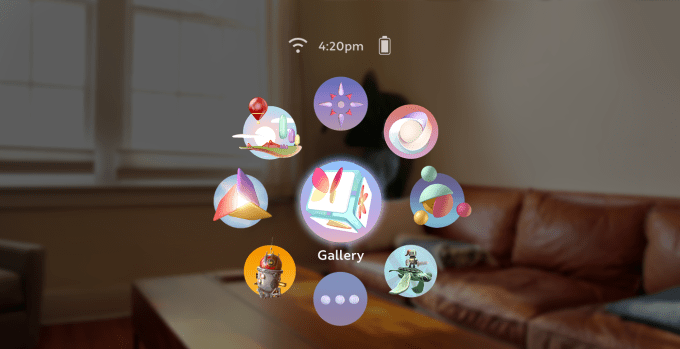
TechCrunch's Lucas Matney describes the Lumin operating system that will power Magic Leap's upcoming Magic Leap One mixed reality headset: Alright, first, this is what the Magic Leap One home screen will apparently look like, it's worth noting that it appears that Magic Leap will have some of its own stock apps on the device, which was completely expected but they haven't discussed much about. Also worth noting is that Magic Leap's operating system by and large looks like most other operating systems, they seem to be well aware that flat interfaces are way easier to navigate so you're not going to be engaging with 3D assets just for the sake of doing so. The company seems to be distinguishing between two basic app types for developers: immersive apps and landscape apps. Landscape apps like what you see in the image above, appear to be Magic Leap's version of 2D where interfaces are mostly flat but have some depth and live inside a box called a prism that fits spatially into your environment. It seems that you'll be able to have several of these running simultaneously. Immersive apps, on the other hand, like the game title, Dr. Grordbort -- which Magic Leap has been teasing for years -- respond to the geometry of the space that you are in and is thus called an immersive app.

Moving beyond apps, the company also had a good deal to share about how you interact with what's happening in the headset. Magic Leap will have a companion smartphone app that you can type into, you can connect a bluetooth keyboard and there will also be an onscreen keyboard with dictation capabilities. One of the big highlights of Magic Leap tech is that you'll be able to share perspectives of these apps in a multi-player experience which we now know is called "casting," apps that utilize these feature will just have a button that you can press to share an experience with a contact.

Intel

Intel's 10nm 'Cannon Lake' Processors Won't Arrive Until Late 2019 (digitaltrends.com) 149

At the company's second quarter 2018 financial results conference call, Intel chief engineering officer Venkata Renduchintala said the "Cannon Lake" 10mn processors won't appear in products until the 2019 holiday season. "The systems on shelves that we expect in holiday 2019 will be client systems, with data center products to follow shortly after," Renduchintala said. Interim CEO Robert Swan went on to tout the company's "very good lineup" of 14nm products. Digital Trends reports: "Recall that 10nm strives for a very aggressive density improvement target beyond 14nm, almost 2.7x scaling," Renduchintala said during the call. "And really, the challenges that we're facing on 10nm is delivering on all the revolutionary modules that ultimately deliver on that program." Although he acknowledged that pushing back 10nm presents a "risk and a degree of delay" in the company's road map, Intel is quite pleased with the "resiliency" of its 14nm roadmap. He said the company delivered an excess of 70 percent performance improvement over the last few years. Meanwhile, Intel's 10nm process should be in an ideal state to mass produce chips towards the end of 2019.

Intel's Cannon Lake chip is essentially a shrink of its seventh-generation "Kaby Lake" processor design. Given the previous launch window, the resulting chips presumably fell under the company's eighth-generation banner despite the older design. But with mass production pushed back to late 2019, the 10nm chips will fall under Intel's ninth-generation umbrella along with CPUs based on its upcoming "Ice Lake" design. Intel claims that its 10nm chips will provide 25 percent increased performance over their 14nm counterparts. Even more, they will supposedly consume 50 percent less power than their 14nm counterparts.

Displays

Samsung's 'Unbreakable' OLED Display Gets Certified (theverge.com) 68

Samsung Display, a subsidiary of Samsung Electronics, just introduced a flexible OLED panel that has a transparent plastic cover already attached, emulating the properties of glass but retaining the screen's innate flexibility. The screen is so durability that it's been certified by UL (formerly known as Underwriters Laboratories). The Verge reports: Samsung, describing the new panel as unbreakable, reports that it has withstood UL's military-standards tests of 26 successive drops from a height of 1.2 meters (close to 4 feet) as well as extreme temperatures as high as 71 degrees Celsius (159.8 degrees Fahrenheit) and as low as -32 degrees Celsius (-25.6 degrees Fahrenheit). The OLED display "continued to function normally with no damage to its front, sides, or edges," we're told, and Samsung even went further by performing a successful drop test from 1.8 meters (6 feet).
Robotics

Slashdot Asks: Which is Better, a Basic Income or a Guaranteed Job? (timharford.com) 899

Barack Obama said this month that AI research is accelerating, making it harder to find jobs for everybody, and concluding "we're going to have to consider new ways of thinking about these problems, like a universal income."

But a Financial Times columnist adds that "an intriguing debate has broken out over how to look after disadvantaged workers both now and in this robot future. Should everyone be given free money? Or should everyone receive the guarantee of a decently-paid job?" An anonymous reader quotes some of the highlights: Psychologists have found that we like and benefit from feeling in control. That is a mark in favour of a universal basic income: being unconditional, it is likely to enhance our feelings of control. The money would be ours, by right, to do with as we wish. A job guarantee might work the other way: it makes money conditional on punching the clock. On the other hand (again!), we like to keep busy. Harvard researchers Matthew Killingsworth and Daniel Gilbert (UK) (US) have found that "a wandering mind is an unhappy mind". And social contact is generally good for our wellbeing. Maybe guaranteed jobs would help keep us active and socially connected.

The truth is, we don't really know... It is good to see that the more thoughtful advocates of either policy -- or both policies simultaneously -- are asking for large-scale trials to learn more.

He titled the column "The secret to happiness after the robot takeover." But what say Slashdot readers?

Is it better to be given a basic income -- or a guaranteed job?

Slashdot Top Deals