United States

US Army Soldier Pleads Guilty To AT&T and Verizon Hacks (techcrunch.com) 21

Cameron John Wagenius pleaded guilty to hacking AT&T and Verizon and stealing a massive trove of phone records from the companies, according to court records filed on Wednesday. From a report: Wagenius, who was a U.S. Army soldier, pleaded guilty to two counts of "unlawful transfer of confidential phone records information" on an online forum and via an online communications platform.

According to a document filed by Wagenius' lawyer, he faces a maximum fine of $250,000 and prison time of up to 10 years for each of the two counts. Wagenius was arrested and indicted last year. In January, U.S. prosecutors confirmed that the charges brought against Wagenius were linked to the indictment of Connor Moucka and John Binns, two alleged hackers whom the U.S. government accused of several data breaches against cloud computing services company Snowflake, which were among the worst hacks of 2024.

AT&T

AT&T Kills Home Internet Service In New York Over Law Requiring $15 Plans (arstechnica.com) 134

Ars Technica's Jon Brodkin reports: AT&T has stopped offering its 5G home Internet service in New York instead of complying with a new state law that requires ISPs to offer $15 or $20 plans to people with low incomes. New York started enforcing its Affordable Broadband Act yesterday after a legal battle of nearly four years. [...] The law requires ISPs with over 20,000 customers in New York to offer $15 broadband plans with download speeds of at least 25Mbps, or $20-per-month service with 200Mbps speeds. The plans only have to be offered to households that meet income eligibility requirements, such as qualifying for the National School Lunch Program, Supplemental Nutrition Assistance Program, or Medicaid. [...]

Ending home Internet service in New York is relatively simple for AT&T because it is outside the 21-state wireline territory in which the telco offers fiber and DSL home Internet service. "AT&T Internet Air is currently available only in select areas and where AT&T Fiber is not available. New York is outside of our wireline service footprint, so we do not have other home Internet options available in the state," the company said. AT&T will continue offering its 4G and 5G mobile service in New York, as the state law only affects home Internet service. People with smartphones or other mobile devices connected to the AT&T wireless network should thus see no change.

Existing New York-based users of AT&T Internet Air can only keep it for 45 days and won't be charged during that time, AT&T said. "During this transition, customers will be able to keep their existing AT&T Internet Air service for up to 45 days, at no charge, as they find other options for broadband. We will work closely with our customers throughout this transition," AT&T said. Residential users will be sent "a recovery kit with instructions on how to return their AIA equipment, while business customers can keep any device they purchased at no charge," AT&T said.

AT&T

AT&T Promises Bill Credits For Future Outages (arstechnica.com) 19

An anonymous reader quotes a report from Ars Technica: AT&T, following last year's embarrassing botched update that kicked every device off its wireless network and blocked over 92 million phone calls, is now promising full-day bill credits to mobile customers for future outages that last at least 60 minutes and meet certain other criteria. A similar promise is being made to fiber customers for unplanned outages lasting at least 20 minutes, but only if the customer uses an AT&T-provided gateway. The "AT&T Guarantee" announced today has caveats that can make it possible for a disruption to not be covered. AT&T says the promised mobile bill credits are "for wireless downtime lasting 60 minutes or more caused by a single incident impacting 10 or more towers."

The full-day bill credits do not include a prorated amount for the taxes and fees imposed on a monthly bill. The "bill credit will be calculated using the daily rate customer is charged for wireless service only (excludes taxes, fees, device payments, and any add-on services," AT&T said. If an outage lasts more than 24 hours, a customer will receive another full-day bill credit for each additional day. If only nine or fewer AT&T towers aren't functioning, a customer won't get a credit even if they lose service for an hour. The guarantee kicks in when a "minimum 10 towers [are] out for 60 or more minutes resulting from a single incident," and the customer "was connected to an impacted tower at the time the outage occurs," and "loses service for at least 60 consecutive minutes as a result of the outage."

The guarantee "excludes events beyond the control of AT&T, including but not limited to, natural disasters, weather-related events, or outages caused by third parties." AT&T says it will determine "in its sole discretion" whether the disruption is "a qualifying" network outage. "Consumers will automatically receive a bill credit equaling a full day of service and we'll reach out to our small business customers with options to help make it right," AT&T said. When there's an outage, AT&T said it will "notify you via e-mail or SMS to inform you that you've been impacted. Once the interruption has been resolved, we'll contact you with details about your bill credit." If AT&T fails to provide the promised credit for any reason, customers will have to call AT&T or visit an AT&T store.

To qualify for the similar fiber-outage promise, "customers must use AT&T-provided gateways," the firm said. There are other caveats that can prevent a home Internet customer from getting a bill credit. AT&T said the fiber-outage promise "excludes events beyond the control of AT&T, including but not limited to, natural disasters, weather-related events, loss of service due to downed or cut cable wires at a customer residence, issues with wiring inside customer residence, and power outages at customer premises. Also excludes outages resulting from planned maintenance." AT&T notes that some residential fiber customers in multi-dwelling units "have an account with AT&T but are not billed by AT&T for Internet service." In the case of outages, these customers would not get bill credits but would be given the option to redeem a reward card that's valued at $5 or more.

Crime

US Army Soldier Arrested In AT&T, Verizon Extortions (krebsonsecurity.com) 10

An anonymous reader quotes a report from KrebsOnSecurity: Federal authorities have arrested and indicted a 20-year-old U.S. Army soldier on suspicion of being Kiberphant0m, a cybercriminal who has been selling and leaking sensitive customer call records stolen earlier this year from AT&T and Verizon. As first reported by KrebsOnSecurity last month, the accused is a communications specialist who was recently stationed in South Korea. Cameron John Wagenius was arrested near the Army base in Fort Hood, Texas on Dec. 20, after being indicted on two criminal counts of unlawful transfer of confidential phone records. The sparse, two-page indictment (PDF) doesn't reference specific victims or hacking activity, nor does it include any personal details about the accused. But a conversation with Wagenius' mother -- Minnesota native Alicia Roen -- filled in the gaps.

Roen said that prior to her son's arrest he'd acknowledged being associated with Connor Riley Moucka, a.k.a. "Judische," a prolific cybercriminal from Canada who was arrested in late October for stealing data from and extorting dozens of companies that stored data at the cloud service Snowflake. In an interview with KrebsOnSecurity, Judische said he had no interest in selling the data he'd stolen from Snowflake customers and telecom providers, and that he preferred to outsource that to Kiberphant0m and others. Meanwhile, Kiberphant0m claimed in posts on Telegram that he was responsible for hacking into at least 15 telecommunications firms, including AT&T and Verizon. On November 26, KrebsOnSecurity published a story that followed a trail of clues left behind by Kiberphantom indicating he was a U.S. Army soldier stationed in South Korea.

[...] Immediately after news broke of Moucka's arrest, Kiberphant0m posted on the hacker community BreachForums what they claimed were the AT&T call logs for President-elect Donald J. Trump and for Vice President Kamala Harris. [...] On that same day, Kiberphant0m posted what they claimed was the "data schema" from the U.S. National Security Agency. On Nov. 5, Kiberphant0m offered call logs stolen from Verizon's push-to-talk (PTT) customers -- mainly U.S. government agencies and emergency first responders. On Nov. 9, Kiberphant0m posted a sales thread on BreachForums offering a "SIM-swapping" service targeting Verizon PTT customers. In a SIM-swap, fraudsters use credentials that are phished or stolen from mobile phone company employees to divert a target's phone calls and text messages to a device they control.

Businesses

Porch Pirates Are Now Raising the Price You Pay at Checkout (slashdot.org) 158

Lost deliveries, shipping delays and theft on the front porch have become such growing problems that companies are making consumers pay for package protection. From a report: Tens of thousands of online retailers now offer the service for a few dollars per order. The fees go to young companies -- Route and Corso, to name two -- that promise to make customers whole without charging the merchant if a delivery doesn't arrive. Consumers are finding that retailers either ask them to pay for package protection or draw a harder line when it comes to replacing a missing item. Some retailers are making the fees mandatory, spreading the burden of package theft among all customers.

To know whether you are paying the fee, review your order before you press purchase. Sometimes it is named after the company offering protection, and sometimes it is called shipping insurance or package protection. Skincare brand Topicals began using Corso two years ago after seeing 30% of its packages were regularly marked delivered but not received, according to customer insights manager Deja Jefferson. By requiring protection, which Topicals discloses on its shipping page, the company doesn't have to worry about convincing customers to opt in. "We actually don't get any complaints on it whatsoever," she said.
Further reading: Porch Pirates Steal So Many Packages That Now You Can Get Insurance.
Open Source

Slashdot's Interview with Bruce Perens: How He Hopes to Help 'Post Open' Developers Get Paid (slashdot.org) 61

Bruce Perens, original co-founder of the Open Source Initiative, has responded to questions from Slashdot readers about a new alternative he's developing that hopefully helps "Post Open" developers get paid.

But first, "One of the things that's clear from the Slashdot patter is that people are not aware of what I've been doing, in general," Perens says. "So, let's start by filling that in..."

Read on for the rest of his wide-ranging answers....
Security

Hacker In Snowflake Extortions May Be a US Soldier (krebsonsecurity.com) 20

An anonymous reader quotes a report from KrebsOnSecurity: Two men have been arrested for allegedly stealing data from and extorting dozens of companies that used the cloud data storage company Snowflake, but a third suspect -- a prolific hacker known as Kiberphant0m -- remains at large and continues to publicly extort victims. However, this person's identity may not remain a secret for long: A careful review of Kiberphant0m's daily chats across multiple cybercrime personas suggests they are a U.S. Army soldier who is or was recently stationed in South Korea.

Kiberphant0m's identities on cybercrime forums and on Telegram and Discord chat channels have been selling data stolen from customers of the cloud data storage company Snowflake. At the end of 2023, malicious hackers discovered that many companies had uploaded huge volumes of sensitive customer data to Snowflake accounts that were protected with nothing more than a username and password (no multi-factor authentication required). After scouring darknet markets for stolen Snowflake account credentials, the hackers began raiding the data storage repositories for some of the world's largest corporations. Among those was AT&T, which disclosed in July that cybercriminals had stolen personal information, phone and text message records for roughly 110 million people. Wired.com reported in July that AT&T paid a hacker $370,000 to delete stolen phone records.

On October 30, Canadian authorities arrested Alexander Moucka, a.k.a. Connor Riley Moucka of Kitchener, Ontario, on a provisional arrest warrant from the United States, which has since indicted him on 20 criminal counts connected to the Snowflake breaches. Another suspect in the Snowflake hacks, John Erin Binns, is an American who is currently incarcerated in Turkey. Investigators say Moucka, who went by the handles Judische and Waifu, had tasked Kiberphant0m with selling data stolen from Snowflake customers who refused to pay a ransom to have their information deleted. Immediately after news broke of Moucka's arrest, Kiberphant0m was clearly furious, and posted on the hacker community BreachForums what they claimed were the AT&T call logs for President-elect Donald J. Trump and for Vice President Kamala Harris. [...] Also on Nov. 5, Kiberphant0m offered call logs stolen from Verizon's push-to-talk (PTT) customers -- mainly U.S. government agencies and emergency first responders.
Kiberphant0m denies being in the U.S. Army and said all these clues were "a lengthy ruse designed to create a fictitious persona," reports Krebs.

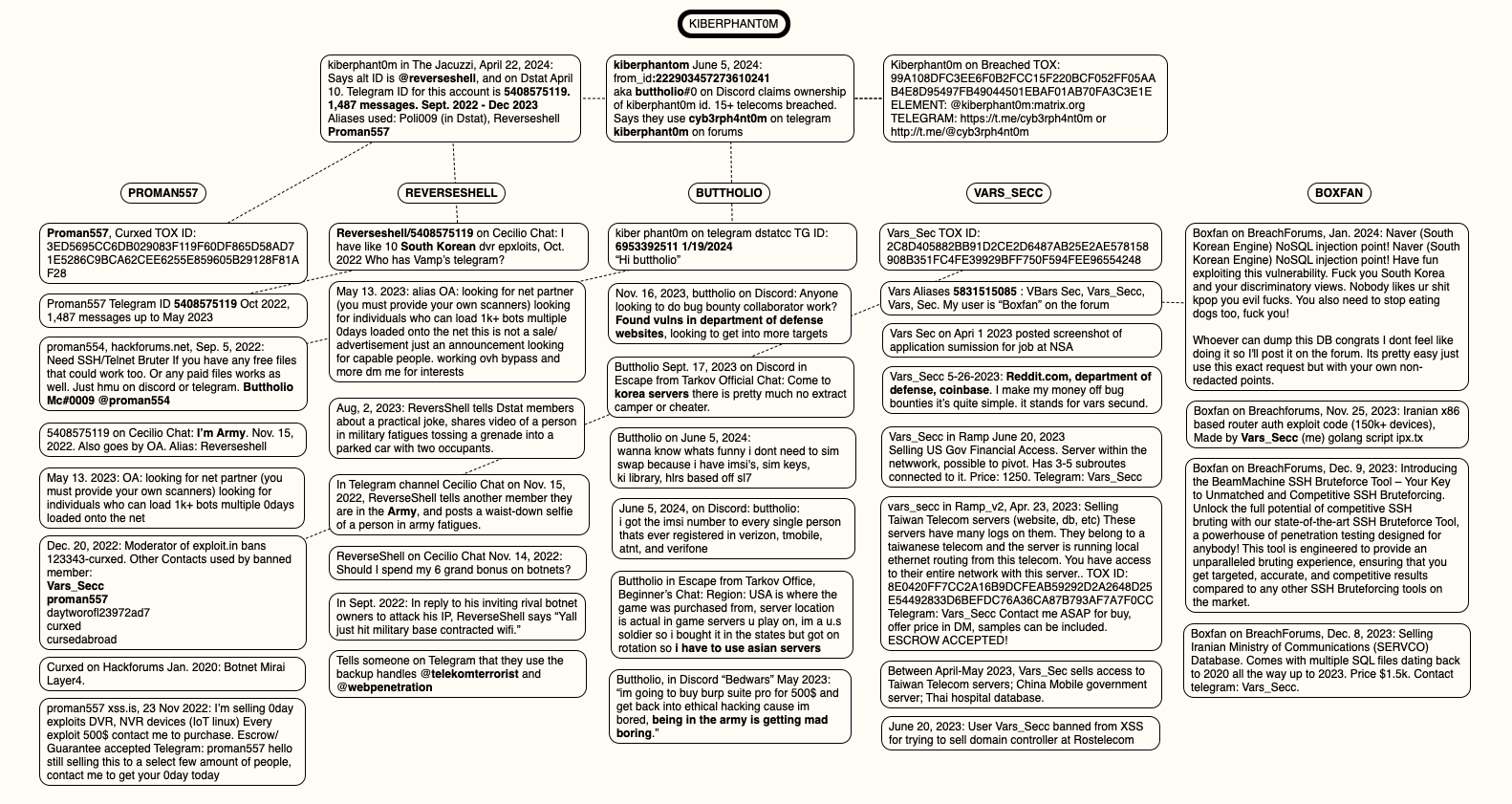
"I literally can't get caught," Kiberphant0m said, declining an invitation to explain why. "I don't even live in the USA Mr. Krebs." A mind map illustrates some of the connections between and among Kiberphant0m's apparent alter egos.
AT&T

US Cellular To Sell Some Spectrum Licenses To AT&T For $1 Billion (reuters.com) 2

U.S. Cellular has agreed to sell $1.02 billion worth of spectrum licenses to AT&T as part of its strategy to monetize its spectrum assets that were not included in an earlier $4.4 billion deal with T-Mobile. Reuters reports: Last month, U.S. Cellular agreed to sell select spectrum licenses for $1 billion to Verizon. It also signed deals with two other mobile network operators, but did not disclose the details. The latest agreement "adds a fourth mobile network operator, in addition to T-Mobile, to the list of those whose subscribers will benefit from the sale of our spectrum licenses," U.S. Cellular CEO Laurent Therivel said on Thursday. From a press release: Following this transaction, as well as those previously announced, UScellular will have reached definitive agreements to monetize approximately 55%, measured on a MHz-Pops basis, of the spectrum holdings (excluding mmWave) that were excluded from the proposed sale to T-Mobile, for a total consideration of approximately $2.02 billion. Including the proposed T-Mobile transaction, UScellular will have reached agreements to monetize approximately 70% of its total spectrum holdings (excluding mmWave), measured on a MHz-Pops basis.

"After our proposed sales, we will be left with 1.86 billion MHz-Pops of low and mid-band spectrum, as well as 17.2 billion MHz-Pops of mmWave spectrum, with the substantial majority of retained value in the C-band spectrum," [said Laurent C. Therivel, President and CEO]. "The C-band licenses have a number of attributes that we believe are favorable to their long-term value. First, our C-band licenses are positioned in an attractive mid-band frequency that can deliver outstanding speed and capacity. Second, there is a substantial 5G ecosystem of equipment vendors and existing infrastructure that uses C-band. Finally, they have a lengthy build-out timeline, with first and second build-out dates of 2029 and 2033, respectively. This provides ample time and optionality for us to either monetize or deploy the spectrum in the future. We will continue to look for ways to opportunistically monetize the C-band, as well as the other remaining spectrum."

AT&T

AT&T Announces $1 Billion Fiber Deal With Corning (reuters.com) 10

AT&T has signed a $1 billion multi-year deal with Corning to acquire fiber and connectivity solutions. Reuters reports: With the U.S. wireless market facing a slowdown, telecom companies such as AT&T and rival Verizon have doubled down on their high-speed internet businesses, an area that has long been dominated by broadband companies such as Comcast. Demand has also been growing for AT&T's plans that allow customers to combine its high-speed fiber data with its wireless phone service for a discount. In the third quarter, AT&T reported 28.3 million fiber passings, or the number of potential customer locations a fiber network passes by. It remains on track to pass more than 30 million fiber passings by the end of 2025.
Businesses

Users Say T-Mobile Must Pay For Killing 'Lifetime' Price Lock (arstechnica.com) 56

An anonymous reader shares a report: T-Mobile promised users who bought certain mobile plans that it would never raise their prices for as long as they lived -- but then raised their prices this year. So it's no surprise that 2,000 T-Mobile customers complained to the government about a price hike on plans that were advertised as having a lifetime price lock. "I am still alive and T-Mobile is increasing the price for service by $5 per line. How is this a lifetime price lock?" one customer in Connecticut asked the Federal Communications Commission in a complaint that we obtained through a public records request.

"I am not dead yet," a customer in New York wrote bluntly, saying they had bought a plan with a "guarantee for life." Both of those customers said they purchased T-Mobile's senior plan marketed to people aged 55 and up. While the price hikes apply to customers on various plans regardless of their age, many of the complaints to the FCC came from people in the 55+ age group. Some pointed out that if T-Mobile simply waits long enough, the carrier won't have to serve 55-and-up customers forever.

Cellphones

T-Mobile, AT&T Oppose Unlocking Rule, Claim Locked Phones Are Good For Users (arstechnica.com) 104

An anonymous reader writes: T-Mobile and AT&T say US regulators should drop a plan to require unlocking of phones within 60 days of activation, claiming that locking phones to a carrier's network makes it possible to provide cheaper handsets to consumers. "If the Commission mandates a uniform unlocking policy, it is consumers -- not providers -- who stand to lose the most," T-Mobile alleged in an October 17 filing with the Federal Communications Commission. The proposed rule has support from consumer advocacy groups who say it will give users more choice and lower their costs.

T-Mobile has been criticized for locking phones for up to a year, which makes it impossible to use a phone on a rival's network. T-Mobile claims that with a 60-day unlocking rule, "consumers risk losing access to the benefits of free or heavily subsidized handsets because the proposal would force providers to reduce the line-up of their most compelling handset offers." If the proposed rule is enacted, "T-Mobile estimates that its prepaid customers, for example, would see subsidies reduced by 40 percent to 70 percent for both its lower and higher-end devices, such as the Moto G, Samsung A15, and iPhone 12," the carrier said. "A handset unlocking mandate would also leave providers little choice but to limit their handset offers to lower cost and often lesser performing handsets."
In July, the FCC approved a Notice of Proposed Rulemaking (NPRM) for the unlocking policy in a 5-0 vote.

The FCC is proposing "to require all mobile wireless service providers to unlock handsets 60 days after a consumer's handset is activated with the provider, unless within the 60-day period the service provider determines the handset was purchased through fraud."
Wireless Networking

AT&T, T-Mobile Prep First RedCap 5G IoT Devices 4

The first 5G Internet of Things (IoT) devices are launching soon. According to Fierce Wireless, T-Mobile plans to launch its first RedCap devices by the end of the year, while AT&T's devices are expected sometime in 2025. From the report: All of this should pave the way for higher performance 5G gadgets to make an impact in the world of IoT. RedCap, which stands for reduced capabilities, was introduced as part of the 3GPP's Release 17 5G standard, which was completed -- or frozen in 3GPP terms -- in mid-2022. The specification, which is also called NR-Light, is the first 5G-specific spec for IoT.

RedCap promises to offer data transfer speeds of between 30 Mbps to 80 Mbps. The RedCap spec greatly reduces the bandwidth needed for 5G, allowing the signal to run in a 20 MHz channel rather than the 100 MHz channel required for full scale 5G communications.
China

U.S. Wiretap Systems Targeted in China-Linked Hack (msn.com) 27

"A cyberattack tied to the Chinese government penetrated the networks of a swath of U.S. broadband providers," reports the Wall Street Journal, "potentially accessing information from systems the federal government uses for court-authorized network wiretapping requests.

"For months or longer, the hackers might have held access to network infrastructure used to cooperate with lawful U.S. requests for communications data, according to people familiar with the matter, which amounts to a major national security risk." The attackers also had access to other tranches of more generic internet traffic, they said. Verizon Communications, AT&T and Lumen Technologies are among the companies whose networks were breached by the recently discovered intrusion, the people said.

The widespread compromise is considered a potentially catastrophic security breach and was carried out by a sophisticated Chinese hacking group dubbed Salt Typhoon. It appeared to be geared toward intelligence collection, the people said... The surveillance systems believed to be at issue are used to cooperate with requests for domestic information related to criminal and national security investigations. Under federal law, telecommunications and broadband companies must allow authorities to intercept electronic information pursuant to a court order. It couldn't be determined if systems that support foreign intelligence surveillance were also vulnerable in the breach...

The hackers appear to have engaged in a vast collection of internet traffic from internet service providers that count businesses large and small, and millions of Americans, as their customers. Additionally, there are indications that the hacking campaign targeted a small number of service providers outside the U.S., the people said. A person familiar with the attack said the U.S. government considered the intrusions to be historically significant and worrisome... "It will take time to unravel how bad this is, but in the meantime it's the most significant in a long string of wake-up calls that show how the PRC has stepped up their cyber game," said Brandon Wales, former executive director at the Cybersecurity and Infrastructure Security Agency and now a vice president at SentinelOne, referring to the People's Republic of China. "If companies and governments weren't taking this seriously before, they absolutely need to now."

Three weeks ago TechCrunch also reported that the FBI "took control of a botnet made up of hundreds of thousands of internet-connected devices, such as cameras, video recorders, storage devices, and routers, which was run by a Chinese government hacking group, FBI director Christopher Wray and U.S. government agencies revealed Wednesday.
AT&T

AT&T Claims VMware By Broadcom Offered It a 1,050% Price Increase (theregister.com) 48

The Register's Simon Sharwood reports: AT&T has claimed that Broadcom made it an offer to increase prices by 1,050 percent, and may be influencing other vendors to make a migration harder. The claim of the colossal price hike came in an email [PDF] filed in evidence by AT&T in its case alleging Broadcom hasn't honored a contract that would allow the carrier to acquire an additional two years of support services for its VMware estate. The email was penned by AT&T executive vice president and general manager Susan A Johnson and appears to be addressed to Broadcom CEO Hock Tan.

"After a 10 plus year strategic relationship with Broadcom ... I am sad to report that we appear to be at an impasse on our VMware deal," Johnson wrote on August 19. "The latest offer that we have received would put us at an average of $REDACTED per year for a 5 year deal, where we currently pay $REDACTED per year to support previously purchased perpetual licenses with a right to renew support through September, 2026. This proposed annual increase of +1,050 percent in one year is extreme and certainly not how we expect strategic partners to engage in doing business with AT&T."

Cellphones

Are Your Phone's 5G Icon and Signal Bars Lying to You? (msn.com) 47

An anonymous reader shared this report from the Washington Post: Look at the top right corner of your phone. You might see an icon with "5G" and another with vertical bars showing the strength of your internet connection. Those symbols don't mean what you think they do.

If your phone shows "5G," you're not necessarily connected to the latest and zippiest cellphone network technology. It might just mean that 5G connections are available nearby. And the bars are a cellular version of a shrug. There is no standard measure of how much signal strength each bar represents. "The connection icon is a lie," said Avi Greengart, president of the technology analysis firm Techsponential...

The good news is you might not need 5G, anyway. Most of the time, your phone calls, texting and web surfing are perfectly fine on the prior generation of wireless technology called 4G or sometimes "LTE." Many phone networks will funnel you over 5G service when it makes a real difference, like if you're on a video call or playing an intense video game.

If you see more specific types of 5G icons, like "5G UW" used by Verizon or "5G UC" if you're on T-Mobile service, Hyers said you're probably connected to a 5G network at that moment. Those extra letters or symbols sometimes indicate types of 5G technology that are capable of faster and more reliable connections, but they aren't always better, depending on your circumstances. Confusingly, AT&T has showed "5G E" icons on phones. That is not 5G service at all.

Here's how major carriers responded to the Post's reporter:
  • "AT&T said its '5G' indicators on phones line up with a telecommunications standards organization that established the icon to mean 5G networks are available."
  • "Verizon didn't respond to my questions."
  • "T-Mobile said for most of its cellphone network, your phone accurately reflects if you're on 5G."

The article suggests setting your phone to just automatically switch to 5G networks when high-bandwidth applications are in use...


AT&T

17,000 ATT Workers End the Southeast's Longest Telecommunications Strike After 30 Days (cwa-union.org) 36

For 30 days, 17,000 AT&T workers in nine different states from the CWA union went on strike. As it began one North Carolina newspaper noted some AT&T customers "report prolonged internet outages." Last week an Emory University economist told NPR that "If it wasn't disruptive or it didn't have any kind of negative element towards customers, then AT&T, I suspect, wouldn't feel any kind of pressure to negotiate."

The 30-day strike was "the longest telecommunications strike in the region's history," according to the union — announcing today that they'd now negotiated "strong tentative contract agreements" and that workers would report to work for their scheduled shifts tomorrow. The new contract in the Southeast covers 17,000 workers technicians, customer service representatives and others who install, maintain and support AT&T's residential and business wireline telecommunications network in Alabama, Florida, Georgia, Kentucky, Louisiana, Mississippi, North Carolina, South Carolina and Tennessee.

Wages and health care costs were key issues at the bargaining table, and the five-year agreement includes across the board wage increases of 19.33%, with additional 3% increases for Wire Technicians and Utility Operations. The health care agreement holds health care premiums steady in the first year and lowers them in the second and third years, with modest monthly increases in the final two years.

The statement adds that "CWA members and retirees from every region and sector of our union mobilized in support of our bargaining teams, including by distributing flyers with information about the strike at AT&T Wireless stores." CWA District 3 Vice President Richard Honeycutt added "We know that our customers have faced hardship during the strike as well. We are happy to be getting back to work keeping our communities safe and connected."

There's also a separate four-year agreement covering 8,500 AT&T West workers in California and Nevada. "Union members will meet to review the tentative agreements, before holding ratification votes in each region."

AT&T's chief operating officer said the Southeast agreement will "support our competitive position in the broadband industry where we can grow and win against our mostly non-union competitors."
AT&T

AT&T Sues Broadcom For Breaching VMware Support Extension Contract (theregister.com) 76

AT&T has filed a lawsuit against Broadcom, alleging that Broadcom is refusing to honor an extended support agreement for VMware software unless AT&T purchases additional subscriptions it doesn't need. The company warns the consequences could risk massive outages for AT&T's customer support operations and critical federal services, including the U.S. President's office. The Register reports: A complaint [PDF] filed last week in the Supreme Court of New York State explains that AT&T holds perpetual licenses for VMware software and paid for support services under a contract that ends on September 8. The complaint also alleges that AT&T has an option to extend that support deal for two years -- provided it activates the option before the end of the current deal. AT&T's filing claims it exercised that option, but that Broadcom "is refusing to honor" the contract. Broadcom has apparently told AT&T it will continue to provide support if the comms giant "agrees to purchase scores of subscription services and software." AT&T counters that it "does not want or need" those subscriptions, because they:

- Would impose significant additional contractual and technological obligations on AT
- Would require AT&T to invest potentially millions to develop its network to accommodate the new software;
- May violate certain rights of first refusal that AT&T has granted to third parties;
- Would cost AT&T tens of millions more than the price of the support services alone.

[...] The complaint also suggests Broadcom's refusal to extend support creates enormous risk for US national security -- some of the ~8,600 servers that host AT&T's ~75,000 VMs "are dedicated to various national security and public safety agencies within the federal government as well as the Office of the President." Other VMs are relied upon by emergency responders, and still more "deliver services to millions of AT&T customers worldwide" according to the suit. Without support from Broadcom, AT&T claims it fears "widespread network outages that could cripple the operations of millions of AT&T customers worldwide" because it may not be able to fix VMware's software.

AT&T

As 17,000 AT&T Workers Strike, Some Customers Experience 'Prolonged' Outages (newsobserver.com) 40

17,000 AT&T workers from the CWA union went on strike Friday. NPR notes the strike affects workers in nine states: Alabama, Florida, Georgia, Kentucky, Louisiana, Mississippi, North Carolina, South Carolina and Tennessee. A North Carolina newspaper says the union will remain on strike until they believe AT&T "begins to bargain over a new contract in good faith" after their previous contract expired back on August 3.

And meanwhile, their article notes that the strike comes as some AT&T customers in North Carolina's Raleigh-Durham-Chapel Hill area "report prolonged internet outages." Saturday afternoon, AT&T also reported internet outages within a circle of northern Charlotte neighborhoods. "As far as the impact, the trained, experienced CWA members who are on strike do critical work installing, maintaining and supporting AT&T's residential and business wireline telecommunications network," CWA communications director Beth Allen said. "Customers should be aware that these workers will not be available to respond to service calls during the strike."

Since at least Wednesday, AT&T internet customers in Durham have reported being without residential service. According to the company's website, outages have been detected across a wide section of the city, including downtown and around Duke University.

AT&T has alerted some affected residents in southwest Durham their internet service "should be online" by Tuesday morning.

An AT&T spokesperson told the newspaper that "We have various business continuity measures in place to avoid disruptions to operations and will continue to provide our customers with the great service they expect."

A union executive said in a statement that AT&T's contract negotiators "did not seem to have the actual bargaining authority required by the legal obligation to bargain in good faith. Our members want to be on the job, providing the quality service that our customers deserve. It's time for AT&T to start negotiating in good faith so that we can move forward towards a fair contract."
Communications

AT&T and Verizon Ask FCC To Throw a Wrench Into Starlink's Mobile Plan (arstechnica.com) 94

AT&T and Verizon are urging the FCC to reject SpaceX's plan to offer cellular service with T-Mobile, arguing that it would cause harmful interference to terrestrial mobile networks. Ars Technica reports: Filings urging the Federal Communications Commission to deny SpaceX's request for a waiver were submitted by AT&T and Verizon this week. The plan by SpaceX's Starlink division also faces opposition from satellite companies EchoStar (which owns Dish and Hughes) and Omnispace. SpaceX and T-Mobile plan to offer Supplemental Coverage from Space (SCS) for T-Mobile's cellular network using SpaceX satellites. As part of that plan, SpaceX is seeking a waiver of FCC rules regarding out-of-band emission limits.

AT&T's petition to deny the SpaceX waiver request said the FCC's "recent SCS order appropriately recognized that SCS deployments should not present any risk to the vital terrestrial mobile broadband networks upon which millions of Americans rely today. The Commission authorized SCS as secondary to terrestrial mobile service, correctly explaining that the SCS framework must 'retain service quality of terrestrial networks, protect spectrum usage rights, and minimize the risk of harmful interference.'" AT&T said SpaceX's requested "ninefold increase" to the allowable power flux-density limits for out-of-band emissions "would cause unacceptable harmful interference to incumbent terrestrial mobile operations. Specifically, AT&T's technical analysis shows that SpaceX's proposal would cause an 18% average reduction in network downlink throughput in an operational and representative AT&T PCS C Block market deployment." Verizon's opposition to the waiver request similarly said that SpaceX's proposal "would subject incumbent, primary terrestrial licensee operations in adjacent bands to harmful interference." Wireless phone performance will suffer, Verizon said [...].
SpaceX and T-Mobile told FCC staff that their plan will not harm other wireless operations and predicted that competitors will make misleading claims. SpaceX also argued that the FCC's emissions limit is too strict and should be changed.
AT&T

AT&T Rebuked Over 'Misleading' Ad Showing Satellite Phone Calling It Doesn't Offer Yet (arstechnica.com) 12

"AT&T has been told to stop running ads that claim the carrier is already offering cellular coverage from space," reports Ars Technica: AT&T intends to offer Supplemental Coverage from Space (SCS) and has a deal with AST SpaceMobile, a Starlink competitor that plans a smartphone service from low-Earth-orbit satellites. But AST SpaceMobile's first batch of five satellites isn't scheduled to launch until September.

T-Mobile was annoyed by AT&T running an ad indicating that its satellite-to-cellular service was already available, and filed a challenge with the advertising industry's self-regulatory system run by BBB National Programs. The BBB National Advertising Division (NAD) ruled against AT&T last month and the carrier appealed to the National Advertising Review Board (NARB), which has now also ruled against AT&T...

AT&T, which is also famous for renaming its 4G service "5GE," reluctantly agreed to comply with the recommendation and released a new version of the satellite-calling commercial with more specific disclaimers.

The 30-second ad — titled "Epic Bad Golf Day" — featured Ben Stiller golfing chasing a badly-hit golf ball all the way into the desert (accompanied by the Pixies' song "Where is My Mind").

But according to the article, T-Mobile filed an official complaint with the advertising review board that "the use of humor does not shield an advertiser from its obligation to ensure that claims are truthful and non-misleading." The ad originally included small text that described the depicted satellite call as a "demonstration of evolving technology." The text was changed this week to say that "satellite calling is not currently available...."

The original version also had text that said, "the future of help is an AT&T satellite call away." The NARB concluded that this "statement can be interpreted reasonably as stating that 'future' technology has now arrived... In the updated version of the ad, AT&T changed the text to say that "the future of help will be an AT&T satellite call away."

Slashdot Top Deals