
Spanish City Sets Up Solar Cemetery 71
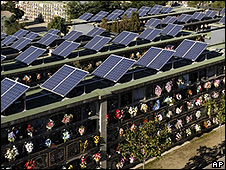
A Spanish city has found an unusual place to generate renewable energy — solar panels in the cemetery. Santa Coloma de Gramanet has installed 462 solar panels over its multi-story mausoleums. The plan was met with some derision at first, but thanks to a successful marketing campaign, the solar cemetery has public support. It has been such a success that there are already plans to install more panels in an effort to triple the amount of power generated. The installation cost 720,000 euros (£608,000) but will keep about 62 tonnes of carbon dioxide out of the atmosphere every year, said Esteve Serret, a director of Conste-Live Energy, the company that runs the cemetery and also works in renewable energy. I'm sure a solar powered zombie movie is already in the works.

Aw, c'mon (Score:4, Funny)
Yeah, but I'm sure they'll figure out a way to incorporate the solar panels into weapons. Zombie BBQ!
Re: (Score:1, Funny)
they will give mod points out to anyone here
Re: (Score:2, Funny)
It's called "Zom-Be-Que". In place of sunlight, you can also use pyrotechnic flares, through the sparks don't last long.
I also heard that another cemetery (burial site) is incorporating dynamos for generating clean energy. Not sure how they power the generators, though.
Re: (Score:1)
Undead hamsters from the pet cemetery of course. The trick is to wrap them like mummys in stretchable fabric so they can keep on the hamster wheels indefinitely. "If you have any office zombie cubical fatalities, to motivate them use fresh free range vegan brains."
Quote from Martha Stewart's guide to office productivity.
Please explain to me... (Score:1)
Solar Zombies (Score:1)
I'm sure a solar powered zombie movie is already in the works. Yeah, but I'm sure they'll figure out a way to incorporate the solar panels into weapons. Zombie BBQ!
I for one welcome our new Solar Powered Zombie overlords...
Re: (Score:1)
Doubly green (Score:5, Funny)
will keep about 62 tonnes of carbon dioxide out of the atmosphere every year
And the residents also cut their CO2 footprint by about 2 tons per year, simply by not breathing.
Re: (Score:2)
Re: (Score:2)
Last time I checked, CO2 footprints have nothing to do with power.
Re: (Score:2)
It is probably done this way to justify the fact that it costs more then any energy it can produce if on the open market and put up against traditional sources.
This sort of really gets to me, it seems like people can't even do math any more. I have a neighbor who was convinced into buying solar panels because he wouldn't have to pay the utility company again. It turns out that not paying the utility company for electricity again is going to cost him roughly 30% more then if he paid them. And that estimate i
Re:Doubly green (Score:5, Interesting)
This sort of really gets to me, it seems like people can't even do math any more. I have a neighbor who was convinced into buying solar panels because he wouldn't have to pay the utility company again. It turns out that not paying the utility company for electricity again is going to cost him roughly 30% more then if he paid them.
You assume that "not paying the utility company" has zero value to your neighbor. Maybe it doesn't. Maybe he gains personal gratification by being "off the grid" that more than makes up for the 30% premium. After all people buy expensive cars that get them where they are going just as well as a cheap car would - they do it because they get other less tangible benefits from their cars, benefits that they feel are worth paying a premium for. There are probably an infinite number of such examples, it is part of the reason we have markets with a variety of choices rather than single suppliers.
Re: (Score:3, Informative)
No, I didn't assume anything, I talk to the neighbor and he didn't realize how much it would cost until after he started paying for it. He did it because he thought it would be cheaper and found that it wouldn't be when he had to pay for it.
Other people might think the way your described, I have even been known to go further across town and buy something that costs a couple dollars more just to avoid giving money to a store I didn't like for whatever reason. I have even driven 10 miles to get gas at a stati
Re: (Score:2)
Anymore, the power company in your area may possibly have a green energy plan. Here in Indianapolis, the local power company will hook you up to wind power in 25% increments of your total power consumption for a small per KWh charge. I use about 750 KWh a month, and I think it costs me an extra 4 or 5 bucks for 100% wind power, which I'm happy to pay.
This means that the only real reason to go solar is to get off the grid, and stop paying for electricity altogether. The "save the Earth" drive is taken out
Re: (Score:2)
Before anyone asks, true to my sig, I just got done writing the prez elect and my senator about this, having expanded upon the idea.
What are 4 of the biggest concerns in America right now? Arguably: The economy, the environment, dependance on foreign oil, and the war(s).
If we were to take the money currently being used for corporate bailouts, and the money used to secure oil-producing nations, without having exact numbers to look at, I would estimate we would have enough money to at least significantly subs
Re: (Score:2)
The problem with a plan like that is that it will take 5-10 or more years to start to implement properly and at least 25 on top of that. Roughly 6% of the registered non-commercial vehicles are replaced each year and that's when the economy is up. Then when you figure population growth, vehicles replaced because of accidents and so on, you start seeing the real replacement numbers shrink quite a bit.
The other big problem is paying for it. You think there would be a $250/month stimulus check by giving free e
Re: (Score:2)
Fixed.
Re: (Score:2)
Current rates, whatever, it is still more expensive then traditional energy. Our current rates just increased by 50% before he got into the mess. I know there are pipe dreams about forcing utility providers to pay more for their energy meaning it will cost the consumer more so they will use less but that isn't a practical reality. I don't know why people think that artificially raising energy rates means that the alternative energy is cheaper, it just means that energy all around is more expensive.
BTW, it d
Re: (Score:2)
...especially in Spain, where up to a third of the electricity is currently produced by wind.
Some might prefer it. (Score:5, Interesting)
Re: (Score:2)
next up (Score:1)
Now we recycle the graves.
We convert the bodies of the corps to pure energy using antibodies.
Re: (Score:2)
Re: (Score:2)
We could also just liquefy the dead and then feed them intravenously to the living. It would give our society a boost of machine-level efficiency.
Re: (Score:1)
antibodies ~ antimatter
Get it...
Does it scale? (Score:2)
Can you ramp this up to produce a solar-powered crematorium?
Re: (Score:2)
Re: (Score:3, Insightful)
1 - Throw coffin with 6 tiny rockets (N,S,W,E,U,D).
2 - Activate algorithm "every hour activate rocket away from sun for five seconds".
3 - Wait.
Re: (Score:1)
Re: (Score:2)
Re: (Score:2)
Re: (Score:2)
(http://en.wikipedia.org/wiki/Solar_furnace#Modern_uses [wikipedia.org])
As compared to "normal" cremation where the corpse is held at 760 deg to 1150 deg C (1400 deg to 2100 deg F) for about 2 hours. (http://en.wikipedia.org/wiki/Crematorium#Burning_and_ashes_collection [wikipedia.org])
Re: (Score:2)
Re: (Score:2)
Wait for the next features.
Solar powered LCD headstones.
"Yes... it's wonderful, isn't it?"
Re: (Score:1)
...nude nun calendars...
I find your ideas intriguing and wish to receive your newsletter.
Re: (Score:2)
Just pretending to save the planet (Score:1)
Of course it's crazy. If they were really wanting to be useful, instead of pretending, they'd spend the money on any one of 100 better schemes.
Sheesh!
Dig a hole and fill it with wood. Invest in CO2 collection technology. Wind farms. Fusion research. All *kinds* of things are better than throwing money at little parasols on graves that pretend to be a solution.
Re: (Score:2)
I think you are missing the point. The key benefit of solar energy is that it can be micro-generation.
You don't need a centralized massive power plant if everyone had a solar panel on their roof.
This also helps with the issue of central point of failures and power line distribution. If energy can be gathered locally, then you aren't wasting efficiency on power lines.
So yes, overall its just a drop in the bucket, but if over time if you have a couple million drops then it adds up.
How much CO2 was produced making these? (Score:2)
Re: (Score:2, Informative)
most panels last about 30 years at least. then they start to work less and less effectively. but the raw materials can be recycled to save energy.
also new solar panels based on LCD technology can recoup the energy used to make them in 8 months, even in the not always so sunny Germany.
they aren't as efficient as silicon solar panels but they are MUCH MUCH cheaper.
Sounds like (Score:4, Funny)
a good use of otherwise dead space.
Steve Freeling (Score:2)
"You son of a bitch. You moved the cemetery, but you left the bodies, didn't you? You son of a bitch, you left the bodies and you only moved the solar panels. You only moved the solar panels! Why?! Why?!"
Yeah, doesn't quite have the same ring to it, does it?
Not very cost effective (Score:2)
Assuming their 62 tonnes per year figure is actually correct (almost certainly optimistic) and their published pricetag gets spread over a twenty year service life of the equipment and the 3.15 to one conversion between a barrel of oil and tonnes of CO2 emissions and it doesn't make much sense unless you assume oil will average close to 200 euros per barrel over those years. Vary it a up bit to account for maintaince costs or down a bit if you assume a longer service life without major repairs.
And that is